
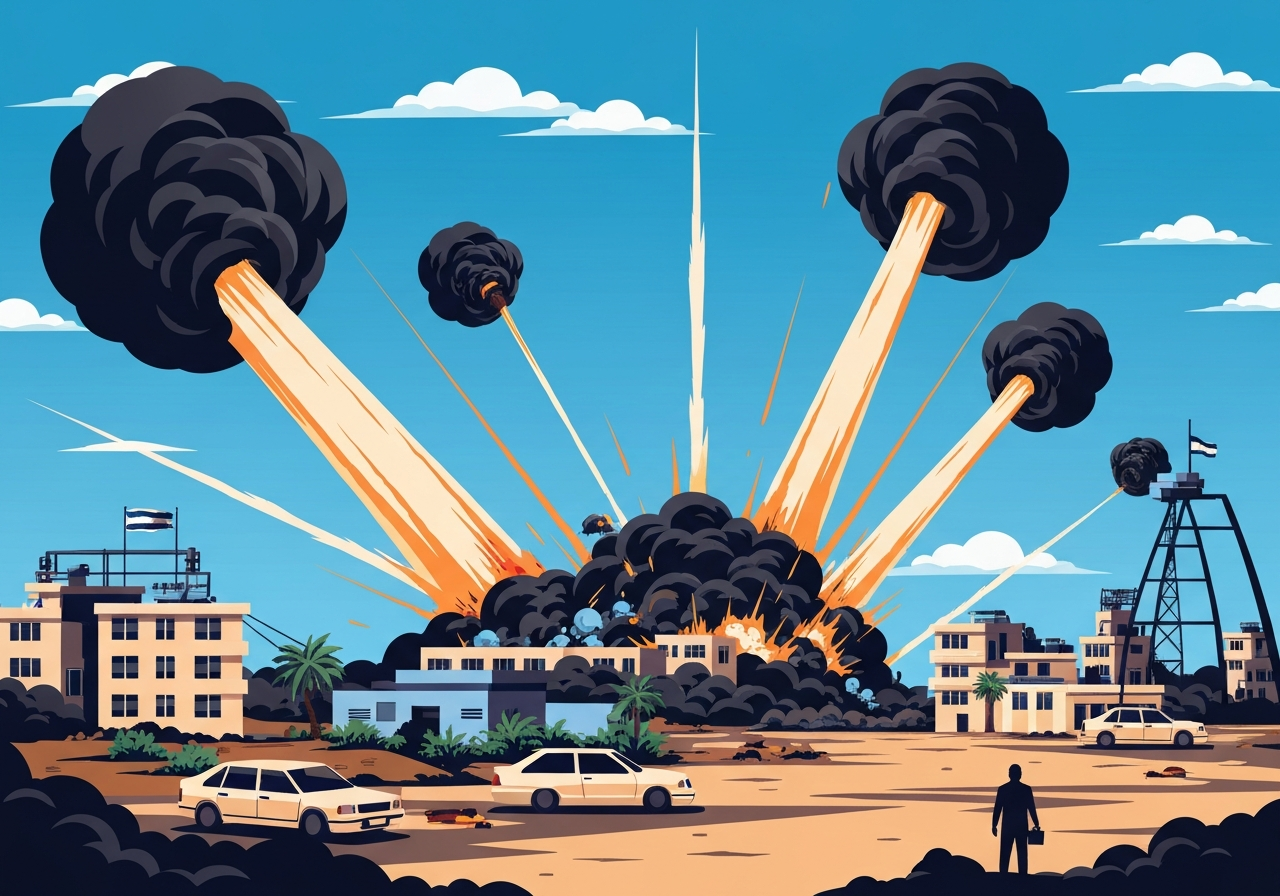
Israel launches massive strikes on southern Beirut after evacuation order
Lead: Israel carried out large-scale airstrikes on the southern suburbs of Beirut on 5 March 2026, hours after ordering more than 500,000 residents to evacuate immediately. The military said it was targeting Hezbollah positions; the evacuation order covered neighborhoods that include hospitals and government offices and prompted chaotic scenes as people fled. The strikes represent a sharp escalation in the widening regional war that began after Hezbollah launched missiles and drones into Israel. Casualty figures and infrastructure damage are still being tallied as displacement and cross-border exchanges intensify.
Key Takeaways
- Israel ordered the immediate evacuation of over 500,000 people in Beirut’s southern suburbs on 5 March 2026, citing imminent military strikes.
- Lebanese health authorities reported at least 102 killed and 638 injured in Lebanon from Israeli airstrikes before Thursday night’s bombardment.
- The wider conflict has, by day six, killed at least 1,230 people in Iran, about a dozen in Israel and six US soldiers, according to reported tallies.
- Evacuation zones included areas with hospitals and government ministries, intensifying humanitarian and logistical challenges for civilians.
- Iran launched retaliatory strikes across the region, including ballistic missiles and actions reaching as far as Azerbaijan and Cyprus, disrupting air travel and raising global risk perceptions.
- Israeli political figures framed the operation as targeting Hezbollah; some officials used rhetoric comparing parts of Beirut to heavily damaged zones in Gaza.
- Traffic gridlock and mass pedestrian evacuations left many elderly and infirm people stranded or dependent on rescue appeals.
Background
The current confrontation began after Hezbollah fired missiles and drones into Israel on Monday, prompting a rapid Israeli military response across multiple fronts. Over the following days the conflict expanded: Iran and allied groups launched strikes on Israeli and US positions, and several countries in the region reported incoming projectiles. Civilian populations in Lebanon, Iran and parts of the Gulf have faced evacuations, infrastructure damage and widespread service interruptions.
Southern Beirut has been a recurrent flashpoint in Israel–Hezbollah confrontations. Even during the 13‑month 2024 war between Israel and Hezbollah, an evacuation of the breadth ordered on 5 March 2026—covering roughly 10% of Lebanon south of the Litani River—had not been issued. Hospitals, ministries and dense residential districts in the southern suburbs create acute humanitarian risks when evacuation orders and strikes intersect.
Regional actors have escalated in direct and indirect ways. Iran’s response has included missile and drone strikes and attacks reaching multiple countries; the United States and Israel have struck Iranian military sites and ballistic missile launchers in turn. That sequence has broadened the war’s footprint beyond the Israel–Lebanon front and compounded diplomatic and security dilemmas for neighbouring states and international partners.
Main Event
On the evening of 5 March 2026, as tens of thousands were already on the move, Israeli warplanes struck multiple targets across the southern suburbs of Beirut, including the Dahiya neighbourhood, where smoke and damage were reported. The Israel Defense Forces (IDF) said the strikes hit Hezbollah positions; Lebanese authorities and eyewitnesses reported hits that affected civilian infrastructure, with hospitals cited among the areas under the evacuation order.
The IDF issued preapproved north- and eastbound routes for civilians to follow—an approach resembling prior Israeli evacuation instructions in Gaza. Despite those routes, heavy traffic and gridlock left many vehicles immobile and forced thousands to continue on foot, while families appealed for help to extract elderly or immobile relatives from homes. Aid agencies warned that movement in such conditions increases vulnerability and complicates humanitarian response.
Domestic political figures in Israel framed the operation as part of a broader campaign. Some senior Israeli officials publicly invoked comparisons to extensive destruction in parts of Gaza, a rhetorical choice that escalated regional tensions. Meanwhile, Tehran intensified retaliatory operations, including ballistic missile launches and strikes beyond its borders, and there were reports of blast sounds and evacuation warnings in parts of Tehran.
Across the region, incidents continued to multiply: a reported drone strike near an airport in Nakhchivan wounded civilians; a tanker was attacked off Kuwait’s coast; and airspace shutdowns created the largest travel disruption since the Covid-19 pandemic. Such incidents have added pressure on regional air traffic control, maritime insurance, and energy markets.
Analysis & Implications
The evacuation and subsequent strikes mark a risky escalation that increases the likelihood of prolonged urban fighting and civilian harm. Ordering more than half a million people to leave dense urban suburbs on short notice strains local capacity and often results in chaotic displacement—outcomes that complicate protection for civilians, medical access and the delivery of relief. Hospitals and public buildings in the evacuation zone compound the humanitarian stakes.
Strategically, the strikes signal Israel’s intent to degrade Hezbollah’s infrastructure and deterrent capability, but they also risk widening the theatre of conflict. Iran’s rapid retaliatory campaign—strikes on bases and infrastructure, and missile launches reaching multiple countries—creates pressure points across the Gulf and into the Caucasus, increasing the risk of inadvertent engagements between state and proxy forces.
Economically, the conflict has already affected global markets: airspace closures and attacks on shipping lanes pushed oil prices higher and disrupted trade routes. Sustained instability could further damage regional economies, reduce investment confidence, and prolong humanitarian assistance needs, particularly in Lebanon where public services are fragile.
Diplomatically, the exchange of strikes and the involvement of US forces—combined with public statements by senior political leaders—make de‑escalation more complex. Threats of targeted removals of political or military leaders, and public calls for involvement in other states’ leadership selection, raise the stakes for international mediation and risk deepening international polarization over responsibility and response.
Comparison & Data
| Metric | Reported figure |
|---|---|
| Residents ordered to evacuate (Beirut southern suburbs) | Over 500,000 |
| Lebanon fatalities (before Thursday night strikes) | At least 102 |
| Lebanon injured (before Thursday night strikes) | 638 |
| Iran fatalities (conflict to date) | At least 1,230 |
| Israel fatalities (conflict to date) | About a dozen |
| US service members killed | Six |
The table above summarizes reported human costs and displacement figures from the early phase of the wider conflict through 5 March 2026. These figures are drawn from national health ministries and public reporting; they should be treated as preliminary and subject to revision as access to conflict zones and verification improve. The scale of forced movement—over half a million people—parallels the largest rapid urban evacuations in the region’s recent history and signals a major humanitarian operation if sustained.
Reactions & Quotes
“This will make the Beirut suburb look like Khan Younis,”
Bezalel Smotrich, Israel finance minister (far-right)
Smotrich’s remark invoked a heavily damaged area of southern Gaza and was widely reported; it increased public alarm and prompted criticism from international observers concerned about proportionality and civilian protection.
“If you think you’ve seen something, just wait,”
Pete Hegseth, US defence secretary
Hegseth’s comment signalled the US expectation of further escalation. US military officials said their forces were engaged in strikes against ballistic missile launchers and infrastructure to blunt further Iranian and proxy attacks.
“Members of the IRGC who surrender will be spared, otherwise they face guaranteed death,”
Donald J. Trump, US President (statement to Reuters)
That statement, reported in international media, framed one element of US rhetoric toward Iranian actors and was followed by diplomatic protests from Tehran and allied actors. Such language may complicate channels for negotiation and safe surrender for combatants.
Unconfirmed
- Claims that the Israeli decision to assassinate Iran’s supreme leader was finalised in November and that the operation timeline was moved up require independent corroboration from additional primary documents and statements.
- Attribution of the drone strike near Nakhchivan to Iran has been denied by Tehran; independent verification of the attacker remains unresolved.
- Reports that a US submarine sank the Iranian warship IRIS Dena and the exact sequence of events remain contested and require confirmation from multiple naval and governmental sources.
Bottom Line
The evacuation of over 500,000 people in southern Beirut and the immediate strikes that followed mark a new and dangerous phase of the Israel–Iran–Hezbollah confrontation. The rapid spread of strikes across multiple countries demonstrates how quickly a localized exchange can become a regional war with high civilian costs. Humanitarian needs are acute: mass displacement, damaged hospitals and disrupted services will require urgent, coordinated assistance.
Diplomatically, the window for de‑escalation is narrowing as political rhetoric hardens and more actors become directly involved. International mediation and clear humanitarian corridors will be essential to reduce civilian harm. For now, the conflict’s trajectory depends on whether key state actors choose to step back from further kinetic operations or whether retaliatory cycles continue to widen the theatre of war.
Sources
- The Guardian — International news organisation (original reporting).
- Reuters — International news agency (reported quotes and field dispatches).