
Lead
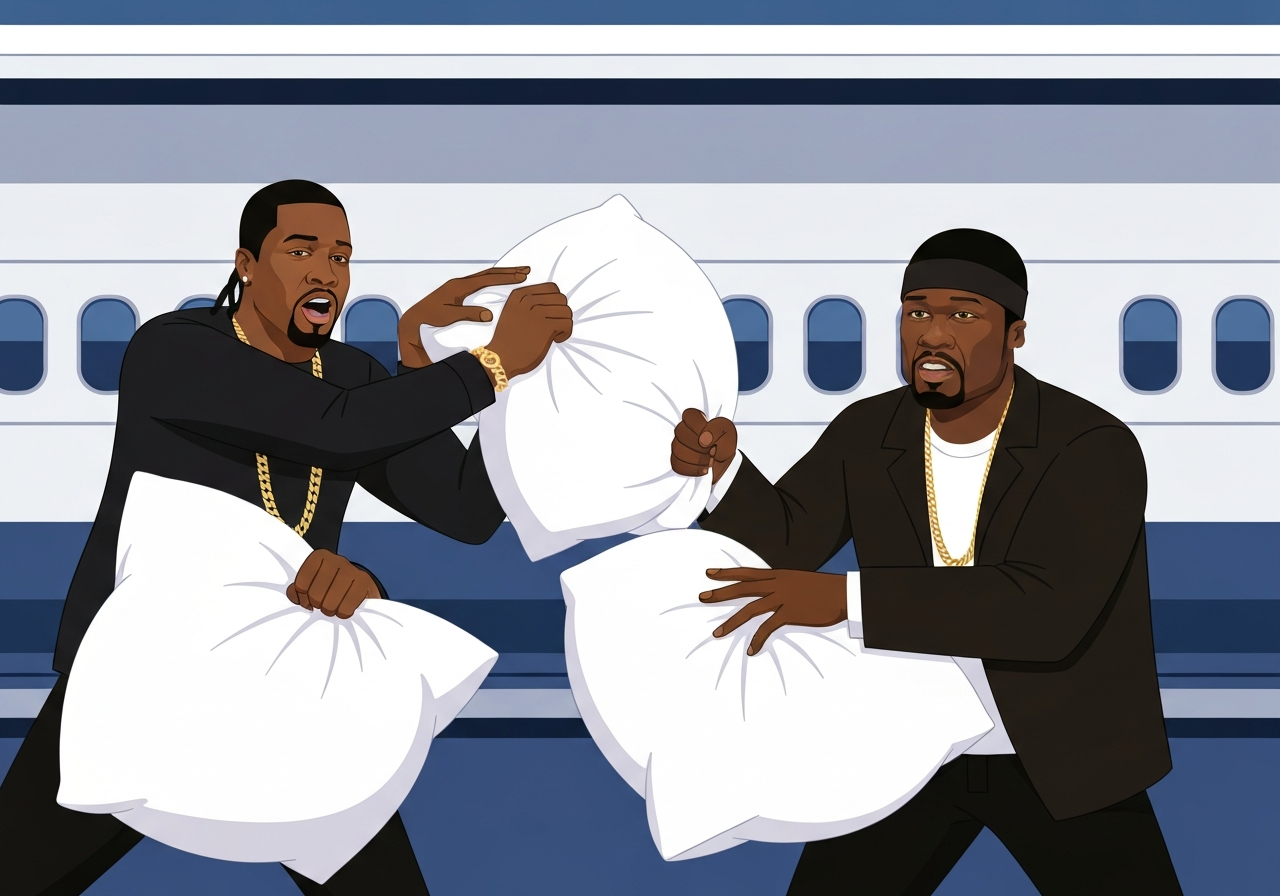
On Feb. 7, 2026, following Super Bowl LX festivities in San Francisco, rapper Ja Rule was involved in a cabin confrontation on a Delta Air Lines flight departing San Francisco International Airport. Video circulating on social platforms shows Ja Rule — 49 — exchanging shouts and what he described as a “pillow fight” with associates tied to 50 Cent, including G-Unit member Tony Yayo. Delta confirmed crew intervention and that one passenger was rebooked on a later flight. The incident revived a decades-long rivalry between the two hip-hop figures in public view.
Key Takeaways
- Incident date and location: Feb. 7, 2026, on a Delta flight out of San Francisco International Airport after Super Bowl LX events at Pier 48.
- People involved: Ja Rule (age 49) and at least two associates believed to be connected to 50 Cent’s circle; Tony Yayo appears in video footage.
- Immediate outcome: Cabin crew spoke to two customers and one passenger was rebooked, according to Delta’s statement reported by the San Francisco Chronicle.
- Social media reaction: Video clips and posts from figures such as Uncle Murda and posts on X amplified the episode within hours of the flight.
- Historical context: The feud traces to 1999 and has included diss tracks, public taunts and occasional physical confrontations over more than two decades.
- Public statements: Ja Rule called the episode “hilarious” on X; 50 Cent framed it as a bid for attention in his X post.
Background
The rivalry between Ja Rule and 50 Cent dates back to 1999 and has persisted through the 2000s into the streaming era. Both artists rose to prominence in different ways: Ja Rule with early-2000s chart hits such as “Mesmerize” and “Always on Time,” and 50 Cent with a music and entertainment business empire built off albums like Get Rich or Die Tryin’.
Accounts of how the feud began diverge: 50 Cent has said it began after an associate robbed Ja Rule of a chain, while Ja Rule points to perceived slights at an earlier video shoot involving Murder Inc., the label that launched his career. That dispute spawned a series of diss tracks — for example, 50 Cent’s “Life’s On the Line” and “Wanksta” and Ja Rule’s “Loose Change” — and occasional physical run-ins, cementing a long-standing personal and public antagonism.
Main Event
Video shared online and reposted by several accounts appears to show Ja Rule standing in the aircraft aisle prior to takeoff, repeatedly calling out Tony Yayo with the words, “What we doing?” as tension mounted. The footage shows another man placing his hands on Ja Rule’s shoulders, a gesture consistent with attempts to restrain or de-escalate the situation.
Uncle Murda, an artist aligned with 50 Cent, posted clips that show the run-up to the confrontation and later wrote on Instagram that Ja Rule left the plane and that Murda reclaimed the seat. Ja Rule later posted on X describing the incident as “hilarious,” saying he “threw the pillow at yayo head” and characterizing the moment as his own spontaneous action.
Delta Airlines confirmed that cabin crew addressed a disagreement between two customers and that one passenger was rebooked; the carrier did not provide additional details about any enforcement action or whether law enforcement became involved. Social posts and short clips were the primary public record of the episode in the hours after the flight.
Analysis & Implications
At a surface level, the episode is another chapter in an enduring personal rivalry that has become part of hip-hop folklore. When long-running feuds carry into public, enclosed environments such as aircraft cabins they raise practical safety and liability questions for carriers and event organizers responsible for transporting high-profile guests after major events.
From a reputational standpoint, the incident demonstrates how social media accelerates and amplifies conflict. Short-form video and immediate social commentary ensure that moments once confined to small circles can quickly become viral narratives, affecting the public images of individuals and their business relationships.
Legally, minor in-flight disputes that do not escalate to assault or breach of aviation rules often remain in the realm of carrier handling — deplaning, rebooking or reporting to authorities if necessary. But repeated public incidents can prompt venues, promoters and airlines to reassess credentialing and security protocols for celebrities and their entourages after mass events.
For both artists’ commercial interests, the episode may have limited lasting financial impact, but it underscores the persistent market for rivalry-driven attention in hip-hop culture. Promoters and streaming platforms often monetize visibility; however, repeated confrontations also risk alienating commercial partners concerned about safety and liability.
Comparison & Data
| Year | Incident | Notable detail |
|---|---|---|
| 1999 | Reported origin of feud | Conflicting accounts: alleged robbery vs. on-set slight |
| Early 2000s | Diss tracks and public taunts | Multiple songs including “Wanksta” and “Loose Change” |
| Feb 7, 2026 | In-flight confrontation | Pillow-throwing episode on Delta flight after Super Bowl LX |
The table highlights three reference points in the feud’s timeline: its contested origin in 1999, the period of intense musical back-and-forth in the early 2000s, and the most recent public confrontation on Feb. 7, 2026. While the quantitative data are limited, the pattern shows episodic flare-ups tied to proximity (shared events or travel) and the high visibility of social platforms.
Reactions & Quotes
Public reaction came quickly from participants and observers on social platforms, where short clips and taunting captions circulated. Statements ranged from playful boasting to dismissive critique of the attention-seeking behavior.
“I popped on these punks by myself on a plane… I threw the pillow at yayo head cuz you soft… knocked ya hat all off sh— was hilarious…”
Ja Rule (post on X, Feb. 2026)
Ja Rule’s post framed the episode as a personal, comedic moment rather than a serious altercation. That framing shaped a portion of the social media response, with some fans treating it as spectacle and others urging de-escalation.
“He was by his self so he had to make a scene.”
50 Cent (post on X, Feb. 2026)
50 Cent’s comment characterized the episode as a calculated bid for attention. That response fit a broader pattern in which each side interprets the other’s actions as performative rather than substantive.
“Two customers were spoken to by the cabin crew following a disagreement, and one customer was rebooked on a later flight.”
Delta Airlines (statement, as reported by San Francisco Chronicle)
Delta’s brief statement, relayed through reporting, focused on the operational handling of the disagreement and did not describe disciplinary or legal follow-up in public reporting.
Unconfirmed
- Exact sequence of who first provoked the exchange on the plane is unclear from available video and social posts.
- Whether any formal report was filed with law enforcement or whether Delta recorded the incident as a security event beyond rebooking is not publicly confirmed.
- The full identities and roles of all other passengers involved beyond Tony Yayo and the named social posts have not been independently verified.
Bottom Line
The pillow-throwing episode on a Delta flight after Super Bowl LX is the latest, highly visible flare-up in a feud that has persisted since 1999. While the immediate consequences reported were limited — crew intervention and a rebooking — the event illustrates how longstanding personal disputes can spill into public spaces and become amplified by social media.
For airlines and event organizers, the incident reinforces the need to coordinate post-event transport and security for high-profile attendees to reduce risk and reputational exposure. For fans and the wider public, the episode is likely to be another moment of spectacle in a rivalry that continues to attract attention decades after it began.
Sources
- San Francisco Chronicle — Media report summarizing the incident and quoting a Delta statement (Feb. 2026).
- Ja Rule on X — Social media post by Ja Rule describing the episode (social media).
- 50 Cent on X — Social media post commenting on the episode (social media).
- Uncle Murda on Instagram — Post and video clips shared by an artist aligned with 50 Cent (social media).