
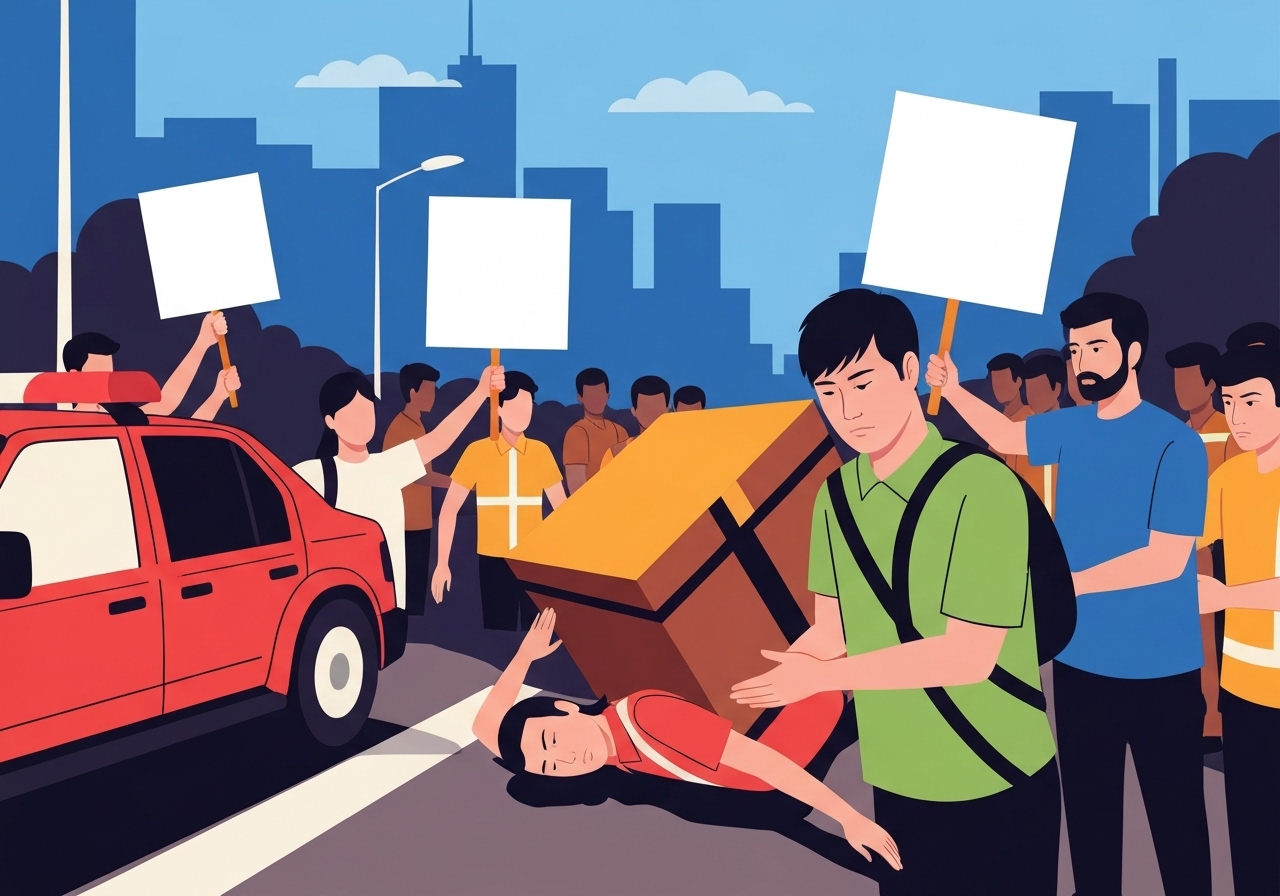
Amid protests in Jakarta on , 21-year-old delivery driver Affan Kurniawan was fatally run over by an armored police vehicle after he stopped to retrieve a dropped phone. He was taken to a local hospital but died, fueling fresh demonstrations and public anger that spread to other cities. In Surabaya on , a police headquarters was set on fire during unrest.
Key Takeaways
- Victim identified as Affan Kurniawan, 21, a motorcycle taxi delivery driver.
- Incident occurred in Jakarta on the night of , amid protests.
- Armored police vehicle struck and pinned him; it then accelerated, running over his body.
- He was transported to a Jakarta hospital and did not survive.
- Unrest spread: a police headquarters in Surabaya was set ablaze on .
- Public anger intensified over policing tactics during crowd control operations.
- No official investigation details had been released at the time of publication.
Verified Facts
While navigating Jakarta during a night of protests, Affan Kurniawan reportedly dropped his phone and knelt to pick it up. At that moment, an armored police vehicle hit him, pinning him beneath its front tires. As bystanders converged, the driver accelerated, running over Kurniawan. He was rushed to a hospital but later died.
The victim was a 21-year-old motorcycle taxi driver working a food delivery run when the incident occurred. The location was Indonesia’s capital, Jakarta, and the timing was Thursday night, .
Demonstrations continued over the weekend. In Surabaya on , a police headquarters was set on fire, and looting was observed outside the building, indicating broader unrest beyond the capital.
The facts above are based on contemporaneous reporting and on-the-ground accounts described in international media coverage.
Context & Impact
Kurniawan’s death has become a flashpoint in a tense political moment, galvanizing anger about how crowds are policed and how quickly force is escalated during demonstrations. The incident is likely to intensify calls for transparency, accountability, and clearer rules of engagement.
Gig-economy riders, who keep Jakarta’s delivery networks moving, often work through protests and traffic disruptions. The case highlights their vulnerability in volatile situations and may prompt platforms and authorities to issue new safety guidance or curfew protocols during civil unrest.
If authorities do not quickly and credibly establish what happened and who is responsible, protests could persist or spread. Conversely, a transparent process could help defuse tensions and set a precedent for handling future crowd-control incidents.
What to Watch
- Whether an independent or internal investigation is announced, with a timeline for findings.
- Identification and status of the officer involved and any disciplinary actions.
- Availability of CCTV, body-cam, or bystander video to clarify the sequence of events.
- The scale and geography of further demonstrations in Jakarta, Surabaya, and other cities.
Unconfirmed
- Whether the involved officer has been identified, detained, or suspended.
- Whether a mechanical failure or driver error contributed to the vehicle’s acceleration.
- Availability and content of any official CCTV or body-camera footage.
- Comprehensive injury and arrest figures related to protests in Jakarta and Surabaya.
Bottom Line
The death of a young delivery rider under an armored police vehicle in Jakarta has crystallized public frustration over crowd-control tactics. A prompt, transparent investigation—backed by evidence—is essential to restore trust and prevent further escalation.