
Lead
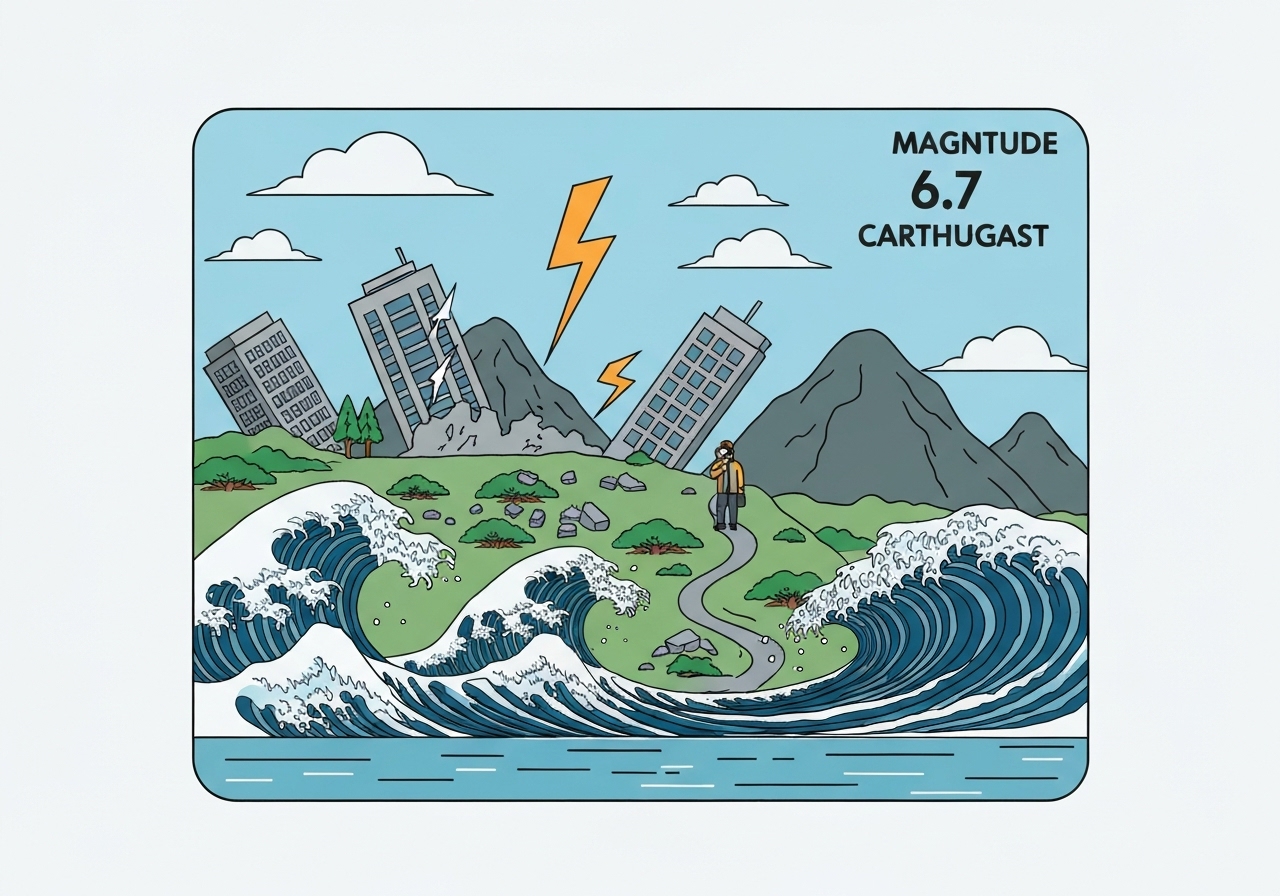
A magnitude 6.7 earthquake struck off the coast of Aomori Prefecture on 12 December 2025 at 11:44 JST (02:44 GMT), according to the Japan Meteorological Agency (JMA). The quake occurred at a depth of about 20 km and prompted a tsunami advisory from the JMA for nearby coastal areas. The United States Geological Survey (USGS) confirmed a 6.7 magnitude measurement. Local authorities reported no immediate abnormalities at regional nuclear facilities.
Key Takeaways
- The JMA recorded the quake at 11:44 JST on 12 December 2025, depth 20 km, magnitude 6.7; the USGS issued a matching 6.7 reading.
- The JMA issued a tsunami advisory for parts of the northeast coast; no large tsunami had been confirmed at the time of reporting.
- Japan’s Nuclear Regulation Authority reported no immediate signs of trouble at reactors or major nuclear installations in the affected region.
- Earlier in the week, a separate magnitude 7.5 quake in northern Japan injured at least 50 people and produced tsunami waves up to 70 centimetres.
- The northeast communities remain on edge because of the 2011 magnitude 9.0 Tohoku quake that caused about 18,500 deaths or missing persons.
- Retailers in Hokkaido reported sharp increases in sales of emergency supplies after the week’s stronger tremor; one Hakodate shop said bottled water and kits tripled in sales.
Background
Japan lies at the junction of multiple tectonic plates along the western margin of the Pacific “Ring of Fire,” making it one of the world’s most seismically active countries. The memory of the 11 March 2011 magnitude 9.0 undersea quake and the subsequent tsunami that devastated parts of northeast Japan still shapes public preparedness and government planning.
Earlier this year the JMA issued a special advisory for other parts of Japan, and the government has long warned that a major rupture along the Nankai Trough could be catastrophic. Official contingency studies have estimated that a worst-case Nankai Trough event and resulting tsunami could cause extremely large casualties and economic loss, figures that have influenced national disaster preparedness planning.
Main Event
At 11:44 JST on 12 December 2025 the JMA located the epicentre off Aomori Prefecture at about 20 km depth and promptly issued a tsunami advisory for coastal zones. The agency’s initial bulletin advised residents to move to higher ground and follow local municipal instructions while it monitored sea-level data. The USGS posted a corroborating magnitude 6.7 assessment on its earthquake monitoring pages within minutes.
National broadcaster NHK compared the felt intensity to a separate magnitude 7.5 earthquake that struck the same broad region earlier in the week, noting the latest shaking was weaker than the 7.5 event that had torn roads and shattered windows. Local officials and first responders mobilised to check infrastructure and coastal areas for damage; early reports did not identify large-scale structural failures or mass casualties.
Operators of nuclear sites in the region ran routine checks after the tremor. Japan’s Nuclear Regulation Authority said inspectors found no immediate abnormalities at facilities under their oversight, while emphasising continued monitoring. Municipal authorities reminded residents to prepare for aftershocks and stay informed through official channels.
Analysis & Implications
The 6.7 quake, while significant, is modest compared with the magnitude 7.5 event earlier in the week and far smaller than the 2011 Tohoku disaster. Nevertheless, clustered seismicity can raise the short-term probability of additional sizable aftershocks in nearby fault systems, which complicates emergency planning and public messaging. Authorities typically weigh the risk of secondary shocks and cascading failures—such as landslides or coastal inundation—when issuing advisories.
Economically, repeated strong tremors in a short span elevate disruption risk for transport, fisheries, and local supply chains in the northeast. Retail indicators—like the tripling of emergency-kit sales reported in some Hokkaido outlets—show how consumer behaviour shifts immediately after shocks, amplifying short-term demand for water, batteries and stabilisation equipment.
Politically and socially, the sequence of quakes tests public confidence in preparedness programs and the effectiveness of early-warning systems. The 2011 Tohoku disaster still frames public expectations, making local governments more likely to issue conservative advisories and to maintain visible relief readiness. Internationally, neighbours and global monitoring agencies track such events for tsunami propagation; even modest tsunamis can affect distant coastlines if conditions align.
Comparison & Data
| Date | Location | Magnitude | Reported Casualties | Max Tsunami |
|---|---|---|---|---|
| 12 Dec 2025 | Off Aomori Prefecture | 6.7 | No immediate major injuries reported | Advisory only, no large waves confirmed |
| 9 Dec 2025 | North Japan | 7.5 | At least 50 injured | Up to 70 cm |
| 11 Mar 2011 | Tohoku (undersea) | 9.0 | About 18,500 dead or missing | Massive, widespread inundation |
The table places the 12 December tremor in context: smaller than the earlier 7.5 event but occurring amid heightened regional alertness. Emergency agencies use such comparative data to calibrate advisories and resource deployments.
Reactions & Quotes
Officials and broadcasters conveyed cautious messages urging vigilance as aftershocks remained possible and sea levels were monitored.
We issued a tsunami advisory for coastal areas and are monitoring sea-level gauges; residents should follow municipal evacuation orders if issued.
Japan Meteorological Agency (official)
The national regulator for nuclear safety reported routine inspections had not detected abnormal conditions at plants in the affected prefectures.
Inspections are ongoing and, at present, we have found no indications of problems at regional nuclear facilities.
Japan Nuclear Regulation Authority (official)
On the ground, residents described swift preparations and a renewed focus on basic survival supplies after a week of shaking.
Sales of water and disaster kits have surged; people are buying in case more strong tremors arrive.
Local retailer quoted by NHK (retail source)
Unconfirmed
- Reports of property damage and localized road collapses are still being compiled; formal damage assessments are pending municipal surveys.
- Any estimate of the probability or timing of a next larger quake remains probabilistic and subject to update as seismic data are analysed.
Bottom Line
The 6.7 earthquake off Aomori on 12 December 2025 was significant but not on the scale of the 7.5 event earlier that week or the catastrophic 2011 Tohoku quake. Authorities emphasised monitoring and precaution: tsunami advisories were issued and nuclear sites reported no immediate abnormalities, but aftershocks and local impacts remain possible.
Residents and responders should stay alert to official bulletins from the JMA and municipal authorities, prioritise basic emergency supplies and follow evacuation guidance if local officials order it. Over the coming days, agencies will refine damage assessments and sea-level observations to determine whether advisories should be escalated or lifted.
Sources
- Al Jazeera — international news outlet reporting the developing event
- Japan Meteorological Agency (JMA) — official national agency seismic and tsunami bulletins
- United States Geological Survey (USGS) — international seismological monitoring (official)
- NHK World — national public broadcaster coverage and local reporting
- Japan Nuclear Regulation Authority — official regulator statements on nuclear facility status