
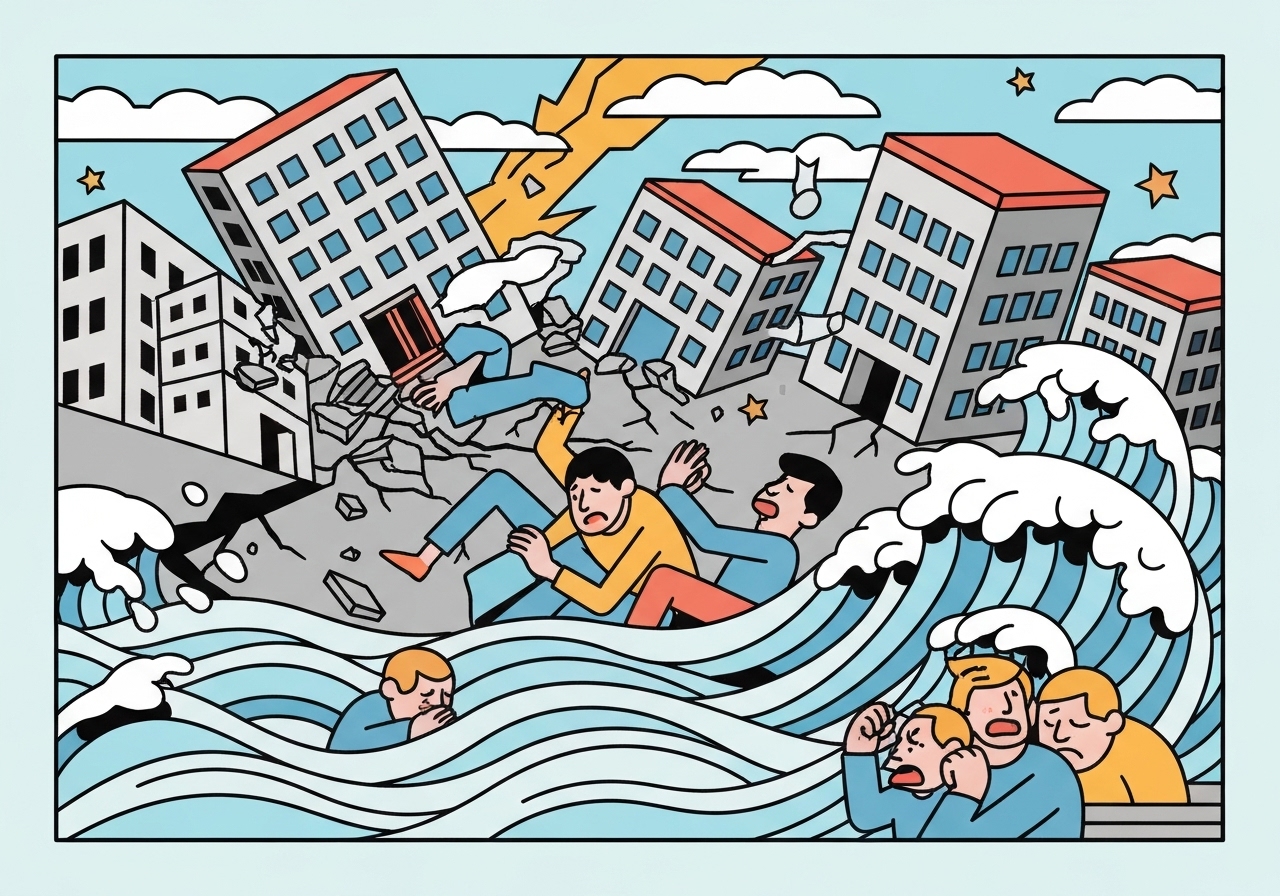
On Dec. 8, 2025, a powerful earthquake with a preliminary magnitude of 7.6 struck offshore of Aomori Prefecture on Honshu after 11 p.m. local time, prompting tsunami warnings for parts of northern Japan and immediate evacuation orders. The Japan Meteorological Agency reported a 5.6-magnitude aftershock and issued tsunami alerts for Aomori, Iwate and Hokkaido, with advisories for Miyagi and Fukushima. Local authorities opened shelters, reported fires and power outages in Hachinohe City, and dispatched teams to assess damage and casualties. Early measurements recorded small tsunami waves at several northern ports while officials continued damage inspections and public safety broadcasts.
Key Takeaways
- The main shock registered 7.6 magnitude and occurred off Aomori Prefecture shortly after 11:00 p.m. Japan Standard Time on Dec. 8, 2025.
- JMA registered an immediate aftershock of magnitude 5.6 and issued tsunami warnings for Aomori, Iwate and Hokkaido; Miyagi and Fukushima received advisories.
- Measured tsunami heights included more than 2.2 feet at a port in Iwate, more than 1.3 feet at Mutsu-Ogawara (Aomori) and Urakawa (Hokkaido), and under one foot at Erimo (Hokkaido).
- No damage had been detected at nuclear power plants as of early reports; officials emphasized ongoing inspections.
- Local effects included fires and power outages in Hachinohe City, about 800 households without power in Iwate, suspended expressway and rail services, and a high school opened as a shelter.
- NHK reported multiple injuries at a hotel in Aomori; the total number of casualties and the full scope of damage remained under investigation.
- Japanese leaders reiterated that tsunami advisories are common after sizable quakes; authorities urged residents to follow evacuation guidance and stay on alert for further aftershocks.
Background
Japan sits along the convergent boundary where the Pacific Plate subducts beneath the Okhotsk and North American plates, producing frequent seismic activity, especially in the northeast. The country’s monitoring and warning systems are among the most developed globally; the Japan Meteorological Agency (JMA) issues rapid earthquake and tsunami alerts to coastal communities and national broadcasters. Despite advanced systems, historical events show that even well-prepared nations can sustain catastrophic damage: the March 11, 2011, magnitude-8.9 quake and subsequent tsunami overwhelmed defenses, caused reactor meltdowns at Fukushima Daiichi and resulted in more than 19,000 deaths. That disaster reshaped Japan’s emergency planning, nuclear oversight and coastal engineering standards.
In recent months JMA has issued advisories following other offshore shocks, reflecting the active seismic environment around Honshu. Local governments maintain evacuation maps and multi-hazard shelters, and transportation operators have finely tuned protocols for halting rail and road services when shaking reaches threshold intensities. Still, the combination of nighttime shaking, aftershocks and coastal alerts increases the complexity of response and the potential for secondary incidents like fires and utility failures.
Main Event
The main quake struck late on Dec. 8, 2025, centered offshore of Aomori Prefecture, and was immediately felt across the northern islands. JMA’s rapid analysis prompted tsunami warnings for parts of Hokkaido, Aomori and Iwate and advisories for Miyagi and Fukushima; officials urged residents in low-lying coastal zones to evacuate to higher ground. Within hours, local patrols and municipal disaster-management offices were conducting reconnaissance by road and sea to determine inundation extent and spot hazards such as damaged structures or landslides.
Instrumental readings showed modest tsunami heights relative to the largest historical events: a port in Iwate recorded waves exceeding 2.2 feet, while Mutsu-Ogawara in Aomori and Urakawa in Hokkaido saw waves above 1.3 feet; Erimo observed less than one foot. Despite the relatively small wave amplitudes, authorities treated the alerts seriously because local bathymetry and coastal geometry can amplify effects in some harbors and estuaries.
Municipal reports from Hachinohe City documented fires and localized power outages that generated emergency calls; a municipal high school was designated as an evacuation center for displaced residents. Rail and expressway operators halted services on affected lines and routes as a precaution, causing region-wide disruptions. Preliminary counts indicated roughly 800 households in Iwate were without electricity early on, and NHK reported multiple injuries at a hotel in Aomori, though official tallies were pending.
Analysis & Implications
Technically, a 7.6 quake offshore of northern Honshu can produce dangerous currents and localized inundation even if measured tsunami heights remain modest at harbor mouths. The JMA’s quick issuance of warnings and advisories reflects a conservative approach designed to reduce risk to life and property; that approach also produces frequent alerts, which can complicate public messaging and fatigue. Emergency managers must balance premature all-clear messaging against the community cost of recurring evacuations and transport interruptions.
The absence of immediate reports of damage at nuclear power plants is notable but not definitive; plant operators follow multi-tiered inspection and cooling-system checks after strong ground motions. Given Japan’s post-2011 regulatory changes, nuclear facilities now undergo stringent safety verifications before returning to normal operations, but the perception of risk will remain heightened among coastal communities and policymakers.
Economically, short-term impacts will concentrate on transport, logistics and local commerce in affected prefectures, particularly if aftershocks force further service suspensions. Longer-term concerns include coastal infrastructure resilience, the cost of repeated emergency responses, and potential pressure to revisit harbor and breakwater designs where small tsunamis can cause outsized local effects. Internationally, partners and monitoring agencies will continue to exchange data and may offer support if coastal damage or humanitarian needs emerge.
Comparison & Data
| Location | Recorded Wave Height (ft) | Alert Level |
|---|---|---|
| Iwate port (Honshu) | > 2.2 | Warning |
| Mutsu-Ogawara (Aomori) | > 1.3 | Warning |
| Urakawa (Hokkaido) | > 1.3 | Warning |
| Erimo (Hokkaido) | < 1.0 | Advisory/Observed |
For context, the 2011 Tohoku earthquake measured 8.9 and produced catastrophic, multi-meter tsunamis that caused mass casualties and nuclear accidents; by contrast, the Dec. 8 event generated much smaller waves but nonetheless triggered precautionary shutdowns and evacuations. The quantitative differences underscore how magnitude, rupture depth, direction and coastal geometry combine to determine local risk.
Reactions & Quotes
Officials and local responders described the event in terse, precautionary language as they coordinated assessments and public instructions.
“Tsunamis were predicted for some coastal areas, and residents should evacuate to high ground immediately,”
Minoru Kihara, Chief Cabinet Secretary (official statement)
Field reporters and residents described the intensity of shaking and the suddenness of the response.
“I could not stand without holding something,”
Kenta Kobayashi, reporter in Tomakomai (local eyewitness)
National leadership emphasized coordination and public guidance while avoiding premature casualty estimates.
“We will provide residents with necessary evacuation instructions and continue to monitor all developments,”
Sanae Takaichi, Prime Minister of Japan (press remarks)
Unconfirmed
- Final casualty and injury totals across affected prefectures had not been confirmed as of early reports; official counts were pending on-scene assessments.
- Comprehensive structural damage assessments for smaller coastal communities and inland areas remained incomplete and were still being compiled.
- Reports of multiple injuries at a hotel in Aomori were initially filed by NHK and awaiting confirmation from local medical or municipal authorities.
Bottom Line
The Dec. 8, 2025, offshore quake of preliminary magnitude 7.6 produced measurable but relatively small tsunami waves and prompted a rapid national response emphasizing evacuation and inspection. While no damage at nuclear plants was reported early on, the event highlights the enduring seismic risk in northern Japan and the importance of rapid alerts, reliable shelters and transport contingency plans. Residents in coastal prefectures should follow official guidance, expect aftershocks, and await consolidated reports from municipal and national agencies for verified casualty and damage figures.
Authorities and emergency services will focus next on damage verification, restoring utilities, and ensuring shelter needs are met; additional advisories or localized warnings remain possible as aftershocks and new observations arrive. For the public, the immediate priorities are heeding evacuation orders, avoiding damaged infrastructure, and checking official sources for verified information.