
Lead
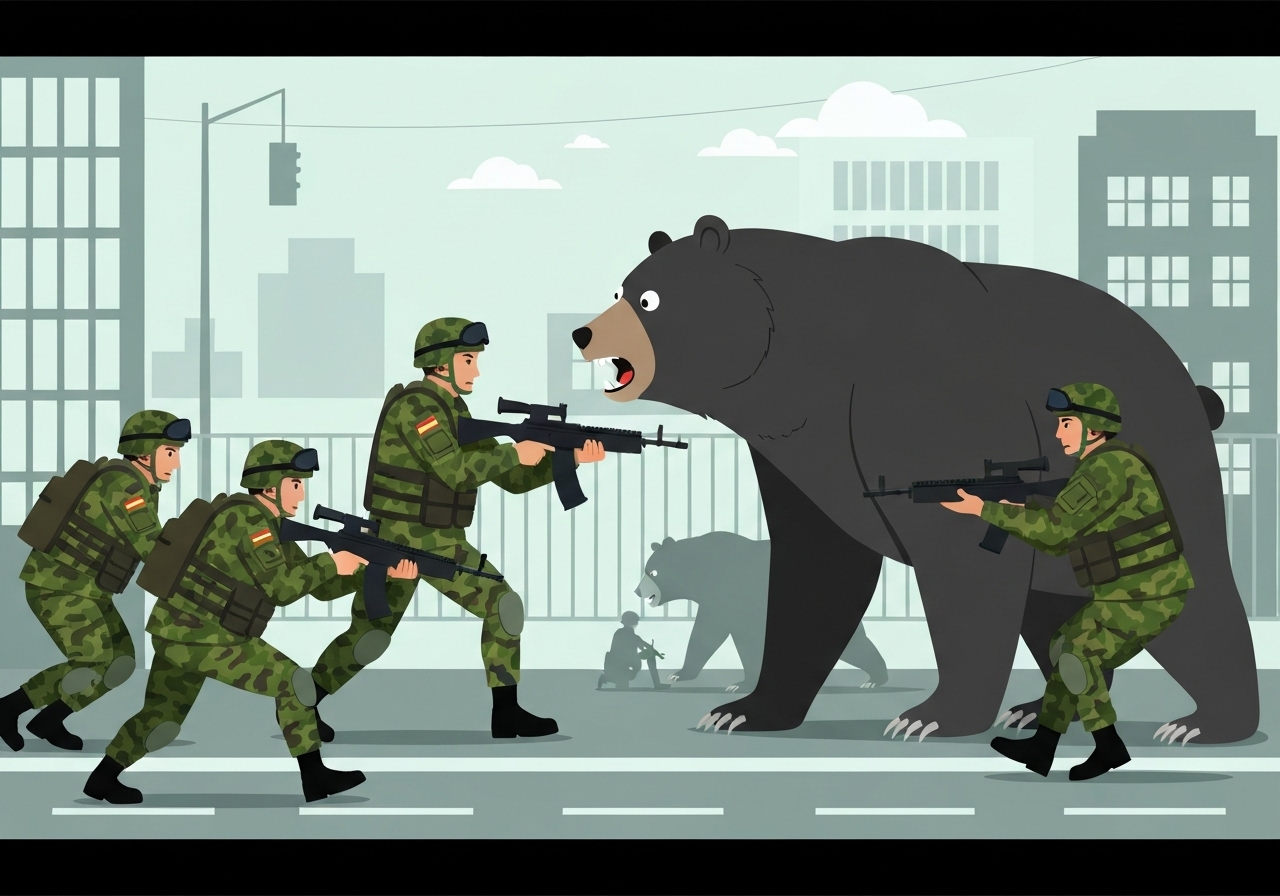
On Nov. 5, 2025, Japan deployed Ground Self-Defense Force personnel to Akita prefecture to help contain a sharp rise in brown and Asiatic black bear encounters that have menaced residents ahead of hibernation season. The operation, authorised under an agreement between the Defense Ministry and Akita prefectural officials, sends troops to set box traps, move hunters and assist with carcass removal while explicitly forbidding troops from using firearms. Since April, Environment Ministry data show more than 100 people injured and at least 12 killed nationwide in bear incidents through the end of October, with repeated sightings near schools, train stations and other community sites in Akita. Local officials described the situation as urgent as aging rural communities struggle to respond.
Key Takeaways
- Troops deployed: Japan sent Ground Self-Defense Force teams to Kazuno and other parts of Akita on Nov. 5, 2025, to help set traps and support local hunters.
- Scope of injuries and deaths: Environment Ministry figures to the end of October report over 100 injured and at least 12 killed in bear attacks across Japan since April.
- Akita impact: Akita prefecture, population about 880,000, recorded more than 50 attacks since May and at least four fatalities, according to local government counts.
- National bear population: The government estimates Japan’s overall bear population at more than 54,000 animals.
- Rules for troops: Defense Ministry officials said deployed soldiers will not fire weapons for culling but will employ box traps, bear spray and net launchers, and move local hunters.
- Economic losses: Local orchardist Takahiro Ikeda reported more than 200 apples eaten, illustrating the agricultural damage driving public alarm.
- Demographic driver: Experts link the rise in human–bear collisions to aging, declining rural populations and fewer trained hunters.
Background
Japan’s mountain and forest regions host both brown bears and Asiatic black bears; as autumn approaches, bears intensify foraging to build fat reserves before hibernation. Over recent years, conservation measures and changes in land use have contributed to population increases in some areas, while rural depopulation has left fewer residents and hunters able to manage wildlife. The Environment Ministry’s estimate of more than 54,000 bears nationwide frames the scale: a large wild population intersecting with shrinking human presence in high-risk zones.
Akita prefecture, in northern Honshu, typifies those pressures: many communities are sparsely populated and aging, with farmland and abandoned orchards that attract bears to residential boundaries. Experts and officials say once bears discover reliable food sources — from persimmon and chestnut trees to unsecured waste — they are likely to return repeatedly. Local hunting expertise has declined as hunters age, and law enforcement and local governments are now under pressure to create organised responses.
Main Event
The Defense Ministry and Akita prefectural government signed an agreement on Nov. 5, 2025, to deploy Self-Defense Force personnel to help trap and remove problem bears. Soldiers in Kazuno set box traps baited with food, used non-lethal equipment such as bear spray and net launchers, and transported local hunters to capture or cull animals. Officials emphasised that troops would not employ firearms in the operation; lethal control is to be carried out by civilian hunters where permitted.
Operations began in forested zones near orchards and residential clusters following repeated sightings and several local injuries. One orchard operator, Takahiro Ikeda, told NHK that bears had consumed more than 200 ripe apples, underscoring both economic loss and the heightened proximity of bears to homes. Akita Governor Kenta Suzuki described authorities as “desperate” because manpower to respond locally has been inadequate.
Defense Minister Shinjiro Koizumi said the mission’s objective is to help secure daily life for citizens while noting that the Self-Defense Forces’ primary role remains national defence and their capacity for sustained support is limited. The ministry also said, as of the operation’s start, it had not received similar aid requests from other prefectures for troop deployment to address bear incidents.
Analysis & Implications
The immediate deployment is a tactical response to acute local risk but highlights systemic gaps in rural wildlife management. Aging populations and fewer active hunters reduce on-the-ground capacity to carry out controlled culling or preventative measures such as regular patrols and orchard maintenance. That demographic trend means short-term military support may be necessary more often unless local capacities are rebuilt.
Ecologically, expanding bear numbers reflect a mix of protection policies, habitat changes and food availability; bears are not classified as endangered nationally and many experts argue population control is a component of public safety. However, culling programs raise social and regulatory questions about permitted methods, jurisdictional authority and ethical oversight. Using the Self-Defense Forces to bridge a civic capability gap reframes wildlife management as a public-safety and governance problem.
Economically, repeated incursions into residential and agricultural areas impose direct losses on farmers, tourism sites such as hot-spring resorts, and local services. Insurance and recovery costs, plus potential declines in visitors to affected areas, could deepen fiscal stress in depopulating prefectures. Policy responses under consideration — expanded government hunter training, revised hunting rules and improved warning systems — seek to balance safety, animal welfare and rural resilience.
Comparison & Data
| Metric | Value |
|---|---|
| National bear population (government estimate) | More than 54,000 |
| Attacks since April (national, to end-Oct) | >100 injured, ≥12 killed |
| Akita prefecture population | ≈880,000 |
| Attacks in Akita since May | >50 injured, ≥4 killed |
These figures show how a large national population of bears translates into concentrated local encounters where human densities are low and food attractants are common. Akita’s share of incidents is significant relative to its population and highlights geographic clustering of risk. Any long-term plan will need to track seasonal patterns — especially the pre-hibernation foraging window — and combine population surveys with community-level prevention.
Reactions & Quotes
Officials framed the deployment as urgent and temporary assistance while urging longer-term solutions.
“Every day, bears intrude into residential areas in the region and their impact is expanding,”
Fumitoshi Sato, Deputy Chief Cabinet Secretary
Sato used the comment to explain the rationale for mobilising troops and to signal central government recognition of escalating local danger. The statement accompanied the formal agreement allowing Self-Defense Force support.
“The bear mission aims to help secure people’s daily lives, but service members’ primary mission is national defense,”
Defense Minister Shinjiro Koizumi
Koizumi stressed limits to military involvement, noting the Self-Defense Forces are already understaffed and cannot provide indefinite assistance for wildlife control. His remarks framed the deployment as a stopgap measure rather than a new standing task.
“My heart is broken,”
Takahiro Ikeda, orchard operator, quoted to NHK
Ikeda’s comment illustrated the emotional and economic toll on farmers losing harvest to repeated bear visits, providing a human perspective on why local communities pressed for an immediate response.
Unconfirmed
- Whether the deployment will be requested or repeated by other prefectures remains uncertain; as of the operation start, the Defense Ministry reported no other formal requests.
- The long-term effectiveness of short-term troop-assisted trapping on reducing future attacks has not been demonstrated and depends on sustained prevention and population management measures.
- Precise local bear census figures for Akita’s problem zones have not been published publicly; the 54,000 figure refers to a national government estimate.
Bottom Line
Japan’s use of Self-Defense Force personnel to help trap and remove problem bears in Akita is a high-profile symptom of deeper rural governance and wildlife-management challenges. The deployment provides immediate capacity to trap and transport animals and to support local hunters, but it does not substitute for long-term investments in community prevention, hunter training and population surveys.
Policymakers must weigh public safety, animal management and the limits of military assistance as they design a more sustainable response. For residents, the near-term priority is reducing attractants, improving warning systems and scaling up trained civilian teams so communities can manage seasonal risks without recurring emergency deployments.