
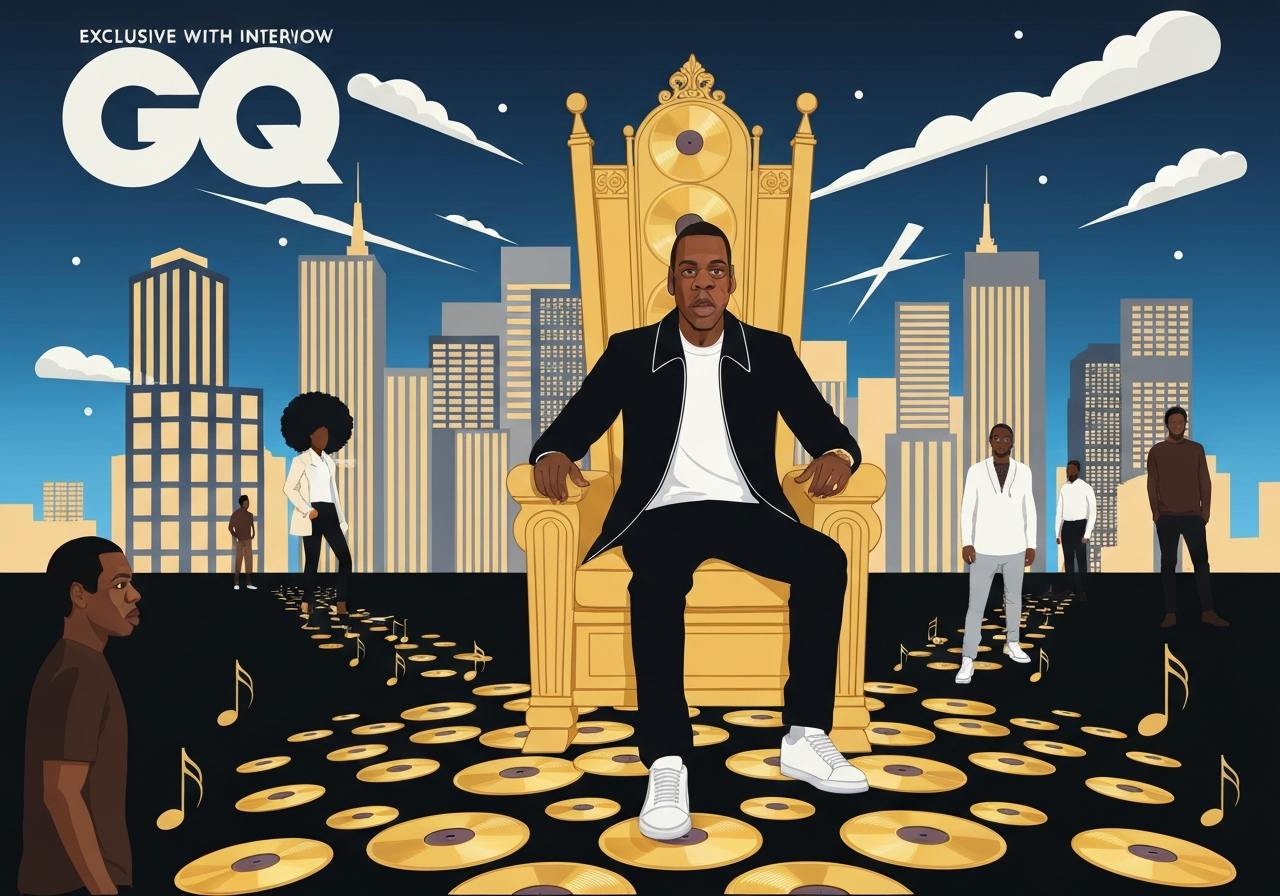
Lead — In January 2026, Jay-Z sat for two extended conversations with GQ, reflecting on three decades in hip-hop, his business empire, and a draining civil suit filed at the end of 2024 and dismissed months later. At 56, he framed 2025 as a period of recuperation and declared 2026 an offensive year creatively and commercially. The interview ranged from his early street-level rise and the 1996 Reasonable Doubt anniversary to the mechanics of modern fame, family life on tour, and the valuation he says underpins parts of his spirits-and-luxury holdings.
Key Takeaways
- Jay-Z told GQ he views 2026 as “all offense” after a difficult 2025; he described the previous year as emotionally and mentally taxing following a civil suit filed late in 2024 that was later dismissed with prejudice.
- He emphasized longtime cultural influence: Reasonable Doubt’s 1996 debut (43,000 first-week sales) reaches its 30th anniversary in June 2026, and he remains centrally visible across music, sport, and business at age 56.
- Jay quantified a D’Ussé transaction as $750 million for 25% cash, implying his half is worth $1.5 billion and the overall enterprise valued at roughly $3 billion—figures he provided to clarify public confusion about the deal.
- He cited gaps between public perception and private reality: Roc Nation (founded 2008) has shifted toward distribution and artist services rather than a classic label model.
- The Super Bowl halftime role he oversees has become a major cultural flashpoint; he defended artistic choices while acknowledging some community pushback.
- Jay described fatherhood and family performance moments—especially his daughter’s set on the Cowboy Carter tour—as grounding amid controversies and business demands.
Background
Shawn Carter’s arc from Marcy Houses to music and multiindustry ownership is central to contemporary culture. He broke through with Reasonable Doubt in 1996, a record he says circulated more widely on the streets than early distribution numbers indicated, selling 43,000 copies in its opening week. Over the next three decades he built Roc-A-Fella and later Roc Nation (2008), expanded into spirits (Armand de Brignac, D’Ussé), streaming (Tidal), and sports ownership, assembling an ecosystem that spans music, commerce, and live spectacle.
The last decade has seen Jay-Z both scale and reconfigure his public role: 4:44, issued nine years before this interview, remains his most recent solo studio album; he appeared on Jay Electronica’s A Written Testimony six years earlier as a major contributor, and his high-profile verse on “God Did” dates to nearly four years prior. Those sporadic creative bursts have been accompanied by large, deliberate business moves, media curation around the Super Bowl halftime shows, and a family life that often intersects with performance—most visibly on global tours with his wife, a leading pop superstar.
Main Event
Across two hours and subsequent follow-ups, Jay-Z told GQ he spent much of 2025 absorbing the personal and reputational fallout from an anonymous civil complaint filed at the end of 2024; he called the allegation untrue and said its emotional toll was severe despite the case being voluntarily dismissed with prejudice months later. He described anger and a sense of violation, and explained why he declined a quick settlement: for him, accepting payment to silence an allegation was not congruent with his principles or public posture.
On business, Jay outlined the D’Ussé transaction math to correct public misreporting: he said he received $750 million cash for a 25% stake, implying his 50% was worth $1.5 billion and the total company near $3 billion. He framed such deals as part of an entrepreneurial approach: leverage relationships, secure ownership, then steer distribution and scale—an approach he links back to early independence after being passed over by labels in the 1990s.
He discussed creative rhythm and timing: since 4:44 he records selectively, saying he writes from lived feeling and that the anger he felt in 2025 would have produced music he chose not to release because it might have amplified negativity. He also described ongoing creative contributions within his family sphere—he increasingly appears in Beyoncé’s liner notes and in collaborative studio moments, which satisfy him in ways a solo release might not right now.
Analysis & Implications
Jay-Z’s combination of cultural authority and corporate footprint creates a distinctive test case for how legacy artists navigate modern scrutiny. The dismissed 2024 lawsuit illustrates how legal claims—regardless of outcome—can exert long-lasting reputational and emotional effects that shape creative output and public strategy. For major artists, litigation risk now carries amplified social and commercial consequences because of instant social amplification and the financial stakes of brand partnerships.
On the business front, Jay’s disclosed D’Ussé numbers, if accurate, reinforce why legacy artists increasingly treat stake sales and brand deals as capital events rather than mere endorsements. The math he offered signals a larger pattern: musicians converting cultural capital into equity across drinks, tech, and sports. That pathway affects industry norms—more artists will seek partial exits or minority sales to fund expansion while retaining creative control.
Culturally, his stewardship of the Super Bowl halftime programming shows how artists can mediate mass platforms for Black popular music and social messaging. Jay framed his choices as pragmatic—placing commercially dominant, globally streamed artists at the center—while accepting that some community members will critique those compromises. His stance highlights the tension between symbolic purity and structural leverage: working inside big institutions can open doors to audiences and philanthropy that pure outsider posture cannot.
Comparison & Data
| Item | Year / Metric |
|---|---|
| Reasonable Doubt release | 1996; 43,000 first-week sales |
| 4:44 (last solo album) | 2017 (9 years before interview) |
| A Written Testimony (contribution) | 2020 (6 years before interview) |
| “God Did” verse | ~2022 (nearly 4 years before interview) |
| D’Ussé stake sale (as claimed) | $750m for 25%; implies $3b enterprise value |
These figures place Jay-Z’s recent public statements in numeric context: his foundational album dates to 1996 and remains a cultural reference point; his most recent full solo project arrived in 2017; and the business valuations he shared, if validated, position his spirits holdings among sizable branded-alcohol transactions. Taken together, the timeline shows long artistic intervals between major releases coupled with continuous commercial activity.
Reactions & Quotes
Below are representative reactions captured during and after the interview; quotes are brief and paraphrased to capture tenor and attribution.
“That lawsuit took a lot out of me; I was heartbroken and angry.”
Jay-Z / GQ interview
Context: Jay used the phrase to describe 2025’s emotional weight and why he spent time off creating public-facing music. He framed the dismissal of the suit as a legal resolution but emphasized lingering personal impact.
“Selling part of a brand is math and leverage; you gain capital to build larger things.”
Industry analyst (paraphrased)
Context: A record-industry analyst summarized the business logic Jay described—converting cultural currency into equity and later using capital for broader investments or operational scale.
“Seeing him at the red carpet with his daughter made me think: family first.”
Fan reaction (social posts aggregated)
Context: Social responses after the incident highlighted how many observers focused on family appearances and public resilience more than the legal technicalities.
Unconfirmed
- Jay-Z’s claimed D’Ussé enterprise value (~$3 billion) and the precise internal ownership split: figures were presented by Jay as clarification but have not been independently verified in public filings.
- Private board-level responses and partner conversations about settlement strategy: Jay described supportive calls from partners but specific board deliberations and internal counsel positions remain private.
- Street-level anecdotes about Reasonable Doubt’s early circulation: audience memory and informal circulation are subjective and not documented by centralized sales records.
Bottom Line
Jay-Z’s GQ conversation is less a conventional press push and more a consolidated account of a public figure recalibrating after legal and emotional strain. He presented himself as a business-minded artist choosing strategic, sometimes quiet maneuvers over rapid public output; he also articulated a philosophy that success and responsibility can coexist, even when public opinion is polarized.
For the industry, the interview underscores two trends: artists turning cultural influence into scalable equity, and legacy performers navigating heightened reputational risk in a 24/7 social-media environment. Watch for more business restructurings, selective creative returns, and continued debate about whether public platforms should be curated for cultural reconciliation or commercial reach.