
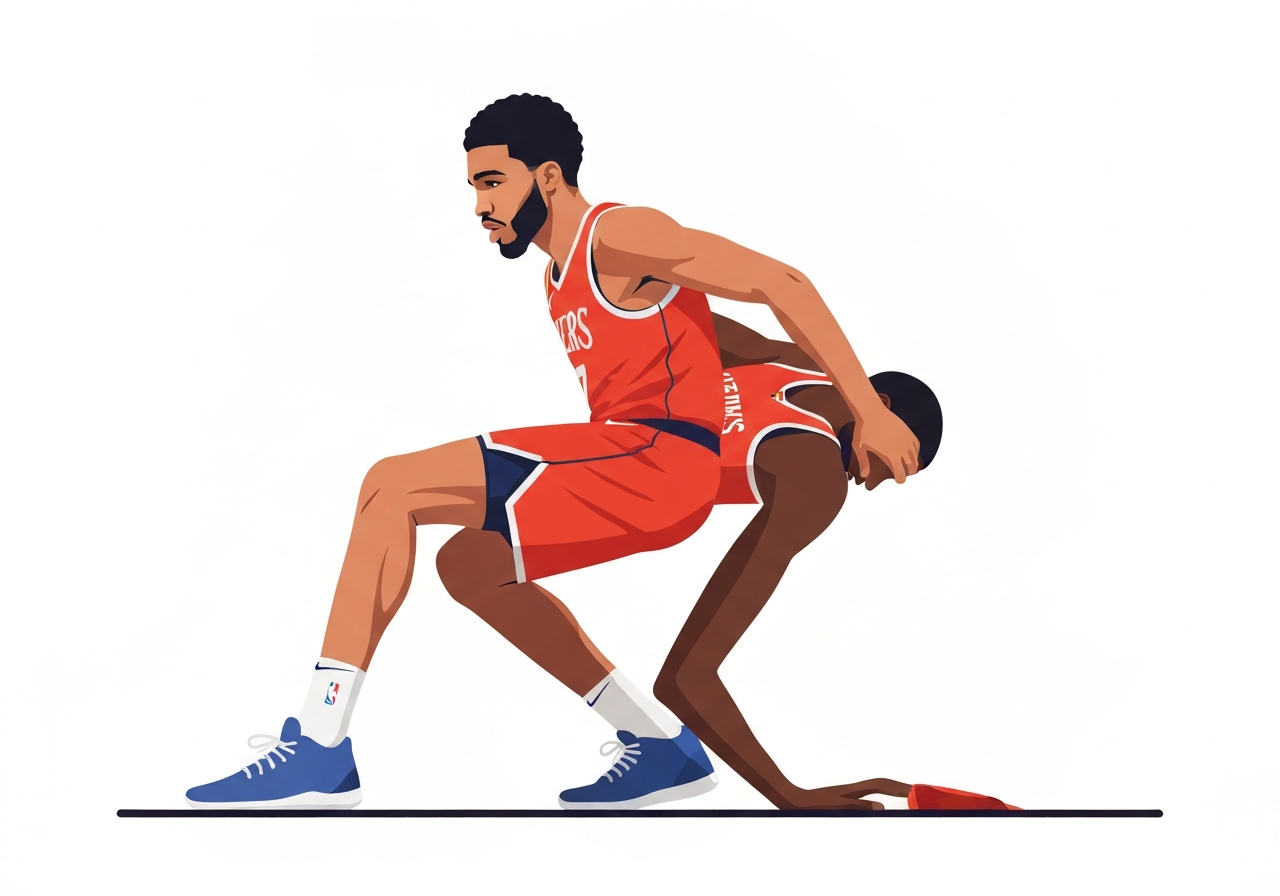
Jayson Tatum returned to action this week after rupturing his Achilles last season, appearing in his second game Sunday — 298 days after his previous NBA outing — and helping the Boston Celtics win on the road in Cleveland. He made his season debut Friday at home against the Dallas Mavericks and followed with a steadier performance against a playoff-bound Cavaliers team on Sunday. Tatum’s visible joy — grinning, high-fiving and thanking teammates — underscored how unusual his rapid comeback feels. Whether his early return represents a genuine shift in how the league handles Achilles ruptures, or a risky shortcut, remains an open question.
Key takeaways
- Jayson Tatum returned to game action 298 days after suffering a ruptured Achilles and has played two games this season (debut Friday vs. Dallas, second game Sunday at Cleveland).
- The Celtics, who altered their roster substantially over the summer, are contending for a top seed in the Eastern Conference; Jaylen Brown has emerged as an MVP candidate while Boston sits only a few games behind the conference leaders.
- Kevin Durant’s Achilles rupture occurred on June 2, 2019; he chose a long recovery path and did not compete seriously for 552 days before resuming playoff-level competition.
- Kobe Bryant ruptured his Achilles in April 2013 and was practicing by November of that year (roughly seven months), but he suffered a tibia fracture six games into his return after a heavy early-minute workload.
- Other recent cases show differing strategies: some players (Damian Lillard, Tyrese Haliburton) have signaled longer absences, while Tatum pursued an accelerated timeline from the outset.
- Medical reality: tendons are surgically repaired and then require staged healing and progressive strengthening; the timeline and workload management after return strongly influence re-injury risk and longer-term function.
- Tatum’s upbeat postgame remarks — including “I’m just happy to be out here” — highlight both personal relief and the emotional boost his presence offers the Celtics.
Background
The Achilles rupture has long been viewed as one of basketball’s most devastating injuries because it strikes the muscle–tendon unit that powers explosive movement. High-profile examples have shaped that view: Kobe Bryant’s 2013 tear and the difficult decline that followed for parts of his final seasons cast a long shadow. Medical teams now understand tendon repair mechanics better than in prior decades, but returning to high-level cutting, jumping and load-bearing activity still requires careful, staged rehabilitation.
Teams’ roster decisions and competitive context shape the stakes of any return. Boston underwent a notable summer overhaul, moving several regular starters and most of its rotation minutes elsewhere, yet still finds itself in the hunt for an Eastern Conference top seed under coach Joe Mazzulla. That means Tatum is not slipping into a low-pressure rehab year; he is re-entering as a primary starter while the Celtics pursue a deep playoff run, raising questions about minutes management and competitive risk.
Main event
Tatum’s first game back came Friday at home against the Dallas Mavericks, his first NBA minutes in 298 days. Observers described him as a bit unsteady but serviceable; the focus was less on production and more on movement patterns and confidence. Two days later in Cleveland, a tougher opponent and a hostile road environment, he appeared more assured and more comfortable attacking the floor.
Across both outings Tatum wore a visibly buoyant demeanor, celebrating plays, trading high-fives and greeting fans. His succinct postgame take captured the mood: he said he was simply “happy to be out here, playing on a team with the guys, competing, making plays, making mistakes.” That tone contrasted with the grim scene many players recall immediately after an Achilles pop.
The Celtics coaching staff and medical team now face practical choices: how quickly to expand his minutes, when to reinstate typical starter workloads and how to balance short-term competitive desire with long-term availability. Those decisions will shape whether this comeback becomes a model or a cautionary tale.
Analysis & implications
There are two interlocking questions: first, can modern surgical technique and rehabilitation materially change expected outcomes after an Achilles rupture; second, does a faster calendar return necessarily equate to the best long-term result? Advances in fixation methods, guided rehabilitation protocols and sport-specific conditioning have improved early outcomes, but evidence about elite, post-rupture performance remains mixed and largely anecdotal at the superstar level.
History offers divergent templates. Kevin Durant opted for a prolonged, conservative timeline after his June 2, 2019 rupture and ultimately returned to All-NBA-level performance, though it took well over a year and a half before he felt fully himself. Kobe Bryant’s earlier return within the same calendar year preceded an additional lower-leg injury that curtailed his effectiveness. Those different outcomes argue that both patience and individualized load management matter more than a single universal timeline.
Tatum’s aggressive push to return quickly reflects a player-specific calculus — desire to rejoin a competitive roster, confidence in medical care, and a personal tolerance for risk — but it cannot settle the broader clinical debate. If he performs at or near his pre-injury level over a full season, clinicians and teams will likely revisit protocols and expectations for elite athletes. If he suffers setbacks, the narrative will swing the other way: fastest is not the same as safest.
Comparison & data
| Player | Rupture date | Days to first return | Approach |
|---|---|---|---|
| Jayson Tatum | 2024 (season-ending rupture) | 298 days (to first game) | Rapid return within the season |
| Kevin Durant | June 2, 2019 | ~552 days (no serious competition for ~552 days) | Extended recovery, gradual reintroduction |
| Kobe Bryant | April 2013 | ~7 months (practiced by November 2013) | Early return, followed by another lower-leg injury |
The table summarizes the contrasting timelines. Context matters: days to return are only one metric; minutes load, physical testing benchmarks, and sport-specific capacity must also be considered. Small-sample superstar cases cannot define standard care, but they strongly influence teams’ risk tolerance and public perception.
Reactions & quotes
“I’m just happy to be out here, playing on a team with the guys, competing, making plays, making mistakes,”
Jayson Tatum, postgame
That quote encapsulated the emotional relief of a star resuming his career. Teammates and fans responded enthusiastically, viewing the immediate impact through both competitive and symbolic lenses.
“That’s what I was thinking… because that’s all I was hearing, that this shit is over,”
Kevin Durant, recalling his reaction after his 2019 Achilles rupture (ESPN interview)
Durant’s memory underscores the historical fear linked to a ruptured Achilles and the psychological hurdle players must overcome even after a successful physical recovery.
Unconfirmed
- Long-term performance: it is not yet known whether Tatum’s scoring, efficiency and durability will match pre-injury levels over a full season.
- Re-injury risk: no conclusive public data yet links Tatum’s accelerated timeline to either higher or lower re-injury probability in his case.
- Minutes management plan: the Celtics’ internal schedule for ramping Tatum’s minutes has not been publicly finalized and may change depending on game-to-game responses.
Bottom line
Tatum’s fast return is both remarkable and diagnostically ambiguous. On one hand, surgical and rehabilitative advances and individualized care likely contributed to his ability to return in under 300 days; on the other hand, historical examples caution that calendar speed does not automatically equal durable success. The immediate effect is a morale and roster boost for a Celtics team competing for a top seed.
What unfolds over the coming months — minutes, performance metrics, absence of setbacks — will determine whether this moment becomes a turning point in how the NBA treats Achilles ruptures or remains an outlier in a spectrum of outcomes. For now, observers should separate factual reporting from projection and watch the data accumulate before drawing firm conclusions.
Sources
- Defector — news analysis and game reporting (original article).
- ESPN — media outlet; source of Kevin Durant interview and broader reporting on Achilles recoveries (searchable articles by Baxter Holmes and others).
- American Orthopaedic Foot & Ankle Society — medical/academic resource on tendon repair and rehabilitation protocols.