
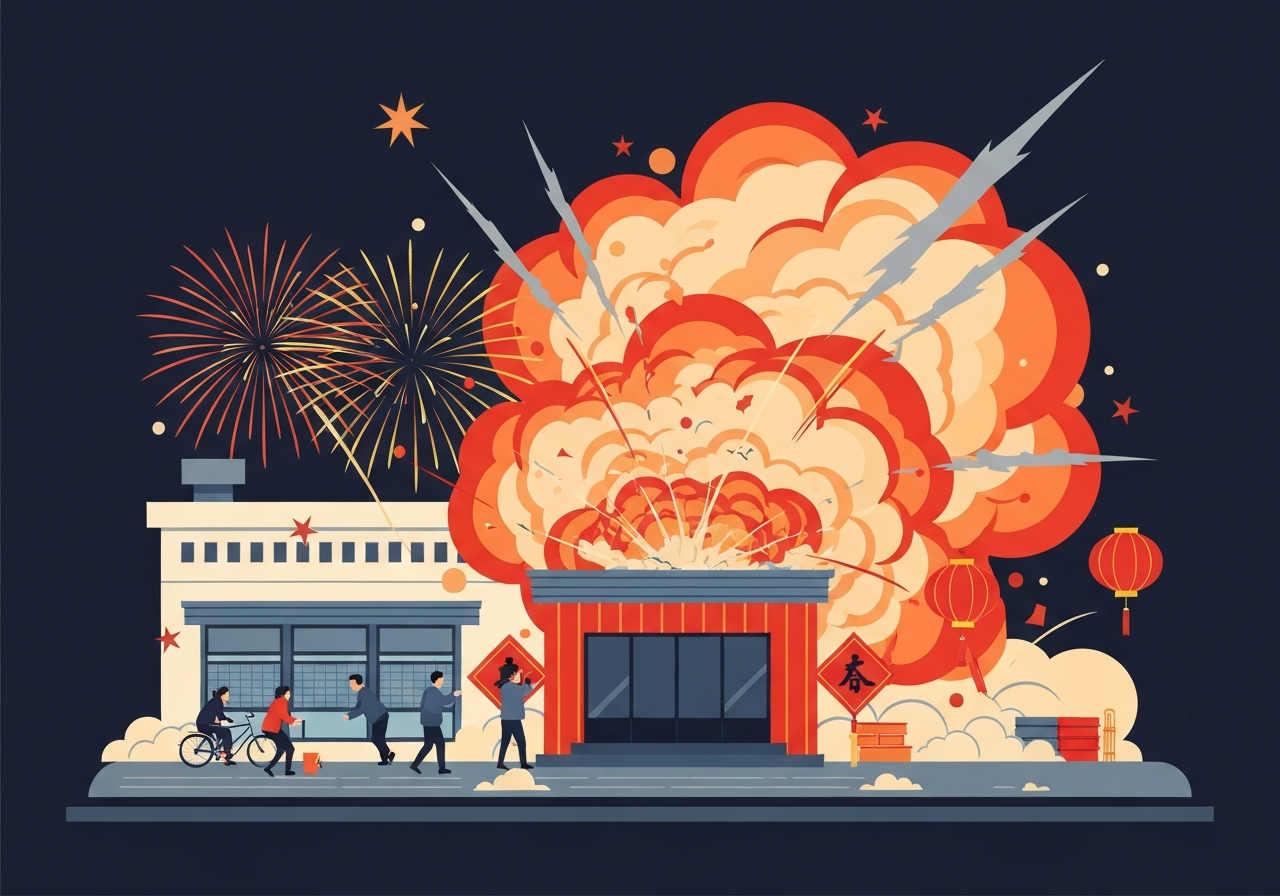
At least eight people were killed and two others suffered minor burns after a large explosion tore through a fireworks shop in a village in Donghai County, Jiangsu province, on Sunday afternoon. Local authorities said the blast followed a resident igniting pyrotechnics too close to the store, and emergency, fire and health teams were dispatched immediately. The incident occurred just days before Lunar New Year celebrations — traditionally a peak period for fireworks sales and use — prompting a nationwide response from the Ministry of Emergency Management. Officials ordered stricter controls on production, transport and retail of fireworks and urged local governments to remove safety blind spots ahead of the Spring Festival.
Key Takeaways
- Fatalities: At least eight people were killed in a fireworks shop explosion in Donghai County, Jiangsu province.
- Injuries: Two additional people were reported with minor burns and received medical attention.
- Cause (reported): Donghai county authorities said a resident set off pyrotechnics too close to the store on Sunday afternoon; an official investigation is ongoing.
- Immediate response: Emergency management, fire, public security and health teams were sent to the scene to carry out rescue and response operations.
- Regulatory action: China’s Ministry of Emergency Management ordered tighter controls on the production, transport and sale of fireworks on Monday.
- Timing: The blast occurred days before Lunar New Year (Spring Festival), when millions prepare to use fireworks.
- Enforcement: Officials called for strengthened patrols and vowed to punish violations related to testing or selling fireworks near retail stores.
Background
Fireworks are a longstanding part of Lunar New Year celebrations across China, where lighting firecrackers at midnight remains a common tradition. In recent years, many cities have restricted or banned fireworks to reduce air pollution and public-safety risks; however, some local governments eased bans last year, allowing more displays and sales in certain areas. That mix of relaxed local rules and the seasonal surge in demand raises the volume of retail activity and informal testing of pyrotechnics near homes and shops.
China is home to a large fireworks manufacturing and retail sector, often concentrated in eastern provinces such as Jiangsu and Hunan. Regulatory oversight is decentralized: national ministries set standards and local authorities implement inspections and patrols. Past incidents — including equipment failures, unsafe storage and on-site testing — have repeatedly prompted temporary crackdowns and revisions to safety guidance.
Main Event
According to a statement from the Donghai county government, the explosion happened on Sunday afternoon when a resident ignited pyrotechnics in proximity to a fireworks retail outlet. The blast destroyed parts of the shop and produced a significant emergency response as local fire and medical teams moved to evacuate the area and treat the wounded. Preliminary on-site accounts reported multiple casualties; officials have so far confirmed at least eight deaths and two minor burn injuries.
The county government said emergency management, fire, public security and health authorities carried out rescue and response operations immediately after the explosion. Local police have secured the scene while investigators from relevant departments collect evidence to determine the exact sequence of events, storage conditions and whether safety rules were breached. The investigation timeline and potential criminal or administrative charges have not yet been disclosed.
In response to the blast, China’s Ministry of Emergency Management issued directives on Monday asking local governments to tighten supervision of fireworks production, transport and retail. The ministry specifically warned that testing firecrackers near shops must be strictly prohibited and urged elimination of safety blind spots to protect citizens during the Spring Festival period.
Analysis & Implications
The incident highlights persistent tensions between cultural practices, local economic interests and public-safety priorities. With the Lunar New Year driving sharp seasonal demand, retailers and consumers often face pressure to procure and test pyrotechnics quickly, increasing the risk of unsafe handling or storage. Relaxed local enforcement in some areas can further amplify that risk when oversight resources are limited.
Policy implications include a likely short-term tightening of inspections, temporary bans in high-risk zones and stricter controls on wholesale and retail distribution chains. The ministry’s directive signals an intent to centralize oversight for the holiday period, but effective enforcement will require coordination between national agencies and county-level authorities that manage day-to-day inspections.
Economically, small retailers and licensed manufacturers may face operational disruptions if stricter transport or sales restrictions are imposed. Conversely, stricter enforcement could reduce accidents and reassure the public, potentially changing consumption patterns for the Spring Festival. For emergency services, repeated incidents underline the need for quicker response capabilities and community-level safety education ahead of major holidays.
Comparison & Data
| Incident | Location | Fatalities | Injuries | Notes |
|---|---|---|---|---|
| Donghai fireworks shop explosion | Donghai County, Jiangsu | At least 8 | 2 (minor burns) | Occurred Sunday before Lunar New Year; investigation ongoing |
| Liuyang display mishap (reported) | Liuyang city | 0 (authorities reported no injuries) | Minor local fires extinguished | Large display malfunctioned in October; dramatic footage circulated |
| Champagne-sparkler nightclub fire (abroad) | Swiss bar (reported) | 41 | Multiple | Used here as an international reminder of pyrotechnic risks |
The table places the Donghai blast in context with other pyrotechnics accidents cited in media reports. While the human toll in Donghai is severe, the scale, causes and regulatory contexts differ across incidents. Comparative data underscore that both consumer misuse and event-level failures can produce catastrophic outcomes, reinforcing the case for robust pre-event inspection and strict retail controls.
Reactions & Quotes
Local and national authorities moved quickly to characterize the event and set immediate policy priorities. County officials emphasized rapid rescue efforts and said multiple departments were mobilized to handle the aftermath.
“Emergency management, fire, public security and health teams were dispatched promptly to carry out rescue and response work,”
Donghai county government (local authority statement)
The national ministry framed the incident as preventable and ordered steps to reduce similar risks during the Spring Festival period.
“Local governments must eliminate safety blind spots and prevent recurrence of similar incidents,”
Ministry of Emergency Management (official directive)
Public response on social media and local channels reflected shock and calls for stricter enforcement of fireworks safety rules, especially during a high-sales period for the holiday.
“People expect a safe Spring Festival; enforcement now must match that expectation,”
Local safety expert (paraphrased commentary)
Unconfirmed
- The precise sequence that led to ignition (how and why the resident tested pyrotechnics near the shop) remains under official investigation and has not been independently verified.
- Final casualty figures could change as investigators and hospitals reconcile records and identify victims, so the reported toll is provisional.
- Details on any criminal charges, licensing violations by the retailer, or responsibility assignments have not yet been released publicly.
Bottom Line
The Donghai County explosion is a stark reminder that cultural traditions combined with relaxed oversight and seasonal demand can create lethal conditions. With at least eight people dead and two injured, authorities have signaled a rapid regulatory response aimed at preventing similar tragedies during the Spring Festival.
Readers should expect follow-up reporting as investigators publish findings and local governments implement or intensify controls. The key indicators to watch are the official investigation results, any announced enforcement measures or temporary bans, and whether inspections reduce accidents during the remainder of the holiday period.
Sources
- The Sun — news report summarizing local statements and media coverage
- Ministry of Emergency Management of the People’s Republic of China — official ministry website (national directive and safety guidance)