
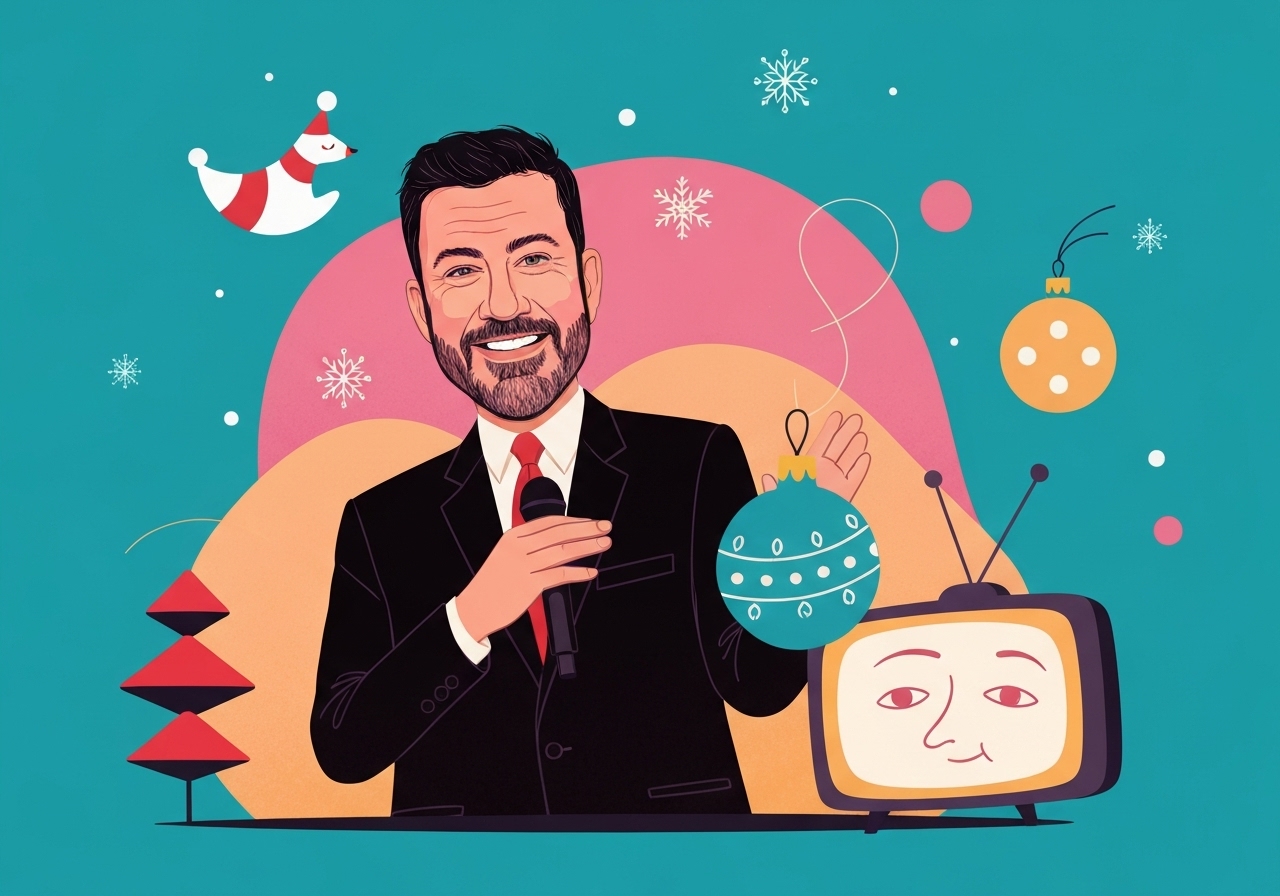
Lead: Jimmy Kimmel, the American late-night host, will deliver Channel 4’s alternative Christmas message on Dec. 25, 2025, at 5:45 p.m., the broadcaster announced. In the address he is scheduled to condemn fascism and reflect on free-speech debates that followed a suspension of his ABC show in September. The appointment places an American late-night figure at the centre of a distinctly British holiday ritual and revives discussion about the line between satire, politics and broadcast norms. Channel 4 framed the slot as Kimmel’s chance to offer “personal reflections on the year.”
Key Takeaways
- Jimmy Kimmel will deliver Channel 4’s alternative Christmas message on December 25, 2025, scheduled for 5:45 p.m. (broadcaster announcement).
- Channel 4 says Kimmel will address fascism and free speech; the broadcaster described the segment as his “personal reflections on the year.”
- Kimmel’s ABC program was suspended in September after comments about the man accused of fatally shooting conservative activist Charlie Kirk; the suspension lasted about one week before the show was reinstated.
- The alternative message is a Channel 4 tradition first broadcast in 1993 as a counterpoint to the royal Christmas address, which airs at 3 p.m. on BBC.
- Past alternative presenters have included Jesse Jackson (1994), Tom Daley, Stephen Fry, Mahmoud Ahmadinejad and Edward Snowden — an intentionally eclectic list reflecting varied political and cultural perspectives.
Background
Channel 4 introduced the alternative Christmas message in 1993 as satirical counterprogramming to the monarch’s televised Christmas broadcast, a long-standing BBC ritual. The royal message, delivered at 3 p.m. on Christmas Day, is traditionally solemn and aimed at the Commonwealth; the Channel 4 alternative was designed to offer a different voice and, at times, deliberate provocation. Over three decades the alternative slot has been used by politicians, activists, entertainers and controversial figures to spotlight causes, lampoon authority or refract the year’s events through an unconventional lens.
The appointment of Jimmy Kimmel, an American late-night host, follows a year in which his own standing in U.S. broadcasting was briefly contested. In September 2025 ABC suspended Kimmel’s show after remarks he made about the man accused of killing conservative activist Charlie Kirk; the network reinstated the program after roughly a week, a sequence that rekindled wider debates about platforming, accountability and free expression. Channel 4’s selection signals both a deliberate editorial choice and the broadcaster’s appetite for a high-profile voice who can prompt national conversation on Christmas Day.
Main Event
Channel 4 announced on Sunday that Kimmel will deliver the 2025 alternative Christmas message, saying he will “share his personal reflections on the year” and speak directly against fascism. The broadcaster set the slot for 5:45 p.m. on December 25, placing Kimmel’s address later in the day than the BBC royal broadcast. Channel 4 characterizes the segment as in the spirit of the alternative message’s history — sometimes satirical, sometimes earnest — and suited to an audience expecting a divergent take from the monarchy’s annual remarks.
In its statement the channel relayed a line attributed to Kimmel’s prepared remarks that frames the address’s tone: “From a fascism perspective, this has been a really great year,” the report said, a provocative formulation intended to spark debate rather than to celebrate. The broadcaster did not release a full script in advance; it said the address will combine personal observation and commentary on political trends. Channel 4 has previously used the slot to feature personalities whose selection prompted national discussion, from civil-rights leaders to exiled whistle-blowers.
For Kimmel, the invitation represents both a restoration of public profile outside the U.S. and an opportunity to re-engage audiences after the September suspension episode. The ABC suspension — and the swift reinstatement — amplified domestic controversy over broadcast practices and put Kimmel at the center of a high-profile free-speech conversation. Presenting Channel 4’s alternative message places him in a tradition that intentionally courts the cultural and political mainstream while offering dissenting viewpoints.
Analysis & Implications
The choice of an American late-night host for a British alternative ritual underscores how globalized media personalities have become cultural interlocutors across national debates. Kimmel’s presence will likely sharpen questions about national voice: whether an imported satirist can credibly critique U.K. politics and social trends on one of the country’s most watched holiday platforms. That dynamic may broaden the address’s audience but also risks domestic pushback from viewers who prefer the alternative message be locally sourced.
On the free-speech front, the appointment arrives amid renewed attention to broadcast governance and content moderation. Kimmel’s September suspension and rapid reinstatement in the U.S. highlighted the tensions broadcasters face when balancing public accountability, advertiser pressures and creative freedom. Channel 4’s editorial decision to host Kimmel may be read as a statement about the network’s willingness to foreground contested viewpoints during a high-visibility slot.
Politically, Kimmel’s planned denunciation of fascism engages a charged set of contemporary debates about extremism, populism and political rhetoric in both Britain and the United States. If delivered in strongly partisan terms, the message could mobilize critics and supporters alike; if measured and reflective, it could redirect Christmas-day viewership toward civil discourse. Either outcome reinforces the alternative message’s role as a platform where cultural and political currents are contested in a broadcast forum.
Comparison & Data
| Item | Detail |
|---|---|
| Alternative message introduced | 1993 (Channel 4) |
| Notable early guest | Jesse Jackson — 1994 |
| Other prominent presenters | Tom Daley; Stephen Fry; Mahmoud Ahmadinejad; Edward Snowden |
The table summarises the slot’s origin and a sample of past presenters to show the program’s eclectic history. Channel 4 has used the alternative message to platform figures whose prominence or notoriety guarantees conversation; its roster reflects a deliberate editorial mix of politics, celebrity and dissent. The episode with Kimmel continues that pattern by pairing a high-profile entertainer with explicitly political subject matter.
Reactions & Quotes
Channel 4 framed the appointment as an opportunity for reflection and debate ahead of Christmas Day, noting Kimmel will speak about the year and issues of democratic concern. The phrasing signaled the broadcaster’s intent to combine provocation with commentary rather than simple comedy.
“From a fascism perspective, this has been a really great year,”
Channel 4 spokesman, quoting Jimmy Kimmel’s planned line
The remark — relayed by the broadcaster — is brief and intentionally provocative; Channel 4 positioned it as part of a broader address that will mix personal observation with political commentary. The comment is likely to attract immediate attention and spur responses from politicians, commentators and viewers.
“He will share his personal reflections on the year,”
Channel 4 spokesman
Channel 4’s second shorthand description emphasizes the program’s reflective component. The network did not publish a full script or an extended statement from Kimmel, which leaves room for interpretation about the address’s precise mix of satire and serious commentary.
Unconfirmed
- Exact content of Kimmel’s full script has not been released; specifics about named targets or policy proposals remain unconfirmed.
- Whether the broadcast will prompt organized protests or coordinated political responses on Christmas Day is unknown at this time.
Bottom Line
Channel 4’s invitation to Jimmy Kimmel merges an American late-night voice with a distinctly British broadcast tradition, ensuring the 2025 alternative Christmas message will be widely watched and widely debated. Kimmel’s planned denunciation of fascism and remarks about free speech position the address at the intersection of cultural commentary and political argument — a place likely to generate strong reactions from across the spectrum.
Observers should watch for how the message is received in the U.K. versus the U.S., and whether Channel 4’s editorial choice influences other broadcasters’ holiday programming choices in future years. For viewers, the address underscores that what began as a satirical counterpoint now functions as a barometer of contemporary tensions over speech, authority and media responsibility.
Sources
- The New York Times — news report
- Channel 4 — official broadcaster (announcement cited)