
Lead
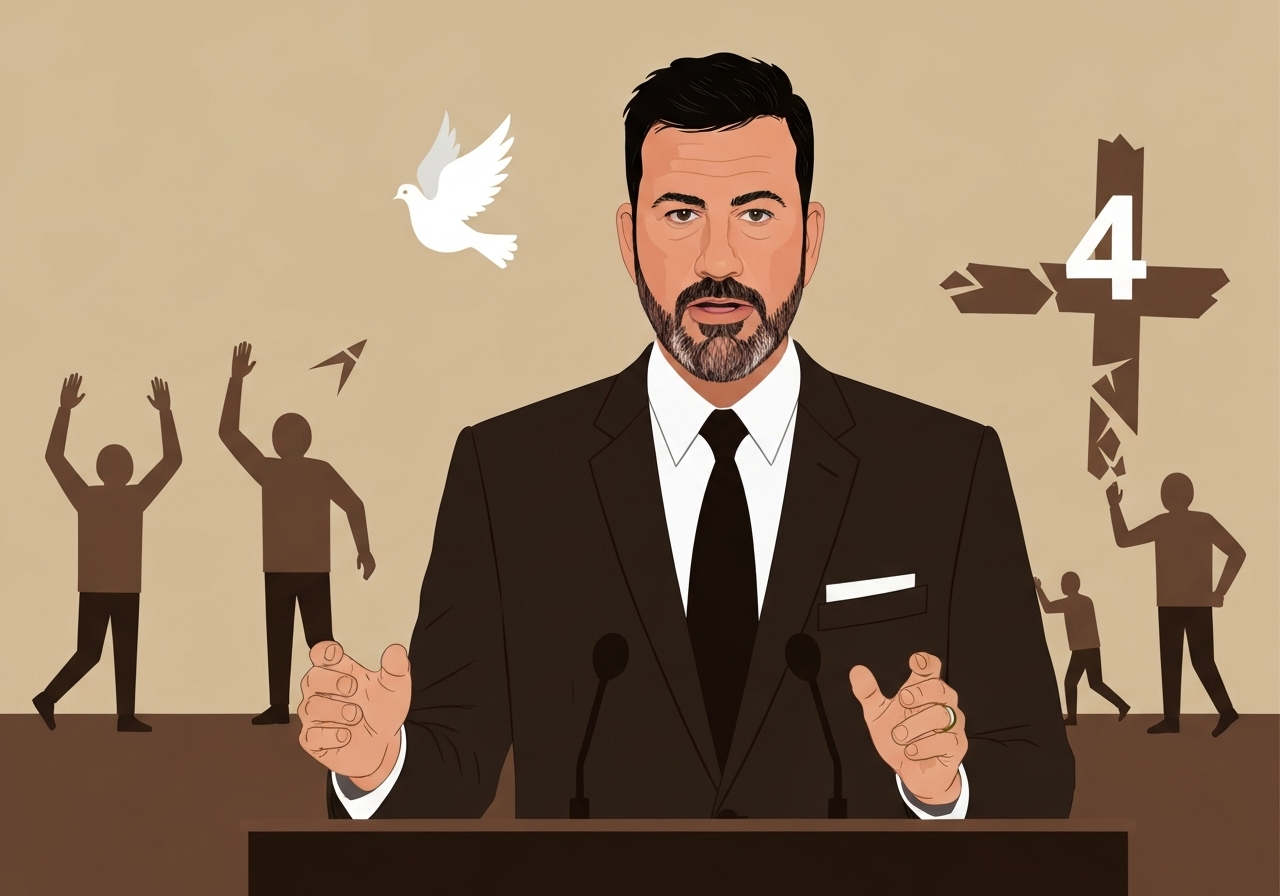
On Christmas Day, U.S. late-night host Jimmy Kimmel delivered Channel 4’s Alternative Christmas Message to British viewers, using the platform to warn about a rise of fascism in the United States. Speaking from London, Kimmel singled out President Donald Trump and the broader political climate of his second term, saying democratic institutions were under strain. The address followed a high-profile September suspension of Kimmel’s ABC show after his remarks about the killing of conservative activist Charlie Kirk; the program returned to air within a week. Kimmel framed the episode as evidence that public defense of free speech had pushed back against attempts to silence critics.
Key Takeaways
- The address aired on Channel 4 in the U.K. on Christmas Day and joined a tradition Channel 4 began in 1993 of broadcasting an alternative message alongside the monarch’s address.
- Kimmel said, “From a fascism perspective, this has been a really great year,” and added that “tyranny is booming over here,” directly criticizing President Trump’s second term rhetoric and actions.
- In September, ABC indefinitely suspended “Jimmy Kimmel Live!” after Kimmel suggested some Trump supporters sought to capitalize on the killing of Charlie Kirk; the program resumed broadcasting in under one week.
- President Trump publicly hailed the suspension as “great news for America” and urged other late-night hosts be fired, amplifying concerns about press freedom.
- Channel 4 has previously used the Alternative Christmas Message for controversial or provocative voices, including whistle-blower Edward Snowden and former Iranian President Mahmoud Ahmadinejad.
- Kimmel apologized to British viewers for turmoil in the U.S., referencing the East Wing demolition at the White House and warning that democratic norms were eroding.
Background
Channel 4 launched the Alternative Christmas Message in 1993 to offer a counterpoint to the monarch’s annual broadcast, often inviting figures with strong or unconventional views to reflect on the year’s events. Over three decades the slot has become a consciously provocative platform used to spotlight human-rights questions, state secrecy and geopolitical tensions. In recent years, the program has featured speakers whose selections sparked debate about platforming divisive figures versus the value of free expression.
In the United States, the second term of President Donald Trump marked continued polarization over institutions including the press, judiciary and scientific bodies. Late-night hosts have remained prominent critics of the president, and clashes between the White House and media personalities have raised broader debates about censorship, deplatforming and the limits of political satire. The September suspension of Kimmel’s show after remarks tied to Charlie Kirk’s killing intensified those debates, prompting responses from across the entertainment industry in defense of speech protections.
Main Event
Kimmel used Channel 4’s platform to deliver a direct, satirical critique of U.S. political leadership, repeatedly framing his observations as warnings about democratic backsliding. He singled out the concentration of power and repeated attacks on independent institutions, saying that the U.S. was “both figuratively and literally tearing down the structures of our democracy,” and linking his remarks to visible changes at the White House property.
The comic acknowledged he did not expect many British viewers to know his work, then leaned into a frank appeal: do not mistake attempts to silence critics as problems confined to other authoritarian states. He contrasted the longstanding Anglo-American relationship with the current turbulence in U.S. politics, imploring the U.K. not to write off America despite recent unrest.
Kimmel also revisited the September controversy: he characterized the public reaction that pushed ABC to reverse an indefinite suspension as a “Christmas miracle,” crediting millions of people — including some who had previously disliked his work — for speaking up in favor of free speech. He framed his return to nightly television as an opportunity to hold the most powerful politician on earth to account.
Analysis & Implications
Kimmel’s Channel 4 address illustrates how late-night comedy remains an influential vehicle for political critique, crossing national boundaries and shaping international perceptions of U.S. governance. When a widely viewed entertainer frames domestic political developments as a threat to democratic norms, it amplifies both domestic outrage and foreign concern, particularly among allied audiences already attuned to institutional erosion.
For the U.K., airing a U.S. comedian’s warning about American democracy carries dual implications: it reinforces anxieties in Britain about spillover effects on international institutions and public discourse, while underscoring the broadcaster’s editorial choice to elevate dissenting voices. That choice also renews questions about journalistic responsibility when giving airtime to partisan satire versus expert analysis.
Domestically in the U.S., the incident around Kimmel’s suspension — and the industry pushback that followed — served as a live test of corporate and civic limits on speech. The rapid reversal of ABC’s suspension showed the reputational and commercial pressures networks face when balancing political backlash and free-expression principles. In the longer term, repeated high-profile clashes risk normalizing punitive responses to contentious speech and could chill outspoken commentary if left unchecked.
Comparison & Data
| Speaker | Role or Notability | Theme |
|---|---|---|
| Edward Snowden | Whistle-blower | State surveillance and secrecy |
| Mahmoud Ahmadinejad | Former Iranian President | Controversial geopolitical views |
| Jimmy Kimmel | U.S. late-night host | Democracy, press freedom, satire |
Channel 4’s Alternative Christmas Message has, since 1993, been used intermittently to spotlight voices that provoke public debate rather than to present official state messaging. That editorial tradition helps explain the presence of figures like Snowden, Ahmadinejad and Kimmel in the same lineage: each selection was intended to spark discussion rather than provide consensus commentary.
Reactions & Quotes
Official and public responses to Kimmel’s address were mixed, spanning defense of free expression to criticism of partisan rhetoric. Industry figures highlighted concerns about press freedom after the September suspension, while some political allies of the president framed the episode as justified accountability.
“From a fascism perspective, this has been a really great year. Tyranny is booming over here.”
Jimmy Kimmel
In context, Kimmel used hyperbolic phrasing to underscore his critique of institutional attacks and to galvanize support for media independence.
“Great news for America.”
Donald J. Trump
President Trump’s comment celebrated ABC’s suspension of Kimmel and signaled calls for further consequences for critics; the remark intensified debates around retaliation against media figures.
“We are a right mess, and we know this is also affecting you, and I just wanted to say sorry.”
Jimmy Kimmel
Kimmel closed portions of his address with an apology to British viewers, acknowledging the cross-border reputational damage from U.S. political turmoil.
Unconfirmed
- Kimmel’s claim that “millions” of people spoke up in September is Kimmel’s characterization and has not been independently quantified in this report.
- Suggestions that “many Trump supporters” sought to capitalize on Charlie Kirk’s killing reflect Kimmel’s interpretation of events and are not established as a verified, quantified pattern here.
- Descriptions of a measurable rise in “fascism” are Kimmel’s political assessment; this article treats that as commentary rather than an empirically validated trend.
Bottom Line
Jimmy Kimmel’s Alternative Christmas Message on Channel 4 turned a festive broadcast slot into a pointed critique of U.S. political leadership and a defense of press freedom. By invoking the language of fascism and institutional erosion, Kimmel sought to elevate concern among an international audience and to frame his September suspension as a test of public commitment to free expression.
Whether the address shifts diplomatic or public opinion in the U.K. is uncertain, but the episode underlines how media figures can influence transatlantic perceptions of democratic stability. Observers should watch for further actions by broadcasters, political figures and civil-society groups that will determine whether such clashes harden into lasting constraints on outspoken commentary or reinforce protections for dissent.