
Lead
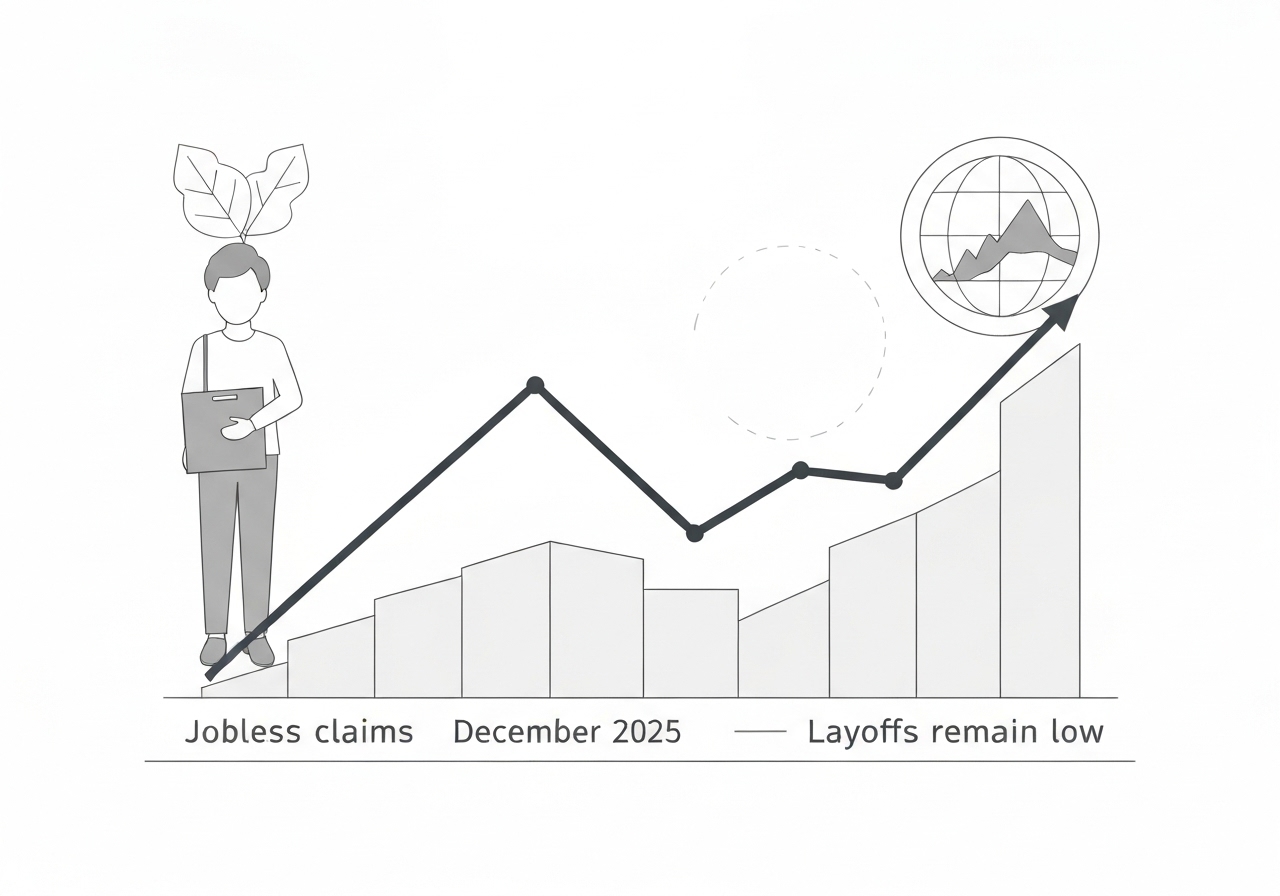
U.S. filings for unemployment benefits ticked up in the final reported week around the turn of the year, rising by 8,000 to 208,000 for the week ending Jan. 3, 2026. The Labor Department released the data on Thursday, Jan. 8, 2026, and the print matched expectations from analysts surveyed by FactSet. Despite the weekly increase, the four-week moving average declined to 211,750, and overall layoffs remain near historically low levels. The mixed signals underscore a labor market that shows signs of softening while still avoiding a broad uptick in job separations.
Key Takeaways
- Initial claims rose 8,000 to 208,000 for the week ending Jan. 3, 2026, up from 200,000 the prior week.
- The four-week average, which smooths weekly volatility, fell by 7,250 to 211,750.
- Analysts polled by FactSet had expected the 208,000 reading, indicating the release was largely in line with market consensus.
- The Labor Department reported that filings for the week ending Dec. 27 jumped by 56,000 to 1.91 million, a separate spike noted in the same release.
- Economists treat initial claims as a near-real-time proxy for layoffs and a leading indicator of labor-market stress.
- Despite the uptick in one week, absolute claim levels remain low by historical standards, limiting immediate evidence of widespread layoffs.
Background
Initial unemployment claims are a weekly count of people filing for jobless benefits for the first time and are closely watched as a timely gauge of labor-market health. Since the recovery from the pandemic-era disruption, claims have trended well below historical averages, reflecting strong hiring and relatively few mass layoffs. Policymakers and markets watch both the single-week reading and the four-week moving average to distinguish one-off spikes from sustained trends. Data firms such as FactSet regularly poll analysts ahead of the Labor Department release, so an in-line print like this typically produces only modest market reaction.
Seasonality and administrative factors can produce short-lived swings in the weekly counts, which is why the four-week average is highlighted in official commentary. Employers have shown caution in recent quarters amid inflation and shifting demand patterns, but this caution has not translated into a persistent rise in initial claims. The Labor Department’s weekly releases therefore serve multiple audiences: economists tracking early signs of layoffs, employers benchmarking labor conditions, and policymakers assessing the broader economic trajectory.
Main Event
The Labor Department’s report dated Jan. 8, 2026, shows 208,000 initial claims for the week ending Jan. 3, an increase of 8,000 from the previous week’s 200,000. The four-week moving average declined to 211,750, down 7,250 from the prior average, suggesting the uptick was not yet signaling a sustained deterioration. The weekly release also noted that filings for the week ending Dec. 27 rose sharply by 56,000 to 1.91 million, a separate movement that the agency highlighted in its tables.
Analysts surveyed by FactSet had anticipated the 208,000 print, and the expectation alignment reduced surprise in financial markets. The Labor Department’s summary described the data as a snapshot of weekly activity, not a definitive measure of longer-term trends. Market observers noted that while single-week volatility is common, the persistent low level of claims keeps the signal for widespread layoffs weak.
Regional and sectoral differences often underlie weekly swings, with some industries more exposed to cyclical shifts in demand. The Labor Department data do not attribute causes at the industry level in the headline tables, but private analysts monitor industry filings for signs of concentrated job cuts. For now, the combination of a modest weekly rise and a falling four-week average creates a nuanced picture: some softening alongside continued resilience.
Analysis & Implications
Initial claims are an early warning system for layoffs; a sustained rise typically precedes broader weakness in payrolls. The current readings—208,000 in the latest week and a four-week average of 211,750—remain low compared with many historical episodes of labor-market stress, implying that employers have not yet embarked on large-scale workforce reductions. That persistence of low claims helps explain why hiring metrics and unemployment rates have not shown abrupt deterioration in recent months.
For policymakers, the pattern matters because the Federal Reserve and other decision-makers monitor labor-market tightness when assessing inflationary pressures. A labor market that cools gradually can reduce wage pressures without triggering a sharp employment downturn. The latest data, therefore, support a view of gradual normalization rather than acute weakening, though they do not rule out sector-specific or regional disruptions.
Economists will watch subsequent weekly releases for confirmation. If initial claims drift higher for several consecutive weeks and the four-week average rises, the signal would strengthen that layoffs are increasing. Conversely, continued low readings would reinforce the interpretation that employers remain reluctant to cut payrolls despite slower hiring. The market implications extend to consumer spending, business investment, and borrowing costs, all of which are sensitive to labor-market confidence.
Comparison & Data
| Metric | Week Ending Jan. 3, 2026 | Prior Week / Recent |
|---|---|---|
| Initial claims | 208,000 | 200,000 (prior week) |
| Four-week average | 211,750 | 219,000 (approx. prior average) |
| Filings (week ending Dec. 27) | 1.91 million | 1.85 million (prior) |
The table above highlights the headline numbers from the Labor Department release. Comparing the single-week figure with the four-week average shows why analysts emphasize the latter: it reduces weekly noise from holiday patterns, administrative processing, and temporary sector-specific adjustments. While the Dec. 27 spike to 1.91 million merits attention, it does not by itself signal a sustained national wave of layoffs without follow-through in subsequent weeks.
Reactions & Quotes
“Initial claims remain near historically low levels even with this modest weekly uptick,”
U.S. Department of Labor (official summary)
The Labor Department framed the release as part of routine weekly reporting, noting both the single-week movement and the smoothing effect of the four-week average. Officials and economists underscored that the data are timely but require trend confirmation.
“The reading was largely in line with expectations, signalling mixed momentum in the labor market,”
FactSet (data firm)
FactSet’s survey of analysts meant the 208,000 number produced limited surprise, and market commentary emphasized the importance of watching multi-week patterns rather than isolated weeks.
“A few sectors may be adjusting staffing, but the headline numbers do not yet point to widespread layoffs,”
Independent labor economist (summary)
Independent analysts noted that industry-specific pressures—rather than a broad retrenchment—are the likeliest near-term explanation if further weakness appears.
Unconfirmed
- Whether the Dec. 27 jump to 1.91 million reflects reporting or administrative backlogs rather than a genuine surge in filings remains unclear.
- It is not yet confirmed if specific industries or states accounted for a disproportionate share of the recent weekly movements; detailed state- and industry-level data will clarify this point in subsequent releases.
Bottom Line
The latest Labor Department release shows a modest weekly rise in initial jobless claims to 208,000 for the week ending Jan. 3, 2026, but the four-week average fell to 211,750, leaving the broader signal mixed. At face value, the numbers suggest some softening in weekly activity without clear evidence of a broad-based increase in layoffs.
Policymakers, markets, and employers will be watching the next several weekly releases for confirmation. If claims trend upward over multiple weeks and the four-week average rises, the data would strengthen concerns about labor-market cooling; if readings remain low, the current interpretation of sustained resilience will hold.