
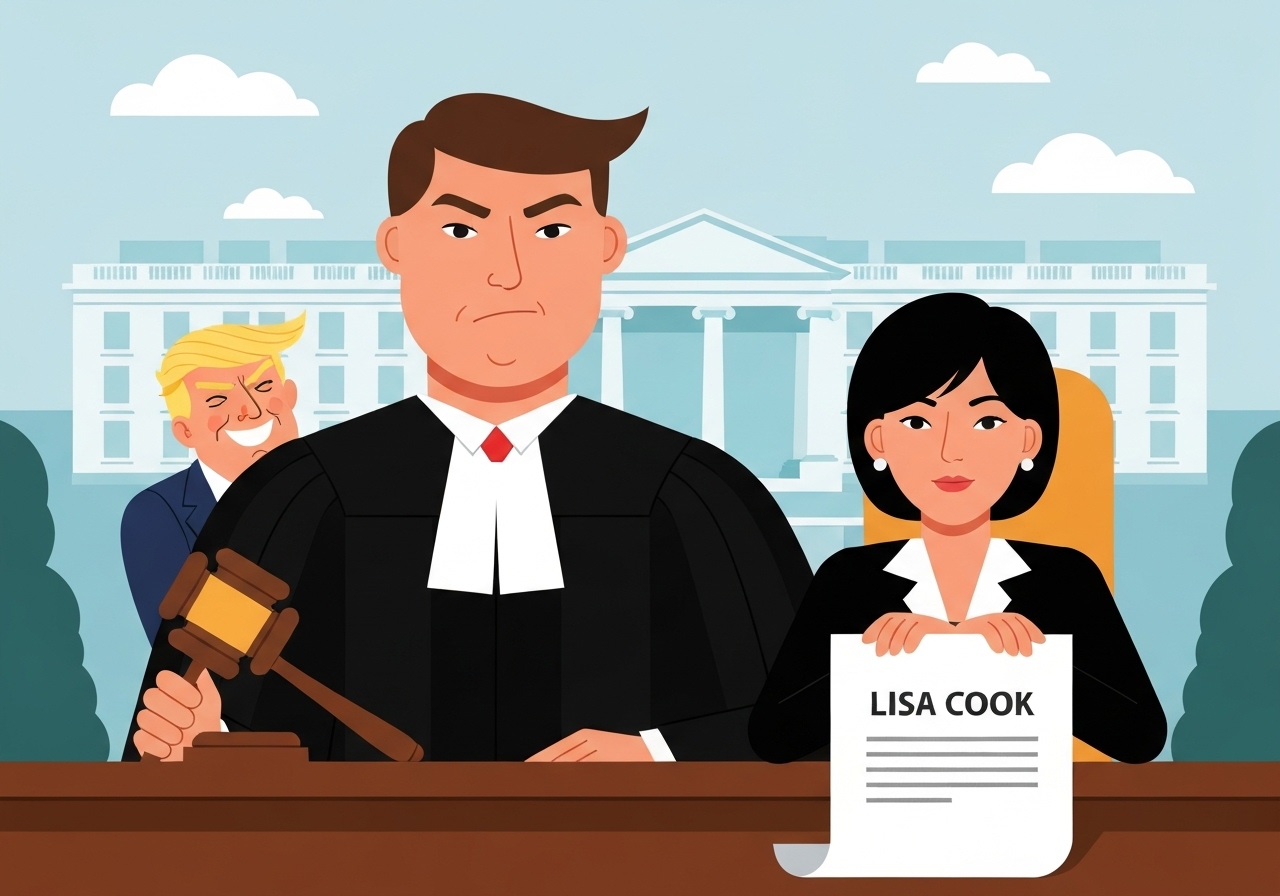
Lead: On Sept. 10, 2025, a federal judge in Washington temporarily barred President Donald Trump from removing Federal Reserve Governor Lisa Cook, halting the White House’s attempt while litigation proceeds. The preliminary order by U.S. District Judge Jia Cobb concluded the administration’s mortgage-fraud allegations likely do not provide lawful grounds for removal. Cook, who denies wrongdoing, will remain in office as the case advances toward higher courts. The ruling is an early judicial check on a dispute that could affect the Fed’s institutional independence.
Key Takeaways
- U.S. District Judge Jia Cobb issued a preliminary injunction on Sept. 10, 2025, preventing the White House from executing its removal of Fed Governor Lisa Cook while the lawsuit continues.
- The court found the administration’s mortgage-fraud allegations — tied to actions before Cook’s 2022 Senate confirmation — are likely insufficient grounds for removal under the statute that permits dismissal only ‘for cause.’
- Cook has denied the fraud allegations in court filings and argued the charges, even if true, predate her tenure and are not removable conduct.
- The Justice Department has opened a criminal mortgage-fraud probe and issued grand jury subpoenas in Georgia and Michigan, according to reporting and a source familiar with the matter.
- The White House, via spokesman Kush Desai, called the removal lawful and signaled further legal steps, saying the ruling would not be the ‘last say on the matter.’
- The dispute raises the prospect of a Supreme Court review and has implications for the Federal Reserve’s ability to set interest rates without political interference, days before the Fed’s Sept. 16–17 meeting.
Background
The statute establishing the Federal Reserve provides that governors may be removed ‘for cause’ but does not define that term or outline removal procedures. Historically no president has dismissed a Fed governor, and the question of what qualifies as ‘for cause’ remained untested in federal court until this episode. Lisa Cook, confirmed by the Senate in 2022 and the first Black woman to serve as a Fed governor, has been a target of the Trump administration since late August 2025 when the president announced he would remove her.
The administration alleges that Cook submitted inaccurate information on mortgage applications for three properties prior to her confirmation, conduct that officials including FHFA Director William Pulte say could have secured lower interest rates or tax advantages. The Fed has maintained Cook in her post and declined to comment on the court order. Cook counters that the allegations are a pretext tied to policy differences, including her stance on monetary policy and the Fed’s rate path.
Main Event
On Sept. 10, 2025, Judge Jia Cobb issued a preliminary ruling granting an injunction that prevents the White House from effectuating Cook’s removal while litigation is pending. Cobb reasoned that the ‘best reading’ of the removal statute restricts dismissal to misconduct occurring during a governor’s service, not before confirmation. The ruling therefore found the mortgage claims — all tied to actions pre-confirmation — unlikely to satisfy the statutory standard.
The White House argued that the president has broad authority to determine when removal is necessary and contended that courts should not second-guess the executive’s judgment. A White House spokesman, however, stated the administration would pursue further legal avenues, indicating the dispute will not end with this preliminary order. Meanwhile, Cook filed suit challenging the removal and seeking declaratory and injunctive relief, asserting that the president lacked statutory authority to fire her for pre-confirmation conduct.
The Justice Department’s criminal inquiry, which reportedly includes grand jury subpoenas issued in Georgia and Michigan, runs parallel to the civil litigation. Officials caution that civil and criminal processes are distinct; the DOJ’s investigation is independent and not a prerequisite for any removal under the Fed statute. The case is expected to move through the federal appeals process and may ultimately reach the U.S. Supreme Court due to the constitutional and institutional stakes.
Analysis & Implications
The injunction underscores the judiciary’s role in delineating limits on executive power when statutory language is ambiguous. If the courts sustain Judge Cobb’s interpretation, presidents would face a higher legal hurdle to remove fed governors for alleged pre-office misconduct, reinforcing the Fed’s insulation from short-term political pressures. That insulation is widely regarded by economists as critical for credible long-term control of inflation and stable monetary policy.
Politically, the ruling intensifies tensions between the White House and the Federal Reserve. President Trump has publicly demanded aggressive, immediate rate cuts and has criticized Fed Chair Jerome Powell, but a prolonged legal fight over governors’ tenure could complicate the Fed’s policy communications and internal dynamics. Markets typically react to perceived threats to central bank independence, which could raise uncertainty ahead of the Sept. 16–17 policy meeting when a rate cut is widely anticipated.
Legally, the case addresses a statutory gap: Congress wrote ‘for cause’ removal without defining it. Courts may consider legislative history, analogous statutes, and constitutional separation-of-powers principles when resolving whether pre-confirmation misconduct fits the statutory text. A Supreme Court ruling for the administration would broaden executive latitude; a ruling for Cook would curtail presidential discretion and likely set a precedent protecting independent-agency officials.
Comparison & Data
| Date | Event |
|---|---|
| 2022 | Lisa Cook confirmed as Federal Reserve Governor |
| Late Aug 2025 | President Trump moves to remove Governor Cook |
| Sept. 10, 2025 | Judge Jia Cobb issues preliminary injunction blocking removal |
| Sept. 16–17, 2025 | Federal Reserve policy meeting (rate decision expected) |
This timeline highlights the compressed sequence from confirmation to attempted removal and the proximity of the court decision to the Fed’s scheduled policy meeting. Historically, no Fed governor has been removed, meaning there is no direct judicial precedent and courts may look to analogous removal provisions for guidance.
Reactions & Quotes
The court concluded that the administration had not identified conduct during Cook’s service that would demonstrate unfaithful or ineffective execution of duties.
Judge Jia Cobb
This ruling recognizes and reaffirms the importance of safeguarding the independence of the Federal Reserve from illegal political interference,
Abbe Lowell, Counsel for Lisa Cook
The president has lawfully removed Governor Cook for cause over mortgage allegations and this ruling will not be the last say on the matter,
Kush Desai, White House Spokesman
Unconfirmed
- Details and outcomes of the Justice Department’s criminal mortgage-fraud probe remain under seal; subpoenas indicate investigation but do not imply charges.
- The White House’s internal rationale for the timing of the removal action has not been fully disclosed and remains a matter of public speculation.
- Whether the case will fast-track to the Supreme Court or follow the normal appellate route is not yet decided and will depend on appeals by the parties.
Bottom Line
Judge Jia Cobb’s preliminary injunction preserves Governor Lisa Cook’s position for the time being and raises a substantial legal question about what constitutes ‘for cause’ removal under the Federal Reserve Act. The decision tempers an immediate presidential assertion of authority and signals that courts may require more concrete on-duty misconduct to uphold a removal.
The dispute has larger consequences for central bank independence, monetary policy credibility and the separation of powers. Markets and policymakers should expect continued legal appeals and heightened political scrutiny ahead of the Fed’s Sept. 16–17 meeting, with the potential for a definitive appellate ruling to shape future relations between presidents and independent agencies.
Sources
- Reuters (news reporting)
- Federal Reserve (official site)
- U.S. Department of Justice (official agency)
- The White House (official statements)