
Lead
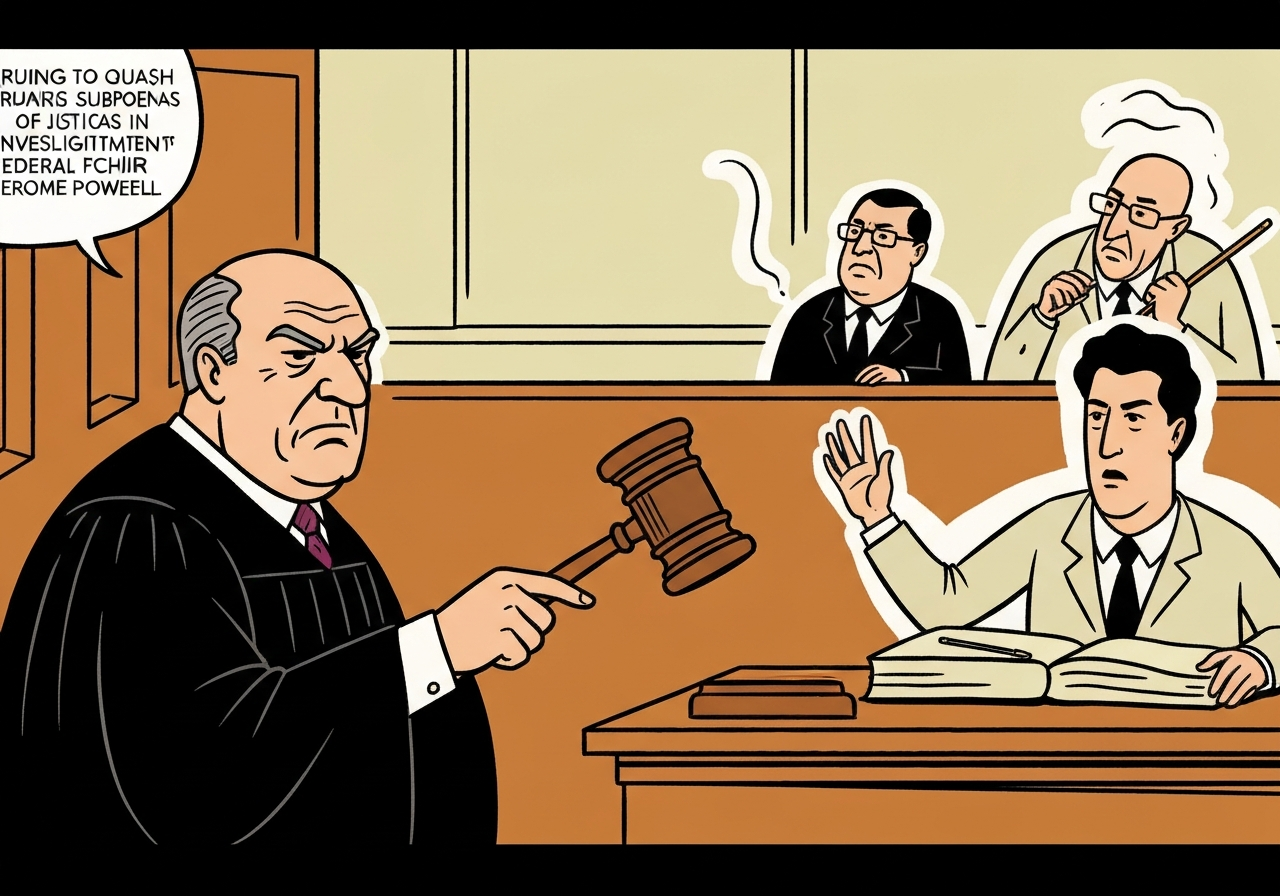
On Friday, U.S. District Judge James Boasberg voided January subpoenas the Justice Department had served on the Federal Reserve, dealing a major legal setback to an investigation of Fed Chair Jerome Powell tied to testimony about a $2.5 billion building renovation. The ruling found the government had provided little to no evidence of criminality and described the subpoenas as thinly justified. The decision also complicates Senate timing for Kevin Warsh’s nomination to succeed Powell when his chair term ends on May 15. U.S. Attorney Jeanine Pirro said she will appeal, setting up more litigation and more delay for the nomination process.
Key Takeaways
- Judge James Boasberg quashed subpoenas issued in January by U.S. Attorney Jeanine Pirro seeking Fed records tied to a $2.5 billion renovation project.
- Boasberg wrote the government had “produced essentially zero evidence” to support criminal suspicion of Chair Powell and characterized subpoena rationales as thin and unsubstantiated.
- The Fed’s current renovation estimate is $2.5 billion, about $600 million higher than the 2022 estimate of $1.9 billion.
- Pirro announced plans to appeal and called the ruling unlawful; her action could further delay Senate consideration of Kevin Warsh’s nomination.
- Sen. Thom Tillis has blocked Warsh’s consideration until the probe ends; with a 13-11 GOP committee majority, Tillis can withhold the committee’s vote if Republicans stay aligned.
- Powell’s separate governor term runs through January 2028; remaining on the board after May 15 would affect the White House’s ability to replace him.
- The court offered to review evidence in camera, but the government declined that option, according to Boasberg’s ruling.
Background
The Justice Department opened an investigation after Powell’s June testimony to the Senate Banking Committee about cost overruns on the Fed’s Washington renovation. At that hearing, Powell denied that the project included luxury features such as rooftop gardens and “VIP elevators,” while administration officials later pointed to earlier plans that they said showed more elaborate amenities. The Fed’s publicly disclosed estimate has grown from $1.9 billion in 2022 to about $2.5 billion, a roughly $600 million increase that prompted scrutiny.
That inquiry formed part of broader tension between the Trump administration and the Federal Reserve, which for decades has been treated as institutionally independent from daily political pressures. The administration has taken other extraordinary steps involving the Fed, including an attempt to remove Board Governor Lisa Cook that the Supreme Court temporarily blocked. Those moves have heightened concerns among lawmakers and market observers about political interference in monetary policy.
Main Event
On Friday, Judge Boasberg issued an order invalidating subpoenas that sought Fed records related to the renovation, finding the government’s stated reasons insufficient. Boasberg wrote that the evidence offered by prosecutors did not justify the grand jury demands and raised the prospect that the subpoenas were intended to pressure Powell politically. The court noted it had offered a private, in-camera review of any nonpublic evidence the government wished to submit, but the government declined that route.
U.S. Attorney Jeanine Pirro criticized the ruling at a news conference, calling the judge “activist” and saying the decision hamstrung the grand jury. She announced plans to appeal to preserve the investigation. The government’s publicly filed documents said the probe was looking into “possible fraud and false statements” by the Fed and Powell related to testimony and construction plans.
The timing of the ruling immediately intersected with the Senate’s consideration of Kevin Warsh, President Trump’s nominee to succeed Powell as Fed chair. Sen. Thom Tillis said he would not allow Warsh’s nomination to proceed while the Powell inquiry remained open, a procedural blockade that can hold the nomination in committee with the current partisan alignment. Powell’s chair term ends May 15, but he could remain on the Fed’s Board as a governor until January 2028.
Analysis & Implications
Legally, the decision underscores limits on a U.S. attorney’s power to subpoena a nominally independent entity and its chairman absent credible evidence of crime. Boasberg’s skepticism focused on the government’s failure to present demonstrable facts linking Powell’s testimony to criminal conduct, and his offer to review evidence in camera indicates the court preferred to protect confidential material while still testing the government’s showings.
Politically, the ruling escalates a tug-of-war between the Department of Justice and the White House’s broader efforts to influence the Fed. If prosecutors press an appeal, litigation could extend past the May 15 transition date, leaving the Biden or Trump administration—depending on outcomes—without a confirmed chair and prolonging market uncertainty about leadership at the central bank.
For the Fed’s institutional independence, the episode is consequential. Even when subpoenas are quashed, the mere initiation of a criminal inquiry and public reporting about it can erode investor and public confidence in the central bank’s insulation from politics. The prospect of the chair being targeted for policy preferences—such as calls to lower interest rates—raises normative questions about how legal tools should or should not be deployed in political disputes.
Comparison & Data
| Estimate (year) | Fed renovation cost |
|---|---|
| 2022 | $1.9 billion |
| Most recent | $2.5 billion |
| Difference | $600 million |
The table shows the core numerical trigger for scrutiny: a reported $600 million increase from the 2022 estimate to the most recent Fed figure. Cost escalations on large-scale public or quasi-public projects are not uncommon, but prosecutors said the discrepancy merited investigation when coupled with disputed testimony before Congress.
Reactions & Quotes
The decision prompted swift, divergent responses in Washington. Below are representative public statements and context.
“The government has produced essentially zero evidence to suspect Chair Powell of a crime.”
Judge James Boasberg
Boasberg used blunt language in his memorandum to justify quashing the subpoenas and to question the government’s motives. He framed the subpoenas as lacking a credible evidentiary basis and expressed concern they might have been employed to pressure a politically disfavored official.
“An activist judge has neutered the grand jury’s ability to investigate crime.”
U.S. Attorney Jeanine Pirro
Pirro criticized the ruling and vowed to appeal, arguing the court exceeded its authority and that the grand jury’s investigative role was improperly curtailed. Her posture signals continued litigation and public contention over the case’s legitimacy.
“We all know how this is going to end…Appealing the ruling will only delay the confirmation of Kevin Warsh as the next Fed Chair.”
Sen. Thom Tillis (R), member, Senate Banking Committee
Tillis used the ruling to bolster his blockade of Warsh’s nomination, tying committee action to the fate of the Powell inquiry. With a narrow Republican committee majority, Tillis’s opposition effectively stalls consideration unless party unity shifts.
Unconfirmed
- Whether earlier building plans definitively included rooftop gardens or VIP elevators remains contested and not independently confirmed in the public filings.
- Whether Powell will resign from the Board when his chair term ends on May 15 has not been definitively stated by Powell; filings reference discussions but offer no final decision.
- Any internal deliberations at the U.S. Attorney’s Office about political considerations or instructions from outside advisers remain unverified.
Bottom Line
Judge Boasberg’s order is a clear judicial check on a high-profile investigative effort into a sitting central banker. The ruling found the evidence presented to date insufficient to support broad subpoenas directed at the Federal Reserve and signaled judicial unwillingness to let grand-jury tools be used as thin instruments of political pressure.
Practically, the decision extends uncertainty: an appeal is likely, the Warsh nomination remains stalled, and questions persist over Powell’s post-May 15 plans. More litigation and Senate maneuvering are probable, and markets and policymakers will watch whether this episode establishes new precedents for how criminal process intersects with central-bank independence.
For readers tracking institutional norms, the key takeaway is that courts still play a pivotal role in policing the boundary between legitimate investigation and politically driven targeting of independent officials; how lower- and appellate courts rule on an appeal could reshape that boundary.