
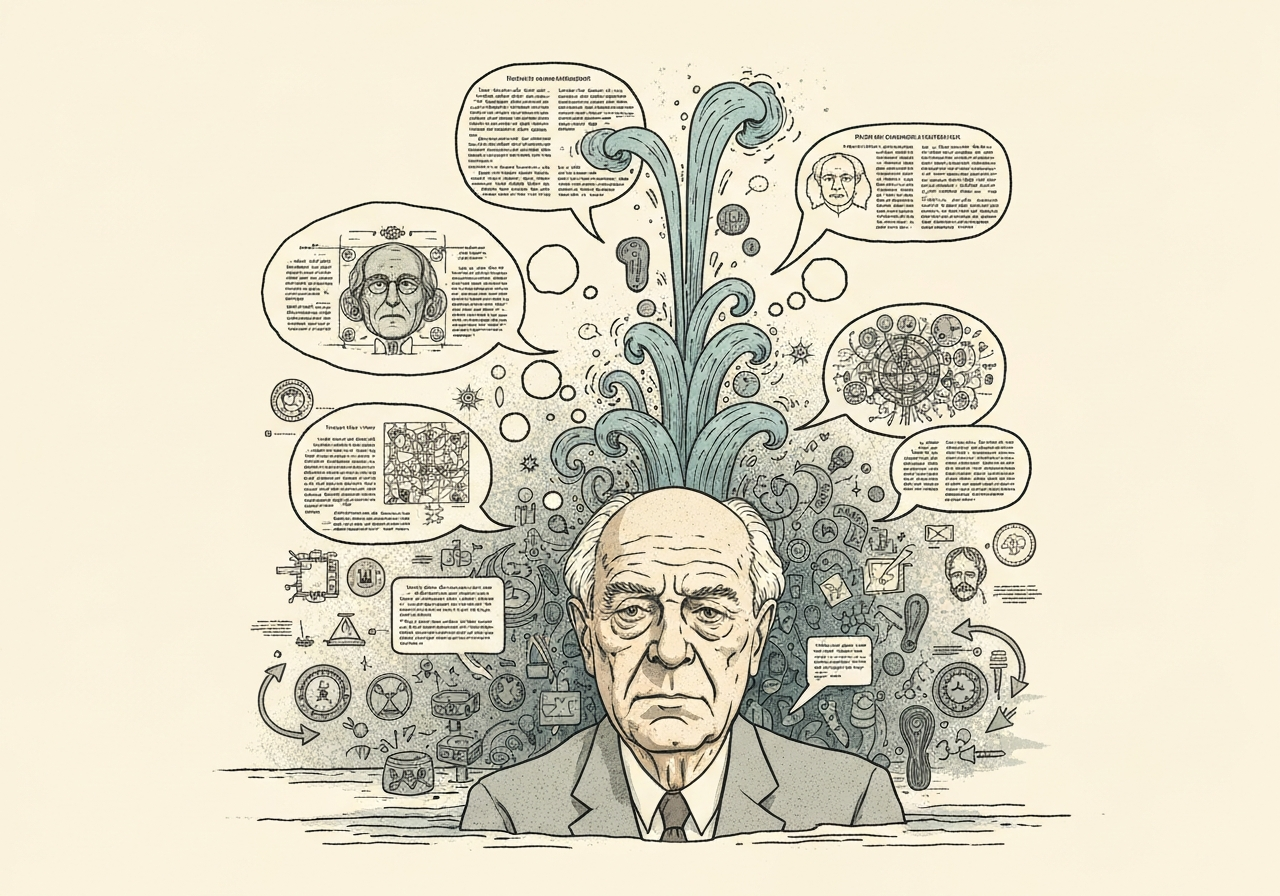
Jürgen Habermas, the German philosopher whose work shaped postwar debates about democracy, public discourse and reason, died on March 14, 2026, in Starnberg, Germany. He was 96. His publisher, Suhrkamp, confirmed his death. Over more than five decades and dozens of books, Habermas defended the Enlightenment faith in reason and developed key concepts — most famously the “public sphere” and the theory of communicative action — that have influenced political scientists, historians and media scholars worldwide.
Key Takeaways
- Habermas died on March 14, 2026, in Starnberg, Germany; his publisher Suhrkamp publicly confirmed the death.
- He was 96 years old and authored dozens of books across a career spanning more than 50 years.
- His 1960s formulation of the “public sphere” reframed how scholars understand democratic deliberation outside state control.
- In the 1970s and 1981’s The Theory of Communicative Action, he developed the “ideal speech situation” as a model for rational consensus-building.
- As a leading figure associated with the Frankfurt School, he differed from earlier figures like Theodor Adorno and Max Horkheimer by retaining a stronger faith in modernity and reason.
- Habermas’s ideas have generated thousands of academic papers and remain central to contemporary debates over media, democracy and deliberative politics.
Background
Born into a Germany still recovering from the Second World War, Habermas rose to prominence by engaging with the intellectual legacies of critical theory while arguing for renewed confidence in reason. The Frankfurt School, whose earlier generation included thinkers such as Adorno and Horkheimer, had mainly emphasized the critiques of modernity; Habermas accepted those critiques but regarded Enlightenment ideals as an “unfinished project” that could be advanced through improved communicative procedures. His early work in the 1960s placed him at the center of debates about democracy, culture and mass media during a period of social upheaval across Europe.
By the 1970s and 1980s Habermas had shifted from diagnosing pathologies of modern societies to proposing normative tools for democratic renewal. He articulated the conditions in which rational-critical debate could flourish and proposed institutional and discursive reforms to protect spaces of public deliberation from state capture and market distortion. His writing bridged philosophy, sociology and political theory, making him a frequent interlocutor in scholarly and public debates about the health of democratic life.
Main Event
On March 14, 2026, Suhrkamp, Habermas’s long-time publisher, confirmed his death in Starnberg, a town southwest of Munich where he had lived in recent years. News organizations and university departments quickly issued notices summarizing his contributions, noting both the breadth of his scholarship and his continued presence in public debates. The immediate reports emphasized his role as one of postwar Germany’s most-cited and consequential intellectuals, and recalled key milestones of his career.
Habermas first gained wide attention with his analysis of the public sphere in the early 1960s, a concept that described how citizens could form public opinion through discursive exchange outside institutional power. In later decades he refined those ideas into a systematic account in The Theory of Communicative Action (1981), where he described communicative rationality and the conditions for reaching mutual understanding. He also articulated the “ideal speech situation” as a normative benchmark for evaluating real-world discourse.
The announcement of his death prompted retrospectives across universities and media outlets, which highlighted his persistent engagement with issues such as democratic legitimacy, the role of mass media, and the tensions between law, morality and public opinion. While many tributes stressed his intellectual accomplishments, commentators also noted his lifelong commitment to public argument rather than sectarian polemic.
Analysis & Implications
Habermas’s passing marks the end of a career that helped define how postwar societies think about the conditions for democracy. Conceptually, his emphasis on communicative procedures and the public sphere provides resources for diagnosing contemporary pathologies such as polarisation, misinformation and the erosion of shared facts. Scholars and policymakers may increasingly turn to his frameworks when proposing reforms aimed at strengthening deliberative fora, public broadcasting standards, or protections for civic associations.
Academically, Habermas’s corpus will likely be subject to renewed scrutiny: younger scholars will test which aspects of his models map onto digital-era communication, where algorithmic amplification and platformized attention create new asymmetries in visibility and participation. His insistence on normative benchmarks — equality of participation, reciprocity of justification, and the conditions for rational-critical debate — remains a touchstone for debates about platform governance, media policy and civic education.
Politically, his defense of the Enlightenment against postmodern skepticism supplies intellectual ammunition for those who argue that democratic institutions require shared norms of truth-seeking and accountability. At the same time, critics who emphasize power asymmetries will press on practical limits of deliberative ideals. Habermas’s legacy is thus likely to animate both theoretical refinement and pragmatic reform efforts aimed at bolstering democratic resilience.
Comparison & Data
| Concept | Representative Work / Era | Primary Influence |
|---|---|---|
| Public sphere | The Structural Transformation of the Public Sphere (early 1960s) | Political science, media studies, history |
| Ideal speech situation | Developed in the 1970s | Philosophy, ethics, jurisprudence |
| Communicative action | The Theory of Communicative Action (1981) | Sociology, political theory |
The table highlights major concepts and their disciplinary reach rather than quantitative metrics. Habermas’s terms have functioned as conceptual anchors across multiple fields; they are often used as diagnostic tools for evaluating media systems, legal legitimacy and civic participation. Contemporary comparisons increasingly ask how his face-to-face oriented models translate into mediated, networked publics.
Reactions & Quotes
Commentators and institutions framed Habermas’s death as the loss of a major normative voice in modern thought while emphasizing the continuing centrality of his concepts.
“There is in everyday communicative life… a kind of push to give reasons.”
Jürgen Habermas (2005 interview)
This brief excerpt captures Habermas’s long-standing conviction that ordinary linguistic exchange contains normative impulses important for democratic argument. He drew from that observation to build theories that connected everyday talk to institutional legitimacy.
“His concept of the public sphere changed how scholars study democracy and media.”
Scholars and commentators
That assessment—summarized from multiple academic responses—reflects a common theme in immediate tributes: Habermas provided vocabulary and analytical tools that reshaped entire subfields, from media studies to deliberative democratic theory.
Unconfirmed
- Official cause of death has not been publicly released as of initial reports.
- Details about memorial services, burial arrangements or institutional commemorations had not been confirmed at the time of reporting.
- Any posthumous publications or unfinished manuscripts have not been verified or announced by his estate or publisher.
Bottom Line
Jürgen Habermas leaves behind a body of work that remains central to contemporary debates about democracy, truth and the role of communication in public life. His insistence that rational-critical discourse can be cultivated rather than abandoned distinguishes him from many postwar critics of modernity and continues to inform normative proposals for democratic repair.
In the short term, scholars will revisit his writings to assess their relevance to digital-era challenges such as misinformation, platform power and fragmented publics. In the longer term, Habermas’s concepts will likely continue to serve as benchmarks for both critique and reform, shaping how institutions and citizens think about the conditions for legitimate collective decision-making.
Sources
- The New York Times — news report and obit (news)
- Suhrkamp Verlag — publisher (official publisher site)