
Lead
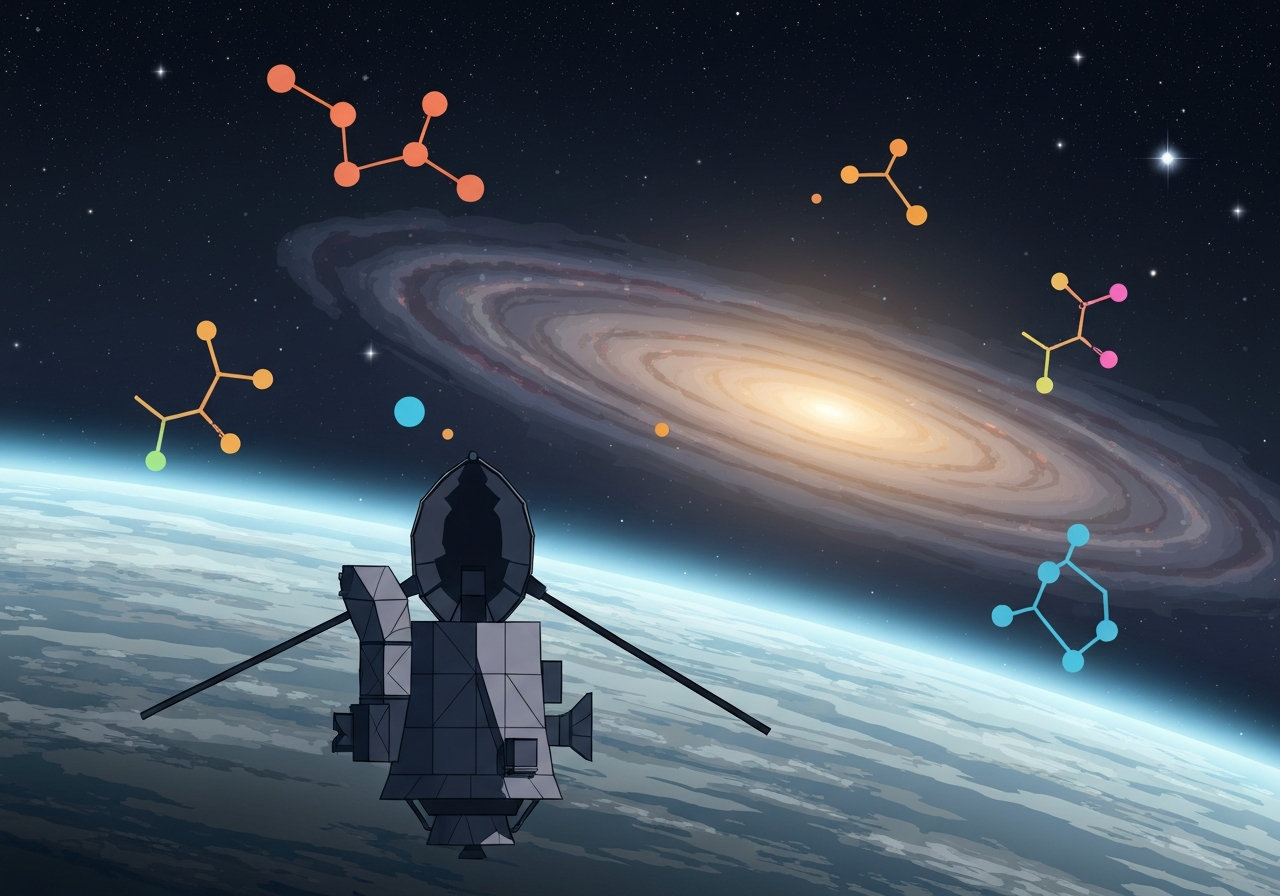
Using the James Webb Space Telescope (JWST), researchers have detected a rich inventory of small organic molecules in the dust-enshrouded core of the ultra-luminous infrared galaxy IRAS 07251–0248. The team, using JWST’s NIRSpec and MIRI instruments, reported the results on Feb. 6 in Nature, finding chemical abundances far above prior theoretical expectations. Among the discoveries were benzene, methane, multiple acetylene chains and the methyl radical — the latter identified beyond the Milky Way for the first time. Scientists say these species are plausible precursors to more complex organics relevant to prebiotic chemistry.
Key Takeaways
- JWST instruments NIRSpec and MIRI probed the heavily obscured nucleus of IRAS 07251–0248 and revealed unexpectedly complex chemistry.
- The team identified small organic molecules including benzene, methane, acetylene, diacetylene, triacetylene, and the methyl radical; methyl radical is reported as a first extragalactic detection.
- Solids were also observed: carbon-rich grains and water ice were detected alongside gas-phase species.
- Abundances and temperatures of gas, dust, and ices were characterized, showing higher concentrations than current models predict.
- Authors suggest energetic particle bombardment (cosmic rays) may fragment larger carbon-rich solids, releasing small organics into the gas phase.
- The study was led by Ismael García Bernete (Center for Astrobiology) and includes coauthor Dimitra Rigopoulou (University of Oxford); results published Feb. 6 in Nature.
Background
Ultra-luminous infrared galaxies (ULIRGs) like IRAS 07251–0248 concentrate enormous masses of gas and dust in compact central regions. That obscuring material absorbs optical light but re-emits strongly in the infrared, making infrared observatories essential for probing these nuclei. Before JWST, telescopes lacked the combined sensitivity and spectral resolution at mid-infrared wavelengths needed to inventory faint molecular signatures deep inside such dusty cores.
Astrochemistry in dense galactic nuclei sits at the intersection of star formation, black-hole growth and energetic processing by radiation and particles. Previous studies found complex organics in the Milky Way and in a handful of nearby galaxies, but models generally predicted lower abundances in extreme, dust-obscured environments. Understanding whether those regions act as factories for organic material affects theories about where prebiotic chemistry can begin in the universe.
Main Event
The research team targeted IRAS 07251–0248 with MIRI and NIRSpec to capture mid- and near-infrared spectra of its inner regions. The spectra showed a suite of features attributable to small hydrocarbons and simple organics, plus absorption signatures consistent with water ice and carbonaceous grains. Quantitative analysis of line strengths and continuum emission allowed the group to derive column densities and approximate excitation temperatures for many species.
One striking result was the detection of the methyl radical (CH3) beyond the Milky Way for the first time; methyl is highly reactive and short-lived in many environments, making it difficult to detect at extragalactic distances. The authors report column densities and relative abundances that exceed expectations from models that include only heating and turbulent mixing.
To explain the surplus of small organics, the team examined alternative production pathways. They propose that high-energy cosmic-ray bombardment and related processing can fragment larger carbon-rich solids and ices, liberating small molecules into the gas. This mechanism would operate in heavily shielded, high-density regions where photons cannot penetrate but energetic particles can.
Analysis & Implications
The abundance and diversity of detected molecules imply that obscured galactic nuclei may be chemically active regions rather than sterile, inert cores. If cosmic-ray processing efficiently converts refractory carbon grains and ices into small organics, ULIRG nuclei could enrich their surrounding interstellar medium with prebiotic precursors on galactic scales. That would broaden the range of astrophysical environments considered relevant to the early steps of chemical complexity.
For astrochemical modeling, the findings present a clear challenge. Standard models that emphasize thermal chemistry, shocks, and photochemistry underpredict the measured abundances, indicating missing processes or underestimated particle fluxes. Incorporating high cosmic-ray ionization rates and grain fragmentation pathways will be necessary to reproduce the observations and to test whether similar chemistry is common in other buried nuclei.
On an observational front, JWST’s sensitivity and spectral grasp are now shown capable of identifying fragile radicals and small hydrocarbons in very dusty, distant regions. That opens the door to systematic surveys of obscured galaxies to quantify how widespread this chemistry is and to track how molecular inventories evolve with galaxy properties such as star-formation rate and central black-hole activity.
Comparison & Data
| Molecule | Phase/Signature | Significance |
|---|---|---|
| Benzene (C6H6) | Gas/spectral features | Indicator of aromatic chemistry |
| Methane (CH4) | Gas lines | Simple hydrocarbon, abundant |
| Acetylene/Diacetylene/Triacetylene | Gas chains | Shows carbon-chain chemistry |
| Methyl radical (CH3) | Gas line | First reported extragalactic detection |
| Carbon grains, water ice | Solid absorption | Reservoirs of solid carbon and volatiles |
The table summarizes detections reported in the Nature paper. While qualitative detections are robust, absolute abundances depend on assumed excitation conditions and line-of-sight geometry. Follow-up observations at complementary wavelengths and targeted modeling will refine column densities and temperature estimates.
Reactions & Quotes
“We found an unexpected chemical complexity, with abundances far higher than predicted,”
Ismael García Bernete, Center for Astrobiology (lead author)
This statement summarizes the team’s surprise at measured abundances that exceed model expectations and motivates further theoretical work to explain the formation pathways observed.
“Small organic molecules could play a vital role in prebiotic chemistry, representing an important step toward amino acids and nucleotides,”
Dimitra Rigopoulou, University of Oxford (coauthor)
Rigopoulou framed the astrophysical chemistry as a possible precursor stage to more complex biogenic molecules, while noting that the detected organics are not themselves biological.
Unconfirmed
- The suggestion that cosmic-ray fragmentation is the dominant production route for the observed molecules is consistent with the data but remains a hypothesis requiring quantitative modeling and independent confirmation.
- Whether IRAS 07251–0248 is representative of other ULIRGs or an outlier is not yet established; broader surveys are needed to assess prevalence.
Bottom Line
JWST has exposed a surprisingly rich organic chemistry in the obscured nucleus of IRAS 07251–0248, detecting small hydrocarbons, reactive radicals and solid-phase carbon and water ice. The presence of these species at unexpectedly high abundances implies active chemical processing in environments once thought too extreme or shielded for such complexity.
The proposed role for energetic particles in producing these molecules, if confirmed, would reshape models of interstellar chemistry and expand the types of environments where prebiotic precursors can form. Immediate next steps include targeted JWST follow-ups, complementary observations at other wavelengths and updated chemical models that include particle-driven grain processing.