
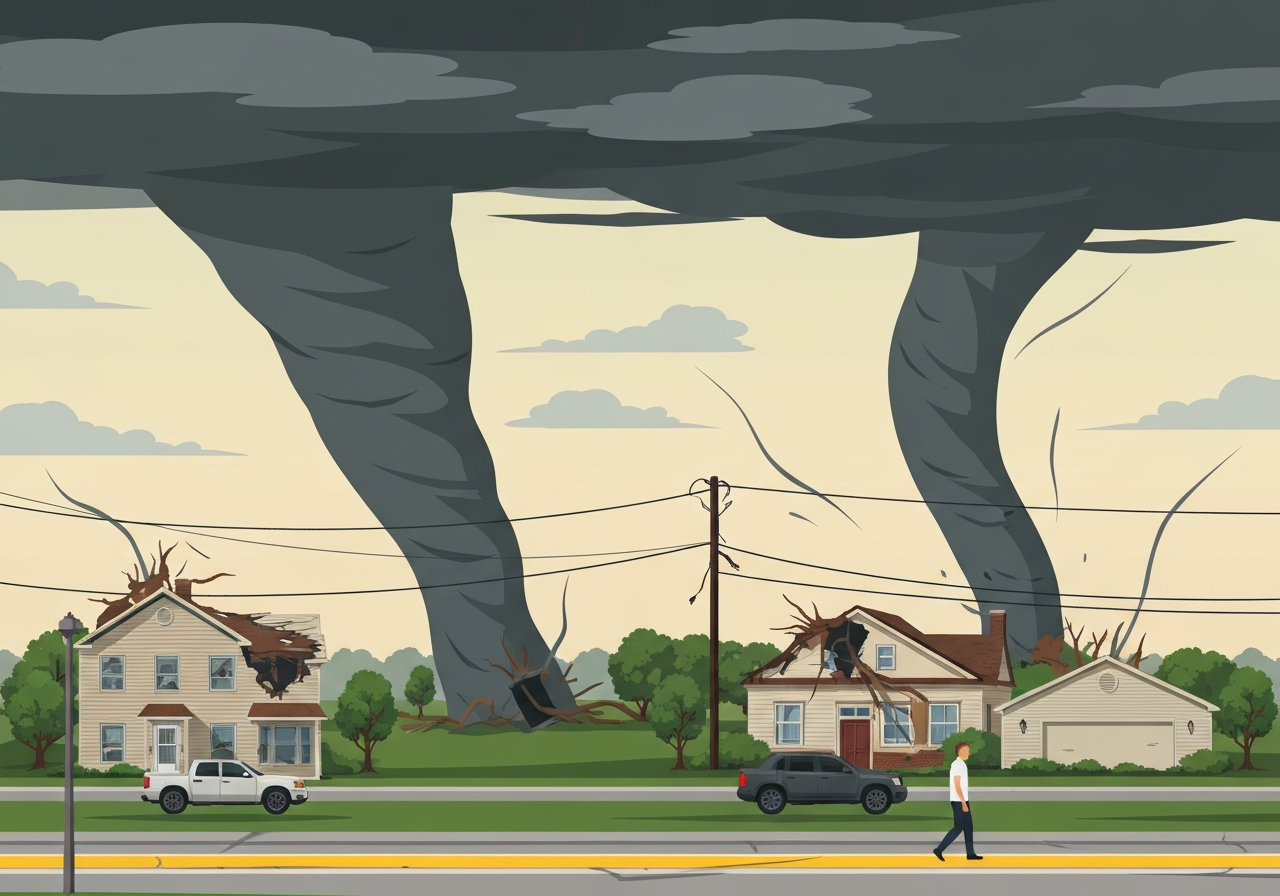
— A severe storm complex that tracked from Pontiac, Illinois, into northwest Indiana on Tuesday likely produced at least four tornadoes and widespread destructive hail, the National Weather Service (NWS) said. The system left a trail of damage across Kankakee County, Illinois, and Lake Village and Wheatfield in Indiana; officials confirmed two deaths in Lake Village and multiple injuries across the region. Hail up to 6 inches in diameter was reported in Kankakee, which NWS said may be an Illinois state record. Survey teams from the NWS were dispatched Wednesday to determine exact tornado paths and confirm storm intensities.
Key takeaways
- At least four suspected tornadoes: A supercell that moved from Pontiac, IL to Pontiac, IN is believed to have spawned at least four tornadoes, with preliminary reports in Pontiac, south of Kankakee, Lake Village and Wheatfield (NWS).
- Fatalities and injuries: Two people were confirmed dead in Lake Village after a tornado struck a residence; Indiana officials report fewer than 10 people seriously injured there, while Kankakee officials reported seven injured in Illinois.
- Historic-size hail: Hail ranging 2–4 inches was widespread; the largest reported stone in Kankakee measured 6 inches in diameter and is being evaluated as a possible Illinois record (NWS).
- Power and infrastructure impacts: ComEd reported roughly 27,000 customers affected at the storm peak, with about 4,000 still without power as of 5 a.m.; NIPSCO reported power issues affecting more than 2,500 customers and roughly 70 downed utility poles in Newton County.
- Search, rescue and sheltering: A grid-style primary search in Lake Village involved roughly 250 volunteers and responders; shelters opened at Kankakee Community College and North Newton High School for displaced residents.
Background
Severe weather on March 10, 2026 developed as a potent springtime supercell across central and northeast Illinois before moving into northwest Indiana. Supercells are rotating thunderstorms capable of producing strong tornadoes, very large hail and damaging winds; in this case the storm tracked roughly northeast from Pontiac, IL toward the Indiana state line. The region is familiar with severe spring outbreaks, but the combination of multiple suspected tornadoes and extremely large hail is notable for the area.
Local agencies — including municipal emergency services, county officials, utility companies and state emergency management — mobilized overnight to conduct searches, clear roads and restore power. Kankakee and Newton counties each faced both residential and agricultural damage, with farm structures, vehicles and outbuildings heavily affected. The NWS typically follows such events with multi-day damage surveys to assign tornado ratings, confirm hail sizes, and distinguish tornadic damage from straight-line wind effects.
Main event
According to preliminary NWS information and local officials, a supercell that formed near Pontiac, Illinois tracked northeast, producing tornadic activity and very large hail along its route. In Kankakee County, residents reported baseball- to softball-sized hail that shattered vehicle glass and damaged roofs and siding across several neighborhoods. Emergency crews in Kankakee excavated residents from homes and treated multiple injuries; Mayor Christopher Curtis reported seven injured and widespread property damage.
Across the border in Lake Village, Indiana, a tornado struck homes in the 8000-block of 600 W, killing an elderly couple and leaving others seriously hurt. Officials said the tornado carved a roughly 3.5-mile path through the town, toppling trees, downing power lines and leaving some people trapped in collapsed structures. Four volunteer firefighters also reported severe damage to their own homes, complicating local response capacity.
Search teams described a nighttime, grid-pattern primary search to account for residents after the storm. Volunteers and first responders — roughly 250 people by local account — worked in darkness and debris to locate survivors and clear routes for ambulances. Utility crews reported dozens of broken poles and tens of thousands temporarily without electricity; prioritized restoration work began the following morning.
Analysis & implications
The suspected multiple-tornado event underscores how a single long-lived supercell can produce several discrete tornadoes over a broad area, complicating response and damage assessment. If the 6-inch hailstone in Kankakee is confirmed, it would be among the largest documented in Illinois history and has implications for building codes and insurance exposure in regions not used to such extreme hail. Large hail of that size dramatically increases the likelihood of total vehicle loss and severe roof damage, raising immediate sheltering and recovery needs.
Human impacts are acute where the tornado struck at night: night tornadoes carry higher fatality risk because people are less likely to receive warnings or to be awake to respond. Authorities’ report of two confirmed deaths in Lake Village and multiple injuries highlights the need for resilient communication channels — including NOAA Weather Radio and cell-alert systems — and community preparedness plans for after-hours events.
Economically, local governments will face short-term costs for debris removal, emergency services and temporary housing, followed by longer-term rebuilding expenses for damaged housing and agriculture. Power restoration timelines depend on the number and location of downed poles and the availability of crews; preliminary reports of 70 broken poles in Newton County suggest several days of coordinated utility work may be required.
Comparison & data
| Metric | Preliminary value |
|---|---|
| Suspected tornadoes | At least 4 |
| Confirmed fatalities | 2 (Lake Village, IN) |
| Reported injuries | Kankakee: 7; Lake Village: fewer than 10 seriously injured |
| Largest reported hail | 6 inches (Kankakee, IL) |
| Power customers affected | ComEd: ~27,000 at peak (≈4,000 still out at 5 a.m.); NIPSCO: >2,500 |
| Tornado path in Lake Village | ~3.5 miles |
The table lists preliminary figures reported by local officials, utilities and the NWS. Values are subject to revision after NWS damage surveys and utility assessments; for instance, exact tornado counts and path lengths often change once teams complete ground and aerial inspections.
Reactions & quotes
“In the dark, in the dead of night, with debris everywhere, primary search was done to the best of our abilities. We had probably 250 people here last night doing it.”
Lori Postma, Lake Township Volunteer Fire Department (local emergency responder)
Postma described an organized, sector-based search amid poor visibility and heavy debris that aimed to rule out missing persons and locate survivors for urgent care.
“We did have to excavate a couple people out of homes, but they are safe.”
Christopher Curtis, Mayor of Kankakee (municipal official)
The mayor spoke to rescue efforts and emphasized that full power restoration could take several days as crews repair downed lines and poles.
“It sounded exactly like bullets hitting your car… I did not think this thing would hit my windshield and crack it right open.”
Gabrielle Zinkel (resident affected by hail)
Residents compared the hail to gunfire and described sudden, intense damage to vehicles and homes, reinforcing reports of extraordinarily large hailstones in several neighborhoods.
Unconfirmed
- The precise number of tornadoes and their final EF ratings remain pending results from NWS damage surveys.
- The 6-inch hailstone in Kankakee is under review and has not yet been officially recorded as an Illinois state record.
- Total counts of injured people across all affected counties remain provisional and could change as hospitals and emergency units finalize reports.
Bottom line
This March 10 storm complex likely produced multiple tornadoes and extraordinarily large hail, producing fatalities, injuries and widespread property and infrastructure damage across parts of east-central Illinois and northwest Indiana. Early damage estimates emphasize both immediate humanitarian needs — shelter, medical care, power restoration — and the likelihood of a prolonged recovery phase for deeply affected neighborhoods and farms.
Final confirmation of tornado counts, strength and the hail record will come from NWS survey teams; those findings will shape insurance claims, rebuilding standards and future preparedness planning. For now, residents in the impacted counties should follow local official guidance, use designated shelters if displaced, and expect utility restoration and road-clearance operations to continue through the coming days.
Sources
- ABC7 Chicago (local news report)
- National Weather Service Chicago (LOT) office (official forecasts and damage survey coordination)
- National Weather Service Northern Indiana (IWX) office (regional storm information)