
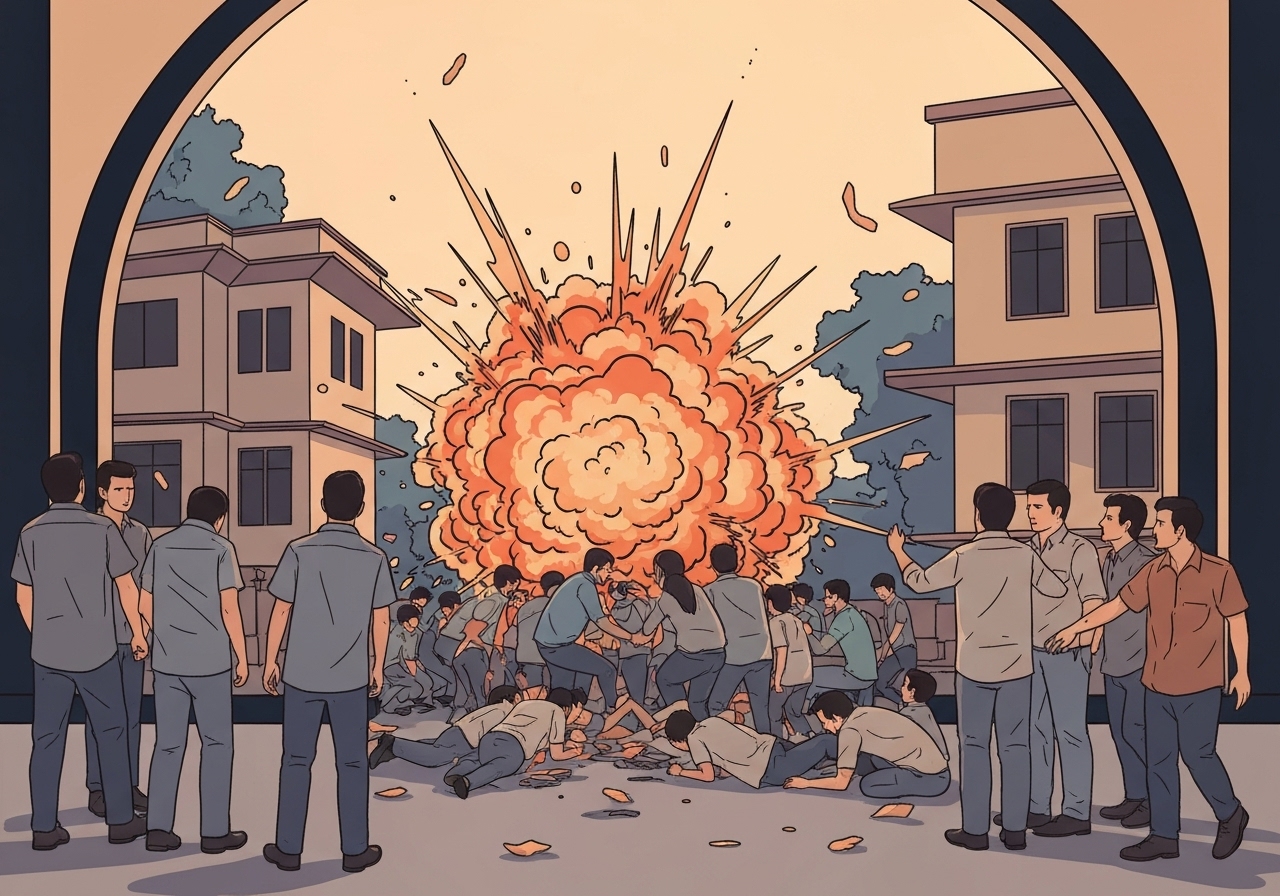
in Nowgam, a neighborhood of Srinagar, an explosion inside a police station killed at least nine people and injured 32 others while a forensic team examined seized explosives, police said. The region’s director-general of police, Nalin Prabhat, described the incident as an accidental detonation of confiscated material brought from Faridabad, and he dismissed suggestions of deliberate sabotage. The victims included police and forensic personnel, two civil administrators and one civilian; some of the wounded remain in critical condition. The blast severely damaged the station, ignited vehicles and scattered debris into surrounding homes.
Key Takeaways
- Casualties: At least nine dead and 32 injured; deaths included six police/forensic officials, two civil administrators and one civilian.
- Location and timing: The explosion occurred late Friday at the Nowgam police station in Srinagar, the main city of Indian-administered Kashmir.
- Origin of explosives: Authorities say the explosive cache was seized in Faridabad and transported to Srinagar as part of an ongoing investigation.
- Operational disruption: Officials reported multiple small successive detonations that hindered immediate rescue work at the scene.
- Property damage: The station, several vehicles and nearby houses sustained fire and structural damage; remains were found up to about 100 meters (328 feet) away.
- Related incidents: The blast follows a separate deadly car explosion in New Delhi earlier in the week that killed at least eight people and prompted wide authorities’ counterterror measures.
Background
The incident comes amid heightened security activity after a car explosion in New Delhi killed at least eight people and was labeled by Indian officials as a terror attack. That investigation led authorities to detain suspects and seize a large quantity of bomb-making material in Faridabad, which officials say was later moved to Kashmir for forensic analysis. India and Pakistan both administer parts of Kashmir and each claims the territory, and the region has seen an insurgency against Indian rule since 1989.
Security forces in India have frequently carried out sweeps and arrests in the disputed territory following attacks on Indian targets. Officials have also used punitive measures such as demolishing houses of people they say are linked to militants; the government said it demolished the home of a man identified by DNA as the driver in the New Delhi car blast. These measures have been criticized by some human-rights groups and fuel local tensions, complicating law enforcement operations and public trust.
Main Event
Police say a team of forensic experts and officers was taking samples from a store of seized explosives at the Nowgam station when the materials detonated. The detonation produced a massive blast wave that tore through the building, set at least one vehicle alight and shattered windows across the neighborhood. Local witnesses reported a sequence of smaller secondary blasts that made it dangerous for rescuers to enter immediately.
Authorities identified the dead as six on-duty police and forensic staff, two administrative officials attached to the investigation and a civilian who had been at the station. Several wounded people were transported to hospitals in Srinagar; officials said a number of those injured were in critical condition. Director-General Nalin Prabhat publicly characterized the event as an accidental explosion and asked the public to avoid speculation about other causes.
Relatives of one of the civilian victims, identified as Mohammad Shafi Parray, gathered at his home in Nowgam and marched to the police station in protest, chanting for justice. Family members said Parray, a tailor, had been summoned to the station on Friday night; a local officer speaking on condition of anonymity said the tailor had been asked to stitch bags to store explosive samples. Residents reported finding body parts and debris scattered into nearby houses, increasing the sense of urgency and anger in the neighborhood.
Analysis & Implications
The blast underscores operational risks when moving and storing high-energy explosive materials for investigation. Even when authorities say materials are kept in an open area, the handling and packaging of evidence demand strict, standardized protocols; any lapse can be catastrophic. If confirmed as an accident, the incident will still likely trigger internal reviews of custody chains, transportation procedures and on-site safety measures in forensic units across security agencies.
Politically, the explosion arrives at a sensitive moment. The New Delhi car blast earlier in the week has intensified security operations and interagency coordination; an accidental detonation during forensic processing could complicate that broader inquiry, undermine public confidence and provide fodder for critics of the security approach in Kashmir. Conversely, if investigations later find procedural failures, there may be calls for reforms in how evidence is handled and for greater transparency.
Strategically, the incident may affect cross-border narratives and diplomatic messaging. India has accused Pakistan of sponsoring militancy in Kashmir, a charge Pakistan denies; any development tied to militant activity can inflame bilateral rhetoric. International observers will watch whether the inquiry yields fresh links to the New Delhi attack or remains confined to a domestic safety failure, which would shape regional responses and potential policy changes.
Comparison & Data
| Incident | Fatalities | Injuries | Location |
|---|---|---|---|
| Nowgam police station blast | 9 | 32 | Srinagar, Jammu & Kashmir |
| New Delhi car explosion (earlier that week) | At least 8 | Not specified publicly | Near Red Fort, New Delhi |
The table places the Nowgam blast alongside the New Delhi car explosion to show the recent clustering of lethal incidents. While the Delhi blast remains under investigation with its own identified casualties, the Srinagar event is notable for the number of injured and for involving personnel directly connected to forensic processing.
Reactions & Quotes
Officials have publicly described the Srinagar detonation as accidental and urged restraint while investigations proceed. The director-general emphasized that the materials were stored as part of an active inquiry and sought to discourage speculation that could inflame tensions during ongoing security operations.
“It was an accidental explosion,”
Nalin Prabhat, Director-General of Police, Jammu & Kashmir
Locals described the scene as terrifying and disruptive to the neighborhood, noting that debris and human remains reached houses some distance from the blast site, amplifying fear and outrage. A resident’s account captured the sudden, violent nature of the event and its immediate impact on civilians.
“The explosion produced a deafening roar that rattled houses and flung open windows closed tight,”
Bashir Ahmed, Nowgam resident
Family members of a civilian victim staged a protest at the police station demanding answers, reflecting community anger and a demand for accountability regardless of official rulings. Their chant, calling for justice, highlights the social dimension of the crisis and the pressure on authorities to explain how a forensic operation resulted in such loss of life.
“We want justice,”
Relatives of Mohammad Shafi Parray
Unconfirmed
- Whether procedural lapses in how the seized materials were packaged or transported directly led to the detonation remains under official investigation.
- No public evidence yet links the Nowgam explosion deliberately to the New Delhi car blast; authorities have described the Srinagar incident as accidental.
- Claims that the sequence of smaller detonations were deliberate booby traps have not been substantiated by investigators.
Bottom Line
The Nowgam police station explosion killed nine and wounded dozens while forensic teams worked on materials seized from a separate probe, according to officials. Even if investigators ultimately classify the event as accidental, the human toll and visible destruction will likely prompt immediate procedural reviews and heighten scrutiny of how explosive evidence is handled across agencies.
In the near term, expectations are for a forensic reconstruction of the blast, internal audits of evidence-handling protocols and possible disciplinary or procedural reforms if lapses are found. Longer term, the incident may deepen public unease in Kashmir and influence the narrative surrounding security operations tied to the New Delhi attack and broader counterterror measures.
Sources
- The Associated Press — International news agency reporting on the Nowgam blast and local reactions (news).
- Press Trust of India — Indian news agency reporting on successive small blasts and related developments (news).
- Jammu & Kashmir Police — Official police statements and public communications regarding the incident (official).