
Lead
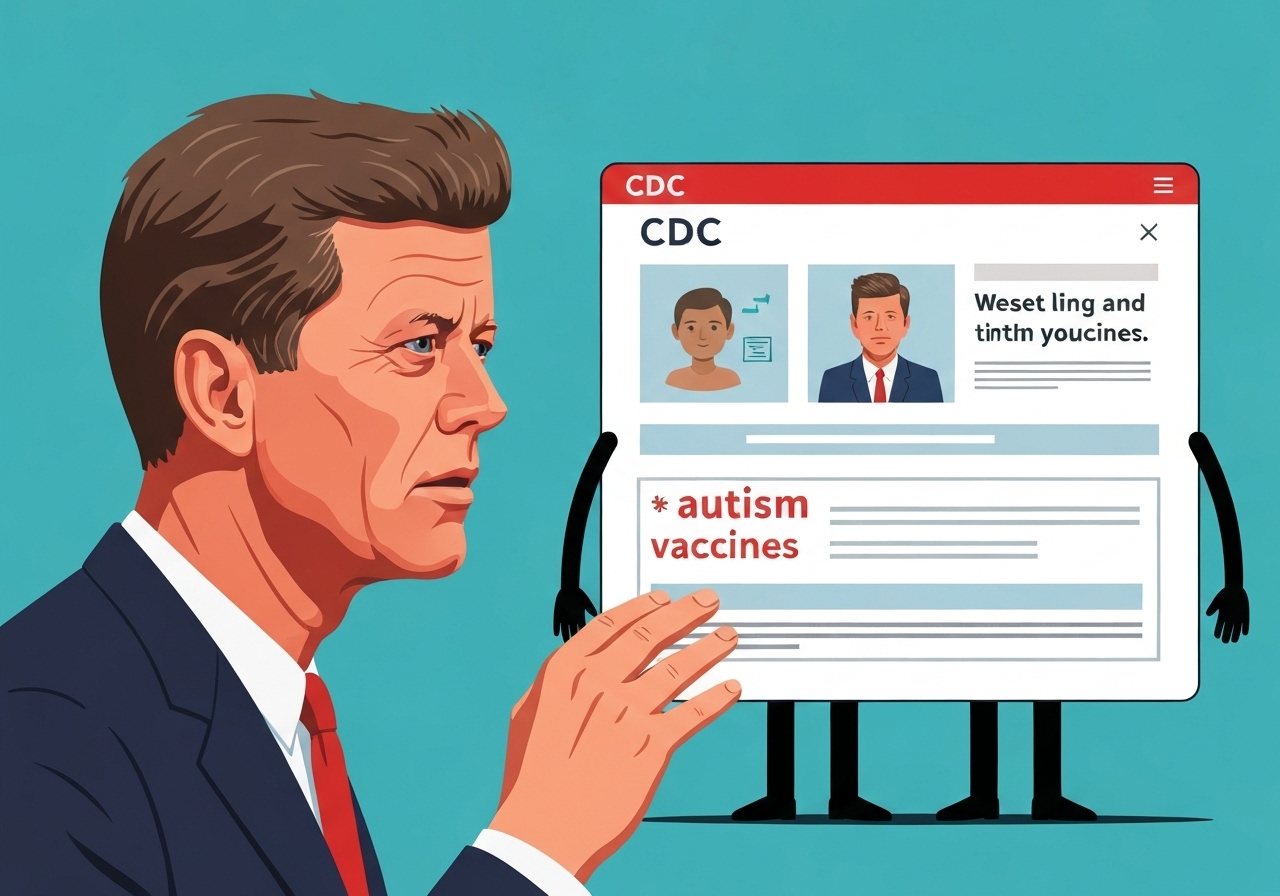
Health Secretary Robert F. Kennedy Jr. told The New York Times he directed the Centers for Disease Control and Prevention to alter long-standing language on its vaccine-and-autism guidance, saying existing phrasing overstated the completeness of evidence. The agency’s online guidance was revised to signal greater uncertainty about whether some infant vaccines could be fully ruled out as a cause of autism. Public health officials and researchers quickly criticized the change, pointing to decades of large-scale studies finding no causal link. A CDC advisory committee is scheduled to meet early next month to review vaccine recommendations that include hepatitis B shots given in infancy.
Key Takeaways
- Robert F. Kennedy Jr., as Health Secretary, told The New York Times he ordered the CDC to change its wording on vaccines and autism; the claim is attributable to his interview with that outlet.
- The CDC updated its online guidance to state that asserting “vaccines do not cause autism” is not an evidence-based claim because some studies have not definitively ruled out a possible link for certain infant vaccines.
- Large-scale epidemiological studies of the MMR vaccine and multiple studies of the preservative thimerosal have found no association with autism; reviews have included data from hundreds of thousands of children.
- Kennedy cited gaps in the scientific literature for other early-life vaccines, including hepatitis B and combination DTaP-containing shots, as a rationale for the wording change.
- Public health agencies including the World Health Organization and the European Centre for Disease Prevention and Control have stated that existing evidence does not support a causal link between vaccines and autism.
- Public health experts and many clinicians described the CDC wording change as likely to increase confusion and fuel vaccine hesitancy rather than improve safety surveillance.
- A revamped CDC advisory committee will convene early next month to consider new recommendations related to hepatitis B vaccination schedules.
Background
Concerns that vaccines cause autism have circulated for more than two decades, originating in research that has since been discredited and retracted. Since then, multiple national and international reviews have examined large cohorts and found no causal relationship between routine childhood vaccines and autism spectrum disorder. The CDC historically used clear language to communicate that vaccines do not cause autism, a position echoed by major public health bodies worldwide.
Robert F. Kennedy Jr. has been a well-known vaccine skeptic for years and is not a trained scientist; his public statements have previously clashed with mainstream public health guidance. Before his appointment as Health Secretary, the CDC and other health agencies were actively working to counter rising anti-vaccine sentiment domestically and globally, using consolidated messaging to maintain public confidence in childhood immunizations.
Main Event
In an interview published by The New York Times, Kennedy said he instructed the CDC to reword its online guidance on vaccines and autism. According to his account, the previous assertion that vaccines do not cause autism presented the science as settled, while he believes certain early-life vaccine exposures have not been examined comprehensively. The CDC’s webtext was adjusted to reflect that some specific questions about infant vaccine schedules have not been exhaustively ruled out by available studies.
The change drew swift pushback. Public health officials and researchers pointed to extensive epidemiological work—often involving cohorts totaling hundreds of thousands of children—finding no link between the measles-mumps-rubella (MMR) vaccine and autism. Separate research on thimerosal, a mercury-containing preservative once used in some vaccines, similarly found no evidence of causation. Critics said the new wording could be interpreted as reopening settled questions and thereby undermine vaccination programs.
Kennedy acknowledged that large studies of MMR and thimerosal found no association but argued that similar large-scale investigations have not been performed for every vaccine administered in the first year of life. He specifically referenced hepatitis B and a combination diphtheria-tetanus-pertussis vaccine (DTaP) among those he believes need more study. He also said he discussed the change with Sen. Bill Cassidy, who disagreed with the decision.
Analysis & Implications
The CDC’s wording shift has immediate communication consequences: public-facing guidance that suggests uncertainty can reduce vaccine confidence, particularly among parents making decisions about infant immunizations. Public health messaging relies on clarity when benefits and risks are communicated at scale; even nuanced revisions can be amplified on social media and by groups opposed to vaccination.
Scientifically, the central debate centers on the difference between absence of evidence and evidence of absence. Large, well-designed cohort and case-control studies provide robust evidence that most routinely used vaccines do not increase autism risk. Where Kennedy points to gaps, experts say targeted research can address specific hypotheses without changing overarching safety statements that rest on substantial cumulative data.
Policy-wise, the upcoming CDC advisory committee meeting is consequential. If the committee recommends altering hepatitis B timing or other infant-vaccine policies, that could trigger clinical guideline reviews and insurer or provider changes. Conversely, if the committee reaffirms current schedules, agencies will likely restore clearer messaging about the lack of causal links supported by existing evidence.
Comparison & Data
| Vaccine or Exposure | Typical Evidence Base | Summary Finding |
|---|---|---|
| MMR | Multiple large epidemiological studies (cohorts and case-control) | No association with autism |
| Thimerosal | Numerous studies, including population-level analyses | No association with autism |
| Hepatitis B (infancy) | Fewer large focused studies on autism outcomes | Evidence base less comprehensive; some experts call for more research |
The table summarizes the relative strength of the published evidence. Public health agencies interpret the cumulative data to mean vaccines are not a cause of autism, while some policymakers and advocates say targeted studies of specific early schedules could close remaining gaps.
Reactions & Quotes
“The whole thing about ‘vaccines have been tested and there’s been this determination made,’ is just a lie,”
Robert F. Kennedy Jr., Health Secretary (excerpted from NYT interview)
Context: Kennedy used this language to express his view that the scientific record does not fully answer questions about all infant vaccine exposures. The remark has been highlighted by critics as undermining established public health messaging.
“Many large-scale studies in hundreds of thousands of children have thoroughly investigated the claim that vaccines cause autism and found no link,”
European Centre for Disease Prevention and Control (public health agency)
Context: The ECDC reiterated the consensus position that existing evidence does not support a causal relationship between vaccines and autism, referencing extensive international research.
“Updating guidance to emphasize uncertainty where it does not exist risks sowing confusion and harming vaccine uptake,”
Independent public health researcher (paraphrased expert reaction)
Context: Multiple researchers and clinicians warned that changing the CDC wording could increase hesitancy and impede routine childhood immunization efforts.
Unconfirmed
- Whether Kennedy’s direction was the sole proximate cause of the CDC wording change, or part of a broader internal review, is not independently confirmed.
- The extent to which there exist unpublished high-quality large-scale studies specifically testing hepatitis B or DTaP schedules for autism outcomes has not been fully documented in public sources.
- The precise timeline and internal deliberations within CDC staff that led to the online text revision have not been released publicly.
Bottom Line
The episode underscores a tension between transparency about scientific uncertainty and the need to preserve clear public-health guidance. While targeted research can address specific unanswered questions about individual vaccine schedules, the broad body of evidence from large international studies continues to find no causal link between routine childhood vaccines and autism.
Immediate outcomes to watch are the CDC advisory committee’s recommendations next month and any further clarification from the CDC about its web guidance and the evidence it relies on. How agencies balance nuanced scientific inquiry with plain-language communication will shape public trust and vaccine uptake in the months ahead.
Sources
- KSL.com (news report summarizing interview; media).
- Centers for Disease Control and Prevention (official CDC vaccine safety guidance; government public health).
- World Health Organization (international public health agency; statement repository).
- European Centre for Disease Prevention and Control (regional public health agency; statements and guidance).
- The New York Times (interview cited by sources; media).