
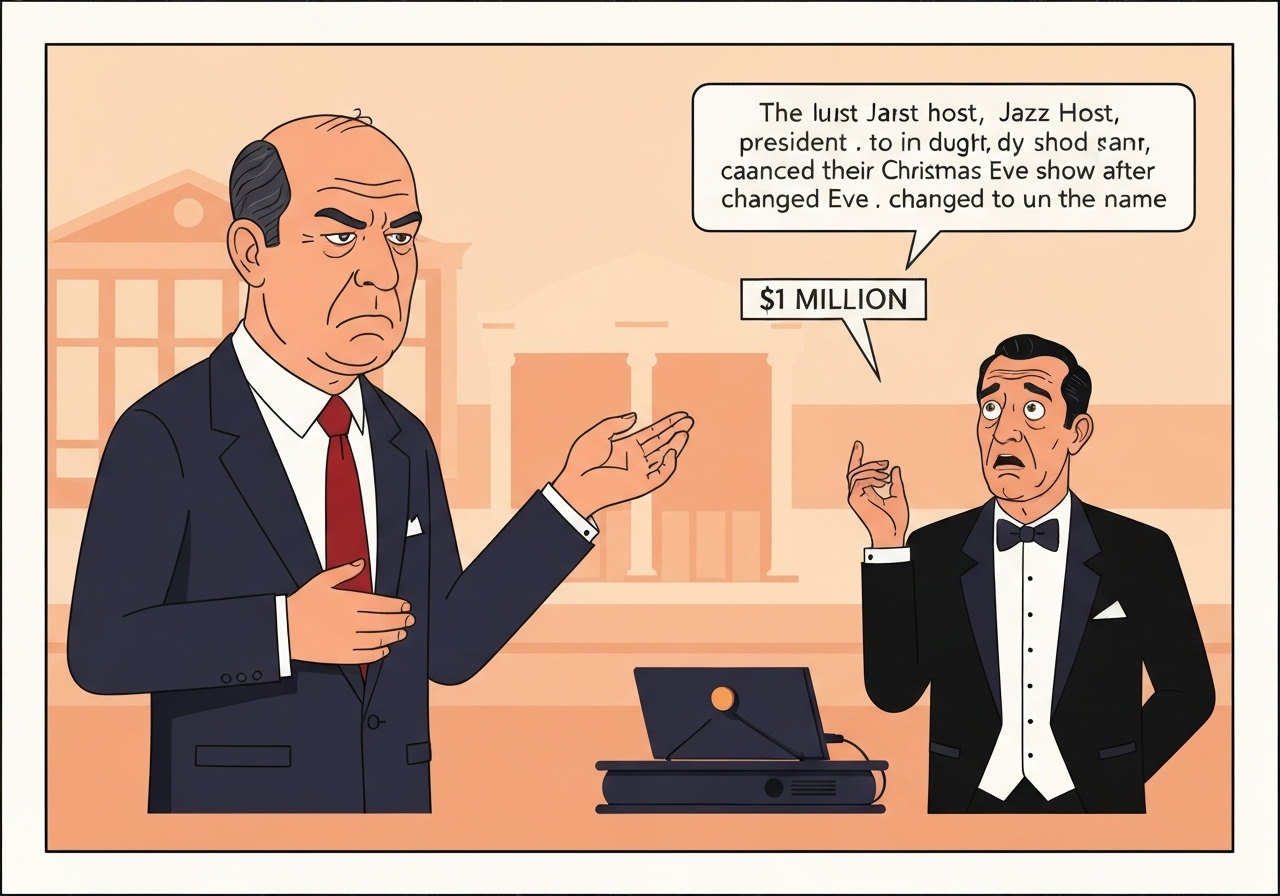
Richard Grenell, president of the Kennedy Center, has demanded $1 million in damages from jazz host Chuck Redd after Redd abruptly canceled a long-running Christmas Eve performance following the White House announcement that the center would bear Donald Trump’s name. The cancellation came days after the new signage appeared on the building; Grenell called the withdrawal an explicitly political response and said the center would pursue compensation. Redd, who has led the holiday Jazz Jams since 2006, told reporters he canceled upon seeing the name change on the center’s website and exterior. The dispute has escalated into a legal and political flashpoint over the cultural center’s governance and a 1964 law that designates the site as a living memorial to John F. Kennedy.
Key Takeaways
- Kennedy Center president Richard Grenell sent a letter to musician Chuck Redd seeking $1,000,000 in damages, labeling the cancellation a “political stunt.”
- Chuck Redd canceled his long-running Christmas Eve Jazz Jam after the White House announced the center would be renamed to honor Donald Trump; Redd has run the event since 2006.
- The Kennedy Center was established as a living memorial to John F. Kennedy after his 1963 assassination; Congress passed a law in 1964 with specific naming restrictions.
- The White House says a Trump-selected board approved the renaming; outside scholars and some officials argue that action may violate the 1964 statute.
- Kennedy family members and institutional historians, including Kerry Kennedy and former House historian Ray Smock, have said any permanent renaming or exterior signage changes would require Congress or further legal review.
- Grenell was appointed to lead the Kennedy Center after previous leadership changes; critics warn the episode highlights politicization risks for cultural nonprofits.
Background
The John F. Kennedy Center for the Performing Arts was designated by Congress in 1964 as a living memorial to the slain president, a status that includes legal constraints on converting the site into a memorial to others or placing additional names on the facility’s exterior. For decades the center operated with a governance structure that mixed public oversight and private fundraising; trustees traditionally avoided naming the building after living political figures. The recent decision to affix President Trump’s name followed a White House statement that a board selected by Trump approved the change, a move that quickly drew criticism from historians and members of the Kennedy family.
Cultural institutions in the United States often face tensions when political actors seek symbolic recognition; trustees, donors and civic stakeholders can clash over brand, funding and mission. The Kennedy Center has become a focal point because of its national profile and the symbolic weight of its congressional designation. The timing—installation of new signage and a high-profile holiday event—amplified the perceived stakes for performers and audiences who view the center as a civic, not partisan, institution.
Main Event
On and around December 24, 2025, the White House announced that the Kennedy Center would include Donald Trump’s name on the building, and new signage appeared on the center’s exterior and website. Chuck Redd, a drummer and vibraphone player who has led the center’s Jazz Jams since 2006 (succeeding bassist William “Keter” Betts), announced he would not perform the planned Christmas Eve show after seeing the change. In emails and statements shared with news outlets, Redd said he canceled the concert in response to the renaming and described the annual event as a popular holiday tradition that often showcased students.
Richard Grenell, who the White House installed as Kennedy Center president after earlier leadership was removed, sent a letter to Redd that was shared with the Associated Press and other outlets. In the letter Grenell called Redd’s withdrawal “classic intolerance” and said the center would seek $1,000,000 in damages “for this political stunt.” The center framed the claim as a cost to a non-profit arts institution arising from a last-minute cancellation of a revenue-generating event.
The dispute has not culminated in publicly filed litigation as of the latest reporting; Redd did not immediately respond to separate requests for comment beyond his statement to reporters. Other stakeholders—including members of the Kennedy family and institutional historians—have publicly questioned the governance route used to effect the renaming and warned that statutory constraints could require congressional action to remedy or confirm changes.
Analysis & Implications
Legally, the December development raises immediate questions about statutory authority. The 1964 law creating the Kennedy Center as a living memorial contains language intended to protect the site from conversion into a memorial for others or from bearing another person’s name on its exterior. If scholars’ assessments are correct, a board vote alone—particularly one controlled by political appointees—may not satisfy the statute’s requirements and could invite congressional review or court challenges.
For the Kennedy Center as a nonprofit, the spat illustrates operational risk: high-profile programming depends on performer goodwill and public trust. A sudden cancellation of a tradition that has run since 2006 deprives the center of ticket revenue and community engagement, and a claim for $1 million heightens financial exposure—even if the sum is ultimately symbolic or contested in court. Donors and institutional partners may reassess their involvement if the center is perceived as politically aligned rather than mission-driven.
Politically, the episode is likely to reverberate through both congressional oversight and public opinion. Members of the Kennedy family have signaled intent to reverse the change if possible; congressional committees could open inquiries into the board’s authority and governance choices. Internationally, the controversy touches broader debates about politicizing cultural institutions and how democracies protect civic memorials from partisan rebranding.
Comparison & Data
| Claim or Action | Reported Status |
|---|---|
| 1964 Congressional designation | Established Kennedy Center as a living memorial to JFK; text cited by critics to block renaming |
| Board approval reported by White House | White House statement says Trump-appointed board approved renaming; critics dispute legal sufficiency |
| Performance cancellations | Chuck Redd canceled Christmas Eve Jazz Jam; event has run annually since 2006 |
| Damages demand | Grenell letter seeks $1,000,000 from Redd for last-minute withdrawal |
The table summarizes core factual claims and their reported status; legal interpretation of the 1964 statute remains contested, and enforcement or adjudication could take months. Financially, the $1 million figure is substantial for a nonprofit event cancellation but may be calculated as direct and indirect losses rather than a fixed statutory penalty.
Reactions & Quotes
“Your decision to withdraw at the last moment — explicitly in response to the Center’s recent renaming… is classic intolerance and very costly to a non-profit Arts institution.”
Richard Grenell, Kennedy Center president (letter)
“When I saw the name change on the Kennedy Center website and then hours later on the building, I chose to cancel our concert.”
Chuck Redd, musician
“Any changes would have to be approved by Congress.”
Ray Smock, former House historian (institutional governance expert)
These excerpts capture competing perspectives: Grenell frames the cancellation as a costly political protest, Redd frames it as a principled refusal, and institutional historians point to statutory and procedural constraints that could invalidate or require reversal of the renaming.
Unconfirmed
- Whether Grenell has formally filed a lawsuit seeking the $1,000,000 demand; no court filings were reported at the time of publication.
- Whether the board’s vote, as described by the White House, satisfies the specific legal requirements of the 1964 statute; scholars dispute the board’s authority but no final legal ruling has been reported.
- Whether additional performers or donors will cancel or withdraw support in response to the renaming; further reactions are possible and not yet fully reported.
Bottom Line
The confrontation between the Kennedy Center leadership and a long-time performer crystallizes a larger conflict over who controls national cultural symbols and how political influence can reshape civic institutions. The $1 million demand is both a financial and symbolic escalation: it signals the center’s leadership is willing to treat a program cancellation as an actionable loss and raises the stakes for performers and partners deciding whether to engage.
In the short term, expect legal and congressional scrutiny of the renaming process and continued public debate about the center’s role as a nonpartisan civic institution. For audiences and artists, the episode underscores that programming decisions can become entangled with high-stakes governance disputes—an outcome that could affect attendance, fundraising and the center’s institutional reputation going forward.
Sources
- The Guardian — international news outlet reporting the initial story and letter details (news).
- Associated Press — news agency cited by outlets as having received the Grenell letter and Redd statements (news agency).
- Kennedy Center — official institutional website and source for official statements and event history (official).
- The White House — statement on board actions and renaming as reported by officials (official).
- Congress.gov — federal legislative records and texts related to the 1964 designation (official/government).