
Lead
Kennedy Center employees say an abrupt internal note from Ric Grenell—President Trump’s appointee overseeing a sweeping makeover—has left roughly 2,000 jobs uncertain as the venue moves toward a planned two‑year closure and building overhaul beginning in early July. The email, seen by The Washington Post and circulated to staff, warned that departments would operate at a greatly reduced scale and that some units could be “totally reduced or on hold,” language staff interpret as preparation for mass layoffs. The message follows a year of leadership upheaval after Mr. Trump replaced the center’s board and took the chairmanship last February. Staff describe the announcement as a unilateral shutdown framed as renovation, with immediate financial and morale consequences.
Key Takeaways
- About 2,000 Kennedy Center staff were notified that a two‑year closure and renovation beginning in early July will force major operational reductions.
- Ric Grenell informed employees that some units will be “totally reduced or on hold,” and that there will be “permanent or temporary adjustments” for many workers.
- Officials say the center entered recent leadership with roughly $100 million in inherited debt; the Trump administration estimates the overhaul at about $200 million, while the Journal reported a likely total closer to $300 million.
- Ticket sales and donor confidence have reportedly fallen, and many artists have declined to perform since the governance changes initiated last February.
- Staffers and some trustees say the name change to include Mr. Trump’s name was proposed by board member Sergio Gor and was ultimately approved, a move that drew private frustration.
- White House press secretary Karoline Leavitt told The Wall Street Journal the president’s involvement in the center’s reconstruction has been positive and hands‑on.
Background
The John F. Kennedy Center for the Performing Arts, a major Washington cultural institution, has been at the center of controversy since President Trump moved to remake its leadership last February. He dissolved the existing board structure and installed a new governance arrangement that placed him in the chair role, a step that critics say politicized an institution long treated as nonpartisan. That governance change coincided with a wave of artist withdrawals and a notable drop in ticket sales, according to staff accounts shared with news outlets.
Administrators say the center inherited approximately $100 million in debt when the new leadership took over, a figure officials cite to justify urgent financial interventions. The White House and allies have framed an overhaul as necessary to modernize the facility and stabilize finances, while opponents argue the disruption has accelerated declines in public engagement and donor confidence. The name change that added the president’s name to the façade was proposed by trustee Sergio Gor and approved by the board, a decision that insiders say was publicly uncontroversial but privately resented by some trustees.
Main Event
In a staff email reviewed by The Washington Post, Ric Grenell outlined plans for a “total renovation of the building beginning in early July” and warned that during “this aggressive construction phase” departments would operate at a smaller scale. He wrote that many units could be reduced or put on hold until preparation to reopen in 2028, language that employees interpreted as signaling imminent layoffs. Staff told reporters the message lacked detail on who would be affected and offered no clear timeline for decisions or severance protections.
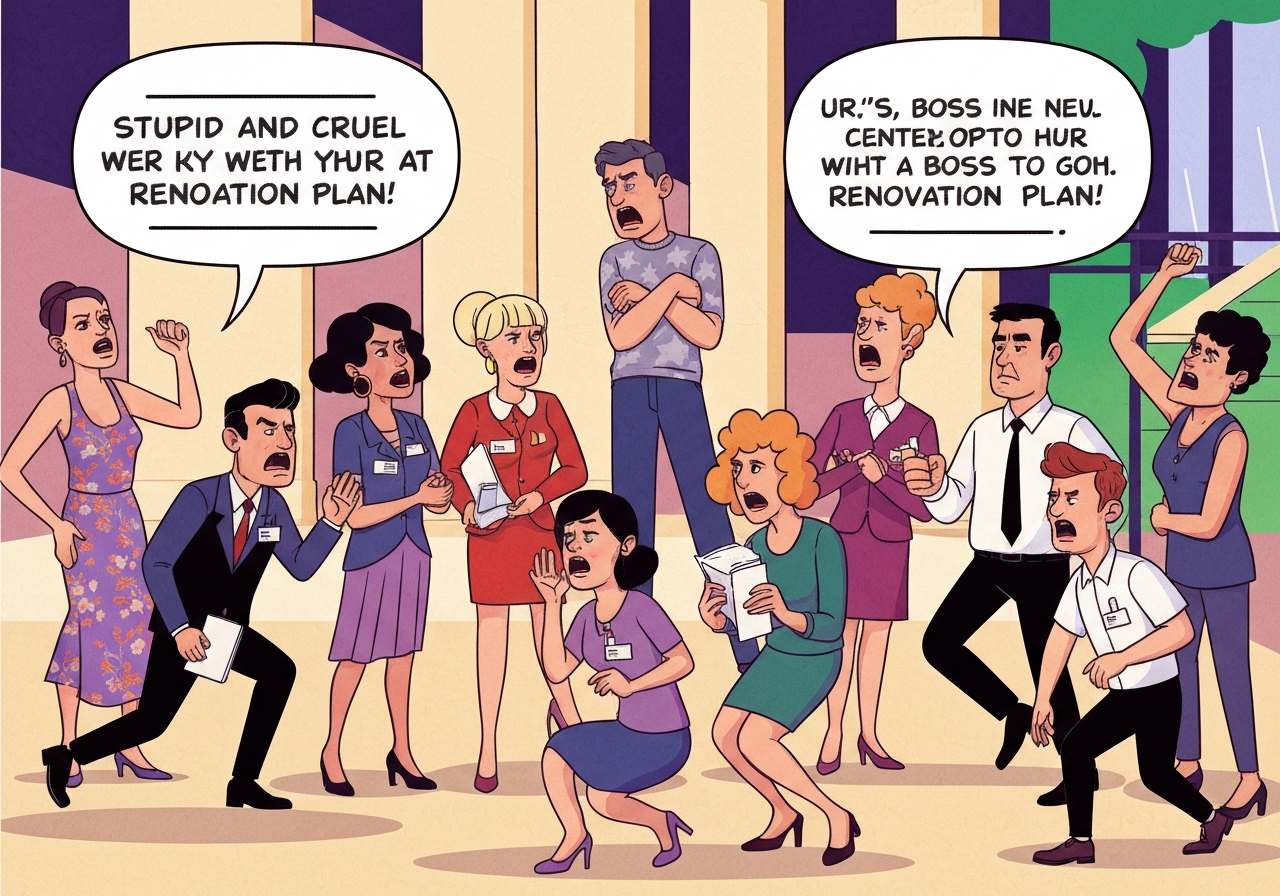
Employees described the note as a sudden escalation following earlier announcements about the two‑year closure. One anonymous staffer told reporters there was no strategic plan accompanying the shutdown, calling the move a dismantling rather than a renovation. Another staffer used stronger language, characterizing the action as “stupid and cruel,” reflecting acute frustration among front‑line personnel who deliver programming and manage daily operations.
Officials at the center have defended the overhaul as a necessary reset. The White House has publicly framed the president’s involvement as extensive and beneficial; press secretary Karoline Leavitt told The Wall Street Journal that Mr. Trump’s hands‑on approach spans from trade to the center’s reconstruction. Meanwhile, a Journal analysis raised questions about the project’s cost, estimating the total could be about $100 million higher than the president’s $200 million figure.
Analysis & Implications
The immediate operational impact is likely to be widespread if departments are scaled back as described. Reduced staffing levels during a multi‑year closure would complicate the center’s ability to maintain community programs, manage donor relations, and preserve institutional knowledge—risks that can have long tails even after construction ends. For cultural organizations, continuity of staff and artistic relationships is often a precondition for post‑project recovery; prolonged layoffs could therefore lengthen the timeline to restore full programming.
Financially, a higher‑than‑expected cost profile—if the Journal’s estimate near $300 million proves accurate—would strain public and private funding channels and could require additional cuts or fundraising that may be difficult amid eroded donor trust. The center’s reported $100 million inherited debt means there is limited fiscal cushion for unexpected overruns, increasing the chance that staffing and programmatic cuts become permanent rather than temporary.
Politically, the decision intensifies scrutiny over presidential involvement in cultural institutions. Attaching a president’s name to a national arts venue is a symbolic act that can polarize stakeholders and donors; combined with governance overhaul, it risks cementing perceptions that operations are being politicized. Domestically, that perception may depress future philanthropic support from donors who prefer distance between politics and cultural stewardship. Internationally, the reputational effects are subtler but could affect the center’s ability to host touring ensembles and diplomatic cultural exchanges.
Comparison & Data
| Item | Reported Figure |
|---|---|
| Staff potentially affected | ~2,000 employees |
| Inherited debt (official) | $100 million |
| President’s stated renovation cost | ~$200 million |
| Journal’s cost estimate | ~$300 million |
| Planned closure/renovation span | Two years (reopen preparations cited for 2028) |
The table places immediate figures side by side so readers can weigh the scale of staffing against financial claims. If true cost rises toward the higher estimate, the ratio of staff impact to budget—already steep given the center’s existing debt—will widen, increasing pressure for program cuts or longer recovery. Historic examples from other major arts renovations show that extended closures often lead to multi‑year rebounds in attendance and philanthropy, not immediate restorations.
Reactions & Quotes
“There is no way to read this message as anything other than preparation for mass layoffs and institutional contraction.”
Anonymous Kennedy Center staffer (quoted to The Washington Post)
“This is all so stupid and cruel.”
Anonymous Kennedy Center staffer (quoted to The Washington Post)
“Isn’t it wonderful to have a President who is so deeply involved in every issue, and every detail…and yes, even the reconstruction of the Kennedy Center.”
Karoline Leavitt, White House Press Secretary (quoted to The Wall Street Journal)
Each quote captures a different perspective: frontline staff emphasizing fear and morale damage, and a White House official emphasizing pride in presidential engagement. Taken together, they illustrate the polarized reception of the plan among stakeholders.
Unconfirmed
- Precise headcount of permanent layoffs: the email signals reductions but does not specify the number or departments definitively.
- Final total renovation cost: the administration cites about $200 million, while a Journal analysis suggests roughly $300 million; an authoritative final budget has not been released.
- Whether the board was unanimously supportive of all operational plans behind the closure: reporting indicates unanimous votes on some items, but private trustee reactions vary and full meeting records have not been published.
Bottom Line
The Kennedy Center’s announced shutdown and renovation have created acute uncertainty for roughly 2,000 staff and exposed fault lines between leadership goals and operational reality. If the project proceeds with significant staff reductions and a higher‑than‑expected price tag, the institution may face a prolonged recovery period for programming, fundraising, and audience confidence.
Short‑term remedies—clear timetables, severance and retention packages, and transparent budgeting—would reduce harm and preserve institutional capacity. In the absence of such measures, the move risks deepening the cultural and financial damage that leaders say the renovation is intended to fix. Stakeholders and the public should expect more detailed budgets and staffing plans as the next critical inputs to judge whether the overhaul can deliver its stated benefits.
Sources
- The Daily Beast — news report summarizing staff reactions and internal communications
- The Washington Post — reporting referenced for the staff email and anonymous staff quotes (news)
- The Wall Street Journal — analysis cited for cost estimate and White House comments (news/analysis)
- The John F. Kennedy Center for the Performing Arts — institutional website (official)