
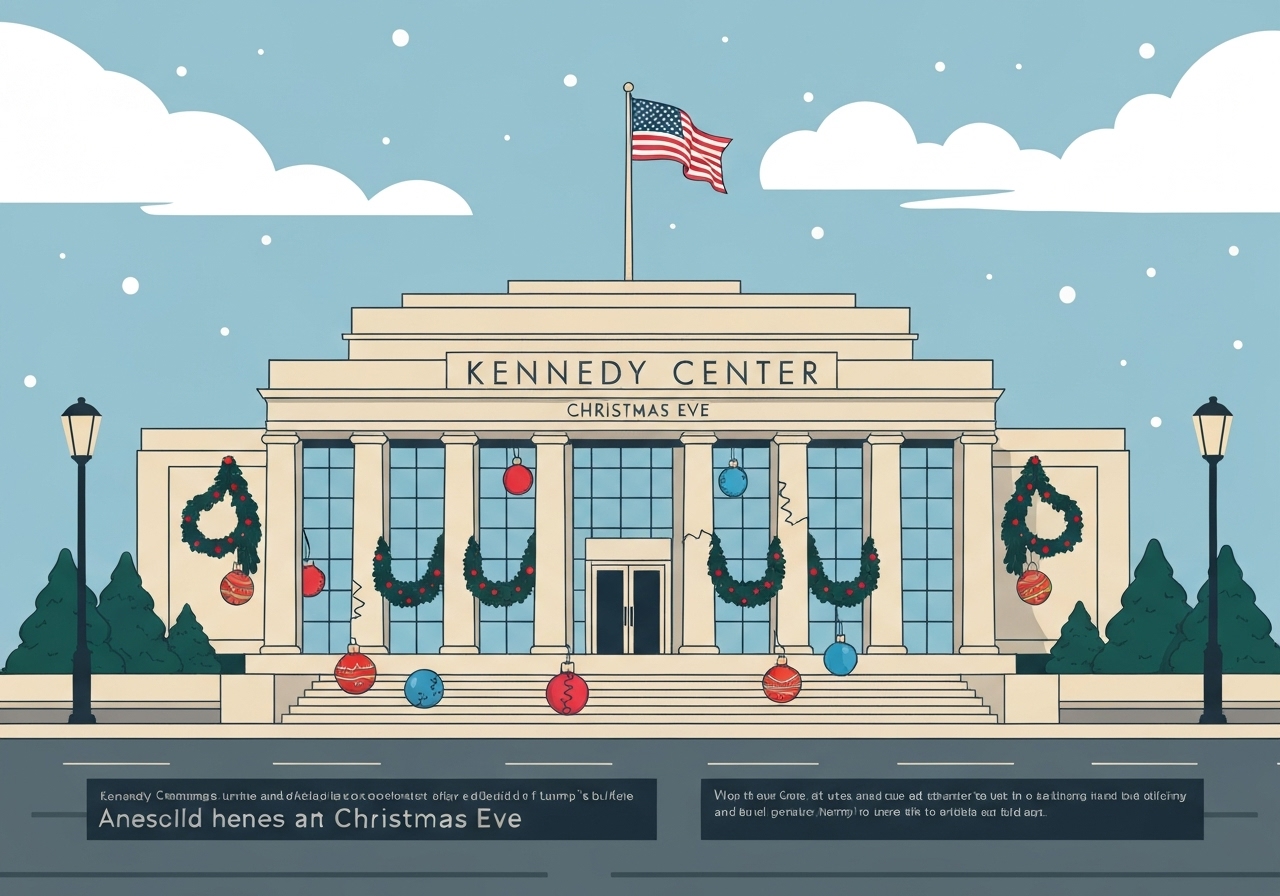
Lead: On Dec. 24, 2025, longtime holiday host Chuck Redd canceled a planned Christmas Eve jazz concert at the John F. Kennedy Center for the Performing Arts in Washington, D.C., after the White House announced last week that President Donald Trump’s name had been added to the institution’s facade. The change — presented by the White House as approved by the center’s board and reflected on the building as the “Trump-Kennedy Center” — has prompted legal challenges and political outcry. The cancellation breaks a multi-decade holiday tradition and adds a cultural protest to an evolving legal dispute over the memorial’s name.
Key Takeaways
- Concert canceled: Jazz host Chuck Redd called off the Dec. 24, 2025 performance after the center displayed the name change publicly.
- Renaming announced: The White House said a Trump-appointed board approved renaming the institution the “Trump-Kennedy Center.”
- Legal challenge: Democratic Rep. Joyce Beatty filed a lawsuit on Dec. 22, 2025, arguing the renaming violates federal law that designates the site as a living memorial to John F. Kennedy.
- Institutional dispute: Kennedy Center president Richard Grenell, appointed by Mr. Trump, maintains the memorial status was not altered despite the new signage.
- Artists withdrawing: Several performers have canceled appearances since Mr. Trump returned to office, including named cancellations and a halted production of “Hamilton.”
- Tradition impacted: Chuck Redd had led holiday “Jazz Jams” at the center since 2006, part of a long-standing seasonal program at the facility.
Background
The Kennedy Center was created as a national living memorial to President John F. Kennedy after his assassination in 1963; Congress passed legislation to establish and name the center as a tribute. That statutory designation has been cited repeatedly by critics who argue that the site cannot receive additional memorials or renamings without congressional action. Governance of the Kennedy Center is carried out by a board of trustees; in recent years that board has been reshaped through presidential appointments and leadership changes, including the installation of Richard Grenell as president.
Relations between the center’s management and segments of the arts community have frayed since major leadership changes and the involvement of the White House in programming decisions. Former practices saw presidents largely in spectator roles at major events; the recent hands-on approach, and an overhaul of the board, have coincided with several artists publicly withdrawing from performances. The legal and political stakes are heightened because the Kennedy Center is both a national memorial and a major cultural institution hosting touring and resident artists.
Main Event
The sequence of events intensified last week when the White House announced that the president’s chosen board had approved appending Mr. Trump’s name to the facility, and the revised name appeared on the center’s website and later on its facade. Chuck Redd, a drummer and vibraphonist who has led holiday “Jazz Jams” since 2006, told the Associated Press he canceled the show after seeing the name change appear online and on the building. The Kennedy Center’s public calendar later listed the Dec. 24 performance as canceled.
Rep. Joyce Beatty of Ohio filed a suit on Dec. 22, 2025, asserting the board lacked authority to add a presidential name and that the statutory memorial designation requires an act of Congress to alter. The complaint characterized the action as a violation of federal law and sought judicial relief to block the renaming or related changes. Center leadership, represented by President Richard Grenell, has disputed the legal premise, saying the memorial status remains intact and that the board acted within its remit.
The dispute follows a string of organizational changes at the Kennedy Center since Mr. Trump returned to the White House. According to public reporting, the president installed new trustees, removed prior senior staff, and broke precedent by personally hosting the Kennedy Center honors earlier this year. Multiple artists — including Issa Rae and Peter Wolf — have announced cancellations in the weeks following the leadership overhaul; Lin-Manuel Miranda also canceled a planned production of “Hamilton.”
Analysis & Implications
Legally, the case centers on statutory language that established the Kennedy Center as a living memorial to John F. Kennedy and on the scope of authority delegated to the board of trustees. If a court concludes the board exceeded its authority, the ruling could restore or clarify limits on unilateral renaming decisions for federally created memorial institutions. Conversely, a ruling for the board could expand the latitude of trustee actions at quasi-federal cultural entities.
Politically, the episode deepens partisan divides over symbolic public spaces. Renaming a memorial after a sitting president — particularly one of a different party from the memorialized figure — raises questions about precedent and politicization of national cultural symbols. Congressional responses may include oversight hearings or legislation to clarify naming rules, but such measures would require bipartisan agreement to resolve a dispute that already has judicial momentum.
For the arts community, the immediate impact is reputational and operational: event cancellations reduce programming and revenue and signal broader discomfort among performers and patrons. Over time, prolonged controversy could alter booking decisions, donor behavior, and audience attendance, particularly if sponsors or artists view the institution as politically contested. Financial and cultural ripple effects may therefore extend beyond this single holiday cancellation.
Comparison & Data
| Item | Fact |
|---|---|
| Kennedy memorial origin | Created after JFK’s 1963 assassination; established by act of Congress as a living memorial |
| Chuck Redd’s tenure | Host of holiday Jazz Jams since 2006 |
| Key dates (article) | Renaming announced last week; concert canceled Dec. 24, 2025; lawsuit filed Dec. 22, 2025 |
The table highlights statutory and timeline anchors for the dispute: the memorial’s congressional origin, the long-running jazz tradition, and the concentrated sequence of announcements, signage changes and legal filings in late December 2025. Those anchors shape how courts, Congress and the public will evaluate the actions and their legitimacy.
Reactions & Quotes
The performer who canceled framed his decision as a response to the visible name change.
“When I saw the name change on the Kennedy Center website and then hours later on the building, I chose to cancel our concert,”
Chuck Redd, musician (email to AP)
A leading congressional critic framed the renaming as unlawful and began legal action.
“A flagrant violation of the rule of law,”
Rep. Joyce Beatty (plaintiff in lawsuit)
Center leadership has defended its actions, arguing the memorial status was not revoked and that governance decisions were made by the authorized board. That defense sets the legal contours that courts will now parse.
Unconfirmed
- Whether the board followed all internal procedures for the renaming: public records on board votes and minutes have not been fully released.
- Any behind-the-scenes agreements between the White House and trustees about signage timing or public announcements remain unverified.
Bottom Line
The cancellation of a long-running Christmas Eve jazz event is a concrete cultural repercussion of a broader institutional and legal battle over the Kennedy Center’s name. The dispute combines statutory interpretation, governance questions and partisan symbolism, and it is likely to play out in both courts and Congress in the months ahead.
For artists and audiences, the episode signals that programming decisions may increasingly reflect political as well as cultural considerations. Observers should watch court filings, board records and any congressional responses to gauge whether the renaming will stand, be reversed, or prompt new laws clarifying how national memorials can be altered.