
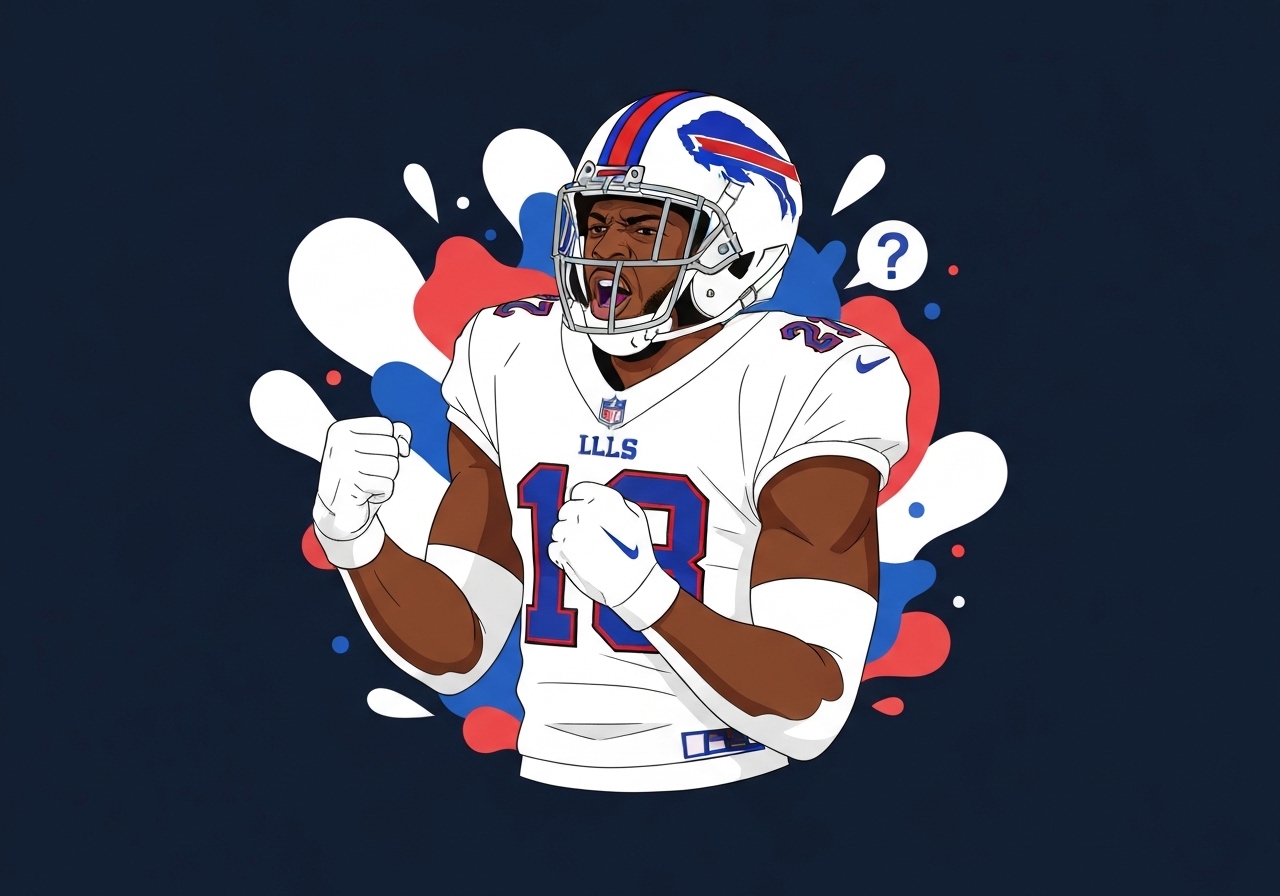
Lead: Keon Coleman, the Buffalo Bills’ 2024 second-round pick, faced direct public criticism from owner Terry Pegula during an end-of-season press conference on Jan. 24, 2026. According to reporting from The Athletic, Coleman was initially surprised by the remarks but has continued to train and prepare for the 2026 season. He has not publicly asked for a trade and remains under contract with two seasons still to run. The episode has intensified scrutiny of both the receiver’s development and the organization’s handling of personnel issues.
Key takeaways
- Keon Coleman, 22, was publicly referenced by Bills owner Terry Pegula at a Jan. 2026 press conference as a pick the coaching staff pushed for in 2024.
- Coleman’s two NFL seasons produced 67 receptions for 960 yards and eight touchdowns (29 catches, 556 yards, 4 TDs in Year 1; 38 catches, 404 yards, 4 TDs in Year 2).
- Sources told The Athletic Coleman was “taken aback” but continued to train and has not requested a trade as of late January 2026.
- Owner Pegula said Brandon Beane did not initially favor the pick, a public reassignment of responsibility that is unusual for an owner to make.
- General manager Brandon Beane defended continued investment in Coleman, noting off-field maturity concerns rather than on-field talent as the principal issue.
- Former Bills lineman Eric Wood publicly criticized Coleman’s effort and punctuality on social media, amplifying internal doubts about the receiver’s standing.
- Any trade market for Coleman would likely yield limited return given two underwhelming seasons and reports of availability issues.
Background
The Bills selected Keon Coleman in the second round of the 2024 NFL Draft after trading back with the Kansas City Chiefs in a move that cleared the way for Kansas City to take Xavier Worthy. Buffalo used the pick one slot ahead of the Chargers’ later standout Ladd McConkey. Coleman arrived with high college production and physical tools but entered a Bills roster that has long sought dependable outside playmakers to pair with Josh Allen.
Across his first two seasons Coleman has struggled to produce consistent impact relative to expectations. His rookie year yielded 29 receptions for 556 yards and four touchdowns, and his second year produced 38 catches for 404 yards and four touchdowns, while he also faced benchings and inactive designations on game days. The Bills’ broader receiving corps and playmaking depth have been recurring topics in Buffalo’s offseason planning, which frames why a high-profile critique of a young player reverberates beyond the individual.
Main event
At a Jan. 24, 2026 press conference, owner Terry Pegula interrupted a question directed at newly promoted president of football operations Brandon Beane and said the coaching staff had pushed to draft Coleman in 2024. Pegula framed the pick as one driven by coaching advocacy rather than Beane’s top choice, and said he wanted to correct the public record. The interruption and assignment of blame to staff choices were notable because owners rarely single out internal decision-making in that manner during a public forum.
The Athletic reported that Coleman was surprised by Pegula’s remarks but immediately returned to work, training for the coming season. Team sources describe him as continuing to prepare rather than seeking an exit, and there has been no confirmed trade request in the days after the presser. Beane, meanwhile, said the organization still believes in Coleman’s potential and emphasized development as the path forward.
External commentary added pressure to the narrative. Former Bills center Eric Wood publicly criticized Coleman’s effort and punctuality on social media, saying those behavioral concerns contributed to the player’s standing. That message found traction among some fans and analysts, who view public accountability and consistent availability as prerequisites for earning playing time and organizational trust.
Analysis & implications
The owner’s public remarks create both immediate and longer-term questions about roster management and internal communication. Publicly reassigning responsibility for a draft choice shifts scrutiny onto coaching and personnel processes; it may also alter how coaches and front-office staff negotiate future targets. For Coleman personally, the statement could be motivational, but it also increases the consequences of another non-progressive season.
From a roster-value perspective, Coleman’s trade market is likely limited. Two seasons of subpar production and reported availability concerns typically reduce a team’s leverage, meaning Buffalo would probably receive modest compensation in any deal. That reality constrains options for the Bills if they decide they can no longer accommodate Coleman, and it raises the likelihood the team will try to extract more value through internal development or low-cost roster moves.
Coaching changes — a realistic possibility for Buffalo in the coming offseason — would be pivotal for Coleman’s future. A new offensive staff could either reset his role and technique or deprioritize him in favor of other playmakers. Given that Coleman has two years left on his contract, the next head coach’s evaluation will likely determine whether the organization keeps investing in him or views him as expendable.
Comparison & data
| Season | Receptions | Receiving Yards | Receiving TDs |
|---|---|---|---|
| 2024 (Rookie) | 29 | 556 | 4 |
| 2025 | 38 | 404 | 4 |
| Total (2 seasons) | 67 | 960 | 8 |
The table underscores a plateau rather than a clear upward trajectory in production between Coleman’s first two seasons. Although his yards per catch and touchdown totals show some consistency, the overall growth expected of a developing second-round receiver is limited. In context, the Bills have prioritized finding dependable weapons around Josh Allen; Coleman’s statistical profile so far has not moved the needle enough to end that search.
Reactions & quotes
Team leadership publicly addressed the situation in ways that sought to balance accountability with the assertion of continued belief in Coleman. The owner’s interjection aimed to correct what he described as a misunderstanding of how the pick unfolded, while the front office framed the matter as part of a longer-term development plan.
“Can I interrupt? The coaching staff pushed to draft Keon. I’m not saying Brandon wouldn’t have drafted him, but he wasn’t his next choice,”
Terry Pegula (Bills owner)
That interruption drew attention because it placed an organizational decision squarely in the public record and shifted focus onto coaching advocacy for the selection. Pegula presented the remark as an effort to set the record straight, but the delivery invited questions about internal alignment and public messaging.
Front-office leaders emphasized they still plan to work with Coleman but described the barriers as maturity and availability rather than a lack of raw ability. Those statements framed the path forward as developmental rather than punitive.
“We still believe in Keon Coleman here, and it’s up to us to develop his talent so he can help us win games,”
Brandon Beane (President of Football Operations)
Beane reiterated that Coleman has two years remaining on his contract and that the organization expects to help him improve. His remarks were intended to reassure fans that the team has a plan, but they also acknowledged past issues beyond purely on-field performance.
Former players and commentators added their perspectives on effort and accountability, increasing the public pressure on the player to respond with consistency.
“He was late to meetings enough to get benched multiple times. Low effort constantly. He brought all the criticism on himself,”
Eric Wood (former Bills lineman, social media)
Wood’s comments amplified the narrative that behavioral factors contributed to Coleman’s standing and were cited by fans and pundits as evidence that the situation extended beyond schematic fit or coaching usage.
Unconfirmed
- There is no independent confirmation that Coleman has formally requested a trade; reports indicate he has not asked out as of late January 2026.
- It is unconfirmed whether Pegula’s comments were coordinated with the front office or made unilaterally at the presser.
- Locker-room sentiment about Coleman’s future role has not been publicly verified beyond isolated social-media commentary and anonymous sources.
Bottom line
The episode highlights a crossroads for Keon Coleman and the Bills. Public criticism from an owner increases pressure on the player to convert potential into consistent production and on the organization to clarify its development strategy. With two years remaining on his contract, Coleman’s immediate choices—responding with improved availability and on-field play or becoming a trade candidate—will shape his career trajectory.
For Buffalo, the situation spotlights broader roster questions: the need for reliable playmakers around Josh Allen and the degree to which the club will tolerate prolonged underperformance from a high draft pick. How the front office and any incoming coach handle Coleman will signal whether the team prioritizes internal development or seeks change via personnel moves.
Sources
- New York Post — (media report consolidating presser remarks and commentary)
- The Athletic — (sports journalism; initial sourcing on Coleman’s reaction to ownership comments)
- Buffalo Bills — (official team site for press releases and organizational statements)