
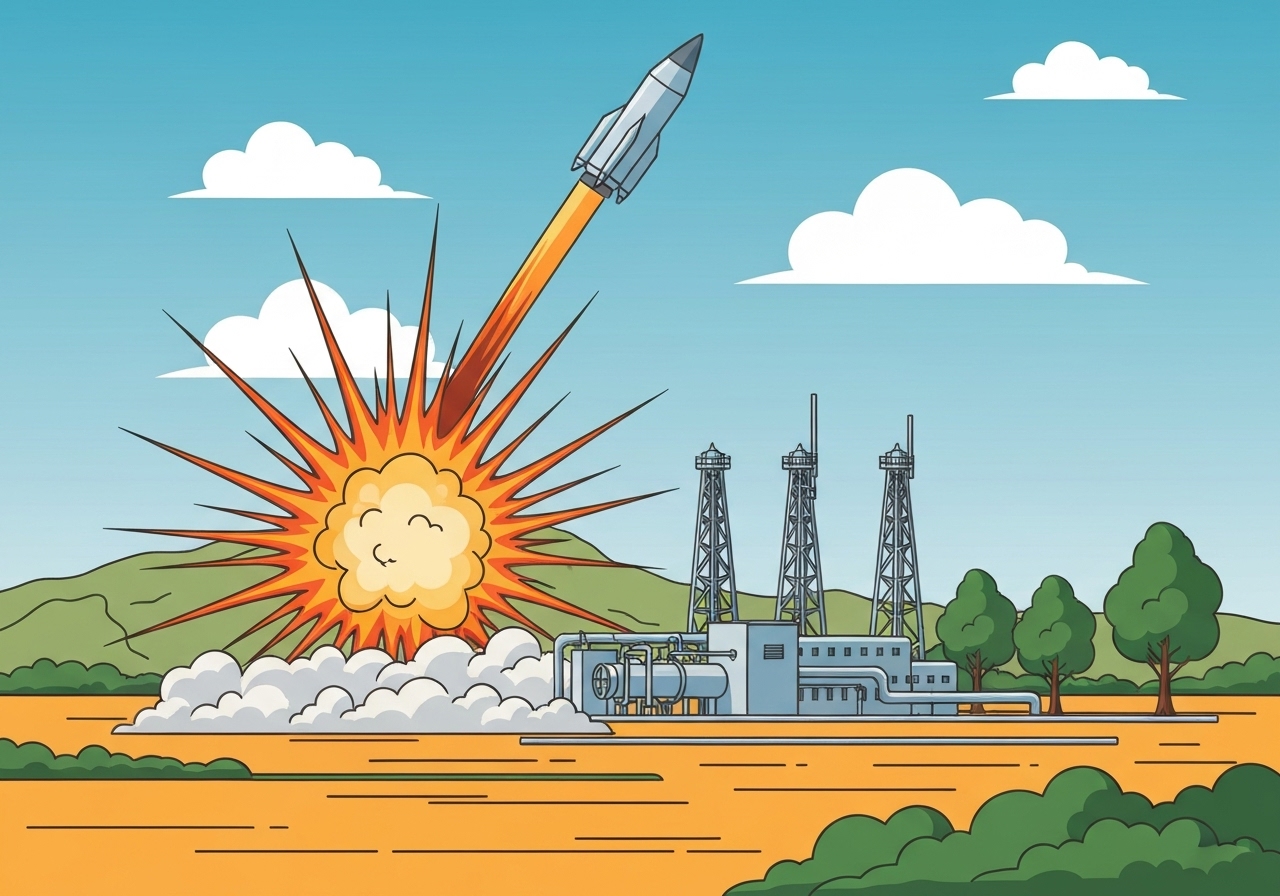
— An overnight rocket strike on the Khor Mor gas field in northern Iraq knocked out production shortly after midnight and left most of the semiautonomous Kurdistan region without power, local officials said. The attack is the latest in a series of drone and rocket assaults on Kurdish-run oil and gas infrastructure over recent months. Iraqi Prime Minister Mohammed al-Sudani denounced the incident as an “attack on all of Iraq,” while authorities have not publicly named the perpetrators. Privately, Iraqi and Kurdish officials have pointed to Iran-aligned militias as likely suspects.
Key Takeaways
- The strike occurred shortly after midnight on Nov. 27, 2025, at the Khor Mor gas field, one of the largest in Iraq’s Kurdistan region.
- Power outages spread across most of Kurdistan after gas output was disrupted, affecting utilities and industrial consumers regionwide.
- Prime Minister Mohammed al-Sudani called the attack an “attack on all of Iraq” and urged a national response.
- Officials have not publicly attributed responsibility; privately, Iraqi and Kurdish authorities have blamed militias aligned with Iran.
- The U.S. envoy to Iraq, Mark Savaya, referenced “armed groups operating illegally and driven by hostile foreign agendas” in a post on X.
- Asa’ib Ahl al-Haq publicly condemned the strike and called for a national investigation; several other militias remained silent.
Background
The Khor Mor complex is a major supplier of natural gas and associated liquids that feed power plants and industry in Iraq’s north. Kurdistan depends on local gas production for a large share of its electricity generation; interruptions to Khor Mor therefore have immediate and widespread consequences for households and businesses. Over the past year, Kurdish-run oil and gas sites have been targeted repeatedly by drones and rockets, increasing concerns about the vulnerability of energy infrastructure. Those attacks have strained relations between Baghdad, Erbil, and neighboring states while complicating security arrangements around critical facilities.
Militias with various loyalties and external backers operate across Iraq, some historically linked to Iran and others aligned more closely with Baghdad or local power brokers. These groups have been accused in the past of striking U.S. or foreign interests in Iraq; officials say the same networks could see Kurdistan as a lower-risk target because of its economic ties with Washington. The central government and the Kurdistan Regional Government (KRG) share responsibility for security coordination, but persistent political friction has limited seamless cooperation at some sites. International companies and regional partners view repeated hits on energy infrastructure as a threat to investment and regional stability.
Main Event
According to Kurdish regional authorities, rockets struck facilities at Khor Mor shortly after midnight on Nov. 27, causing fires and damage to pipelines and processing units that halted gas flow. The outage propagated through the region’s power-generation system as gas-fed plants lost their fuel supply, prompting rolling and in some areas prolonged blackouts. Emergency crews responded to contain fires and assess structural damage; officials said restoration work would take time while safety checks proceed.
Prime Minister Mohammed al-Sudani issued a public condemnation, framing the strike as an assault on Iraq’s sovereignty and calling for a comprehensive inquiry into the incident. Iraqi federal authorities have not released an official attribution; investigators from both Baghdad and Erbil are reportedly collecting forensic evidence at the scene. In a message posted on X, U.S. envoy Mark Savaya linked the attack to “armed groups operating illegally and driven by hostile foreign agendas,” suggesting concern among Washington’s diplomatic representatives.
One militia, Asa’ib Ahl al-Haq, issued a statement condemning the strike and urging a national probe, signaling a break from groups that have previously been suspected of similar operations. Other militia leaders and some political figures did not immediately comment, and there was no immediate claim of responsibility for the assault. Energy operators warned that damage assessments and repairs to key processing units could delay the return of full gas flows and that electricity restoration would depend on staged repairs and fuel availability.
Analysis & Implications
The attack underscores the vulnerability of Iraq’s energy infrastructure to asymmetric strikes and the regional ripple effects such incidents can produce. For Kurdistan, where gas from Khor Mor supplies a significant portion of electricity, the immediate impact is humanitarian and economic: hospitals, water systems, and businesses face disruptions while repairs proceed. Repeated strikes also raise insurance and operational costs for operators and may deter foreign investment in a sector already complicated by legal and political disputes between Baghdad and Erbil.
Politically, the pattern of attacks complicates Baghdad–Erbil relations by adding a security dimension to preexisting disputes over resources and revenue sharing. If militias aligned with external actors are responsible, as some officials privately assert, the incidents risk drawing regional actors deeper into Iraq’s internal security challenges. For Washington and other foreign partners, protecting energy infrastructure tied to allied economic relationships becomes a higher priority amid competing diplomatic pressures in the region.
On the military and counterterrorism front, investigators will look for signatures—weapon type, launch vectors, and munitions fragments—that can be linked to known groups or external suppliers. A public attribution could force painful diplomatic choices for the central government and its partners: pursue prosecutions or cross-border pressure, or attempt negotiated de-escalation with local power brokers. Either path carries risks for internal stability and for Iraq’s role as an energy supplier to regional markets.
Comparison & Data
| Actor | Public Stance |
|---|---|
| Iraqi Prime Minister (Mohammed al-Sudani) | Condemned; called for national response |
| Kurdistan Regional Authorities | Reported damage; declared major outages |
| U.S. Envoy (Mark Savaya) | Blamed armed groups with hostile foreign agendas |
| Asa’ib Ahl al-Haq | Condemned attack; called for investigation |
The table summarizes official and public reactions available as of Nov. 27, 2025. Detailed forensic data and a complete timeline of prior attacks have not been released publicly, limiting quantitative trend analysis. Energy-sector sources warn that cumulative disruptions over recent months have incrementally raised operational risk in northern Iraq.
Reactions & Quotes
Government and diplomatic voices framed the strike as more than a local incident, emphasizing national and international implications before full attribution was available.
“This attack is an attack on all of Iraq,”
Mohammed al-Sudani, Prime Minister of Iraq
Al-Sudani used the phrase to urge a unified national response and to signal Baghdad’s interest in leading accountability efforts. His office called for coordinated investigations and closer protection of critical infrastructure, and officials noted that security agencies were mobilized to secure other vulnerable sites.
“Armed groups operating illegally and driven by hostile foreign agendas”
Mark Savaya, U.S. Special Envoy to Iraq (post on X)
The U.S. envoy’s wording suggested Washington sees nonstate armed actors—with external backing—as a likely driver of such attacks, a characterization diplomats said reflected broader regional concerns. The comment also underscored U.S. attention to the safety of energy assets tied to partners in Kurdistan.
“We condemn the attack and call for a national investigation,”
Asa’ib Ahl al-Haq (militia statement)
The statement from Asa’ib Ahl al-Haq marked an unusual public denunciation from a group previously linked to Iran; analysts said its posture could signal internal politics among armed groups or an attempt to avoid escalation. Other militias offered no comment, leaving a public attribution gap that investigators will seek to close.
Unconfirmed
- No group has publicly claimed responsibility, so the identity of the attackers remains unconfirmed by independent forensic evidence.
- Private attributions to Iran-aligned militias have been reported by officials but lack a public, demonstrable link at the time of writing.
- The precise scale of structural damage and the timeline for full power restoration are not yet verified by independent operators or international monitors.
Bottom Line
The rocket strike on Nov. 27 at Khor Mor has immediate humanitarian and economic effects across Kurdistan by severing a key fuel source for power generation. Beyond the blackout, the incident exposes the fragility of northern Iraq’s energy infrastructure and the political fault lines that complicate timely protective measures. If repeated, such attacks will raise costs for operators, chill investment, and force harder security choices for Baghdad and Erbil.
Investigators must now establish responsibility with forensic evidence to enable a credible response; without clear attribution, policymakers risk miscalculation or inadequate deterrence. For residents and businesses in Kurdistan the urgent priorities are restoring power, shoring up emergency services, and ensuring transparent, coordinated repair efforts that reduce the chance of recurrence.