
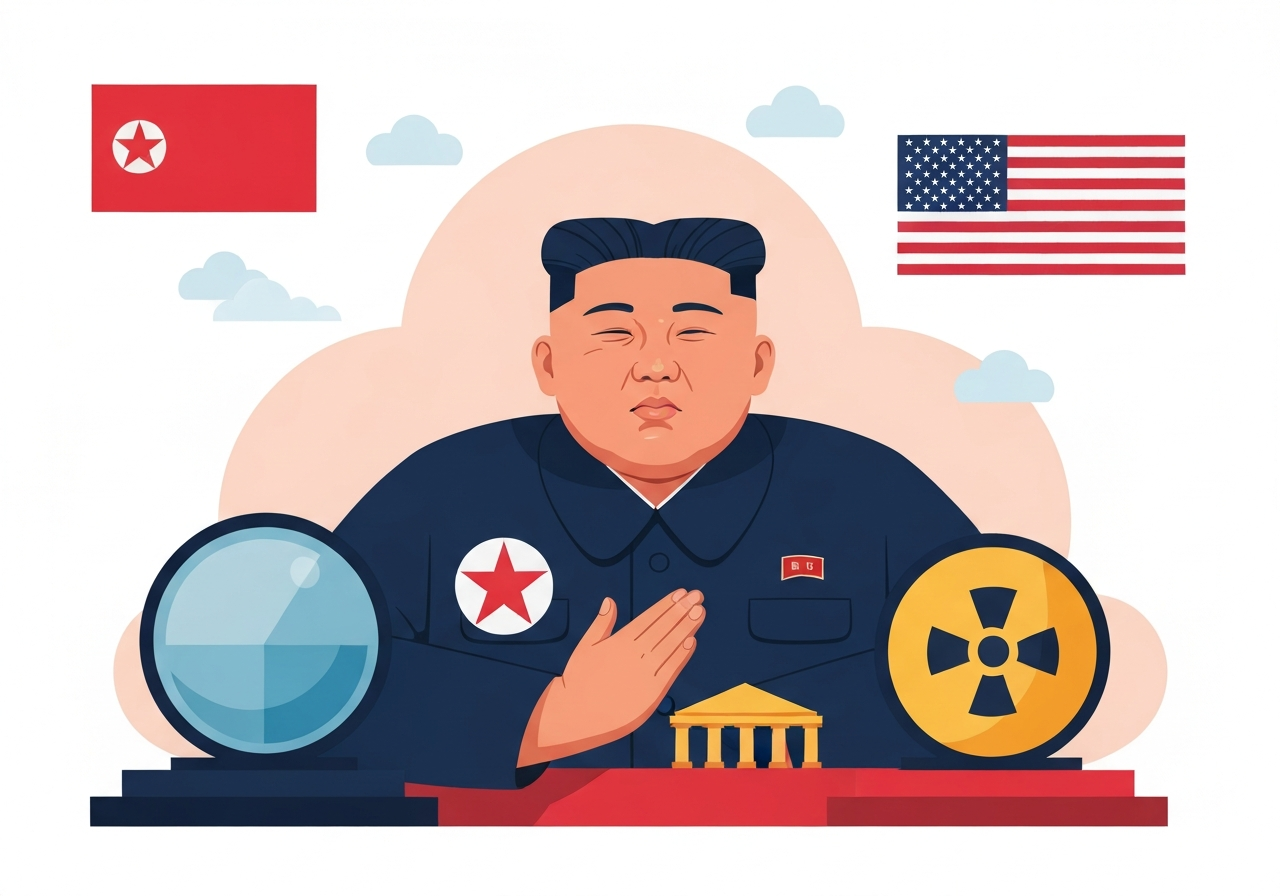
North Korean leader Kim Jong-un told delegates at the ruling Workers’ Party congress on Feb. 26, 2026, that relations with Washington could improve if the United States accepts North Korea as a nuclear-armed state. The comments came as Pyongyang wrapped a seven-day party meeting held once every five years, during which Kim outlined foreign-policy goals for the next half-decade. State media reported he vowed to expand and consolidate the country’s nuclear forces while offering either “peaceful coexistence” or a “permanent standoff” depending on U.S. policy. The remarks arrive amid heightened North Korean diplomatic activity and closer ties with Moscow and Beijing following Russia’s 2022 invasion of Ukraine.
Key Takeaways
- Kim spoke at a seven-day Workers’ Party congress that concluded on Feb. 26, 2026; the congress is held roughly every five years and sets top policy priorities.
- State media (KCNA) reported Kim said North Korea will expand its nuclear forces and consolidate its status as a nuclear-armed state.
- Kim said Pyongyang could pursue “peaceful coexistence” or a “permanent standoff” with the U.S., contingent on Washington’s treatment of North Korea’s nuclear status.
- The speech followed what the New York Times and other outlets described as increased North Korean diplomatic leverage after supplying troops and weapons to support Russia’s war in Ukraine since 2022.
- Pyongyang continues to demand formal recognition as a nuclear state and an end to U.S.-led international sanctions as preconditions for improved relations.
- Analysts say Kim’s language is calibrated to convert military gains and external partnerships into diplomatic concessions from the United States and others in the region.
Background
The Workers’ Party congress, convened every five years, is North Korea’s premier political event for setting leadership priorities and national strategy. This seven-day session was closely watched in Seoul, Washington and Beijing because it functions as a multiyear roadmap for Pyongyang’s domestic and foreign policies. Over the past decade Kim has pursued simultaneous goals: strengthen nuclear and missile capabilities, secure economic resilience under sanctions, and cultivate external partners.
Since Russia’s full-scale invasion of Ukraine in February 2022, Pyongyang’s international posture has shifted. Reporting by multiple outlets has documented increased military and material exchanges with Moscow; North Korea has also sustained and strengthened political ties with China. Those moves have been interpreted by some analysts as efforts to translate battlefield or diplomatic alignments into leverage at the negotiating table with Washington.
Main Event
At the close of the congress, state media carried Kim’s extended address in which he framed North Korea’s nuclear program as irreversible and central to national dignity. He told the assembled delegates that if the United States stops what he called a “hostile policy” and accepts North Korea’s current status, there is no reason the two countries cannot get along. KCNA summarized the tone as confident and matter-of-fact, underscoring a posture of guarded openness coupled with demands for recognition.
The congress reaffirmed plans to expand the nuclear arsenal; KCNA and party communiqués described moves to consolidate deterrent capabilities across the coming years. Delegates discussed economic and military priorities side by side, signaling that Pyongyang sees its weapons program as integral to security and bargaining power. The messaging was aimed at domestic audiences and external capitals alike.
Officials in Seoul and Washington monitored the event for signals about concrete policy shifts — arms-testing timetables, force posture changes, or offers of talks. Kim’s condition-based offer of better ties—recognition of nuclear status in exchange for improved relations—represents a departure from past demands framed solely as sanctions relief or security guarantees.
Analysis & Implications
Kim’s statement reframes North Korea’s negotiating posture from seeking sanctions relief and security guarantees to demanding formal status recognition. That shift, if followed by a sustained diplomatic campaign, could complicate existing nonproliferation frameworks and raise legal and political questions for Washington and its allies. Recognition of a new nuclear state would be unprecedented in the post-Cold War era and would likely trigger legal, economic and alliance responses.
For the United States, the demand poses a binary choice that is politically fraught. Accepting North Korea as a nuclear-armed state would undermine decades of nonproliferation policy and could prompt regional nuclear hedging. Rejecting the demand risks entrenching a permanent standoff that Kim himself invoked. U.S. policymakers must weigh short-term risk reduction against long-term strategic norms.
Regionally, South Korea and Japan would face pressure to accelerate missile defenses and deepen security cooperation with the United States. Beijing and Moscow may view Pyongyang’s bargaining posture as leverage to extract concessions or security assurances, reinforcing their roles as strategic interlocutors. Economically, any move toward recognition would not automatically lift international sanctions; the UN Security Council and major capitals would need to negotiate changes, a process likely to be protracted and contested.
Comparison & Data
| Item | Recent Benchmark |
|---|---|
| Workers’ Party Congress | 7 days, concluded Feb. 26, 2026 (held roughly every 5 years) |
| Russia–North Korea ties | Heightened after Feb. 2022 invasion of Ukraine; reported military transfers and cooperation |
| North Korea’s nuclear stance | Publicly affirmed expansion and consolidation at 2026 congress |
The table highlights key markers referenced during the congress: cyclical party planning, geopolitical alignments since 2022, and the explicit restatement of nuclear policy. These markers show how Pyongyang is packaging military strength and external partnerships as leverage in diplomatic messaging.
Reactions & Quotes
Official North Korean reports and state media framed the congress outcome as a strategic advance; outside capitals responded cautiously and with concern about stability in Northeast Asia.
“I don’t see any reason not to get along well with the United States if it withdraws its hostile policy toward us and respects our current status.”
Kim Jong-un, as reported by KCNA
“The party will expand and consolidate our status as a nuclear-armed state,”
Korean Central News Agency (state media)
International reactions were not uniform; many diplomats called for restraint and urged renewed diplomacy, while analysts warned that Kim’s demand for formal recognition is likely a negotiating maximal position rather than an immediate diplomatic offer. Public commentary in Seoul emphasized vigilance and coordination with allies.
Unconfirmed
- Reports that Kim addressed former President Donald Trump directly are reported via state summaries but lack independent confirmation of a named addressee.
- Precise details and volumes of troops and weapons transferred from North Korea to Russia since 2022 are subject to varying reports and have not been fully independently verified.
- Whether Kim’s remarks represent a concrete diplomatic offer with negotiable terms versus a rhetorical posture to extract concessions remains unclear.
Bottom Line
Kim Jong-un’s public condition—that improved U.S. relations depend on recognition of North Korea as a nuclear-armed state—marks a clear recalibration of Pyongyang’s bargaining posture. It pairs a limited opening for better ties with a sweeping precondition that would challenge established nonproliferation norms and alliance policies in Northeast Asia.
Expect careful, measured responses from Washington, Seoul and Tokyo in the near term: diplomats will seek to avoid escalation while assessing whether Pyongyang intends to translate rhetoric into new testing, deployments or formal diplomatic outreach. The strategic tug-of-war over recognition, sanctions relief and regional security arrangements is likely to shape Northeast Asian geopolitics for years to come.
Sources
- The New York Times — news report covering Kim’s speech and the Workers’ Party congress (news)
- Korean Central News Agency (KCNA) — state media reports and official summaries of the party congress (official)
- United Nations Security Council — information on sanctions frameworks relevant to North Korea (official)