
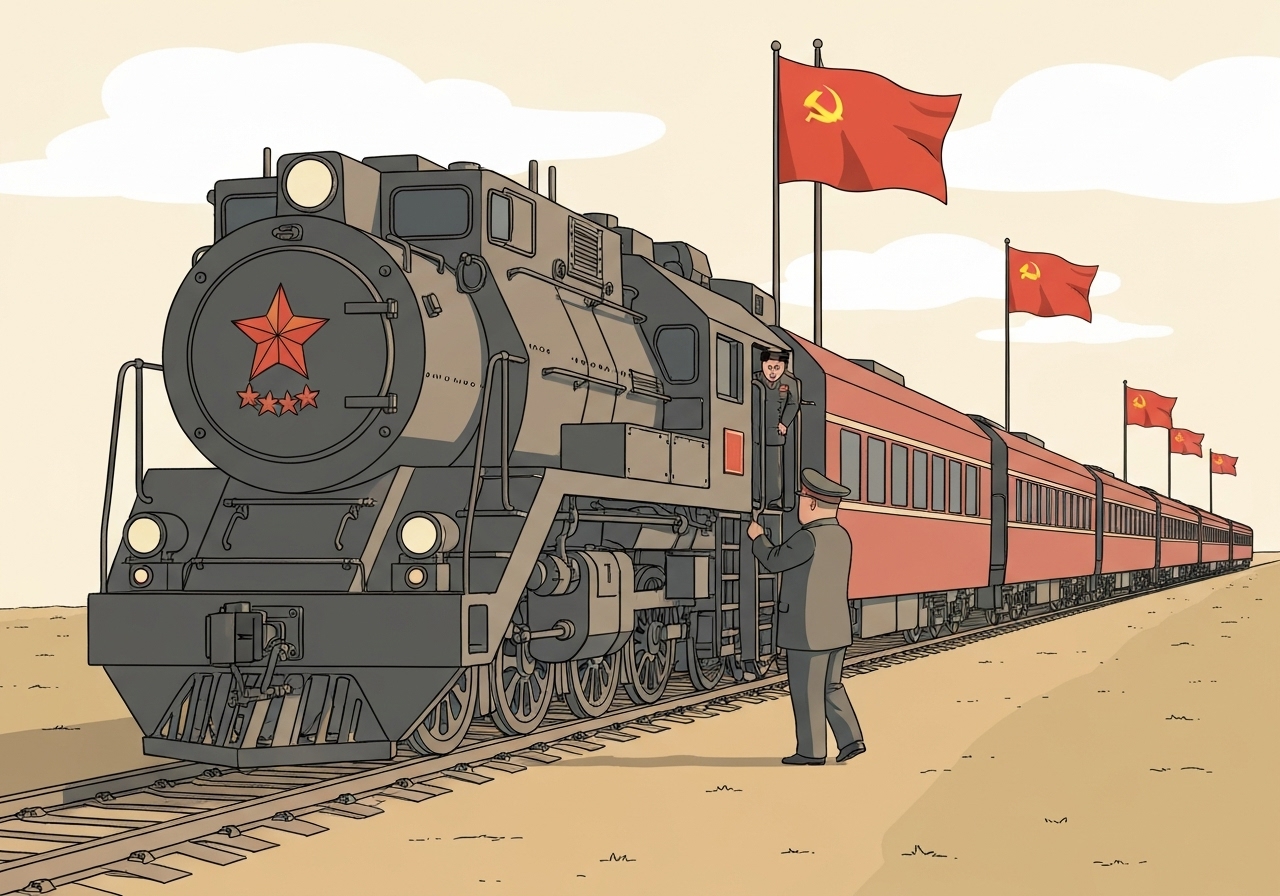
North Korean leader Kim Jong-un crossed into China early on aboard his signature armoured train and is expected in Beijing later in the morning to attend a military parade on marking Japan’s surrender in the second world war. He is due to view the event alongside China’s Xi Jinping and Russia’s Vladimir Putin, according to North Korean state media.
Key Takeaways
- Kim departed Pyongyang on Monday and entered China early Tuesday; arrival in Beijing is expected Tuesday morning, per Rodong Sinmun.
- South Korea’s Yonhap describes his bullet‑resistant train as a moving “fortress” that typically travels about 60 km/h, making the trip roughly 20 hours.
- State images show Kim aboard with senior aides, including Foreign Minister Choe Son Hui, and an interior fitted for meetings and rest.
- The Beijing parade on Wednesday will host 26 world leaders; Putin is slated to attend, placing Kim, Xi and Putin at the same venue.
- This will be Kim’s first appearance at a major multilateral event in his 14 years in power.
- No trilateral meeting among Kim, Xi and Putin has been confirmed.
- Pyongyang has deepened ties with Moscow; Western and South Korean officials say North Korea has supplied munitions to Russia, while claims of troop deployments remain disputed.
- Relations with China have reportedly cooled recently; Beijing still remains North Korea’s largest trading partner and key aid source.
Verified Facts
North Korea’s official newspaper Rodong Sinmun reported that Kim left Pyongyang on Monday and crossed the border into China in the early hours of Tuesday, en route to Beijing. The visit aligns with China’s Victory Day commemorations marking the end of the Pacific war, with a large military parade scheduled for .
Yonhap News Agency characterized Kim’s train as heavily armoured and comparatively slow, averaging around 60 km (37 miles) per hour. At that pace, the trip from Pyongyang to Beijing typically takes close to 20 hours. Armoured trains have been the preferred long‑distance transport for North Korea’s leadership for decades, offering secure space for aides, communications, and trip planning.
Although Kim does not share his father’s reported aversion to flying—he flew to Singapore in 2018 for talks with then–U.S. President Donald Trump and to Dalian the same year to meet Xi—he has repeatedly opted for rail on high‑profile journeys. For the 2019 Hanoi summit with Trump, he travelled roughly 4,500 km through China by train, a 2½‑day trip.
Rodong Sinmun photos on Tuesday showed Kim with his entourage, including Foreign Minister Choe Son Hui, boarding and riding a green carriage trimmed in gold. Additional images depicted a wood‑panelled office setting aboard the train.
Chinese authorities are hosting 26 world leaders for the parade. Putin is expected to attend, placing Kim, Xi and Putin at the same venue for the first time during Kim’s rule. However, there has been no official confirmation of a three‑way meeting.
Context & Impact
Kim’s appearance in Beijing underscores North Korea’s ongoing effort to elevate its diplomatic profile while leveraging relationships with China and Russia amid sustained tensions with the United States, South Korea and Japan. Sharing a platform with Xi and Putin signals tighter strategic alignment among the three leaders, even if no formal trilateral talks occur.
Ties between Pyongyang and Moscow have intensified since Russia’s full‑scale invasion of Ukraine. Washington and Seoul have presented evidence that North Korea shipped artillery and other munitions to Russia, drawing new sanctions and international scrutiny. Allegations that North Korean personnel may be assisting Russia remain unverified.
Relations with China, North Korea’s primary economic lifeline, cooled during years of pandemic border controls and periodic frictions. A high‑visibility visit for China’s war‑end commemoration offers Kim a chance to stabilize ties with Beijing and potentially secure trade and aid assurances.
Regionally, the optics of Kim attending a major military parade alongside Xi and Putin will likely reinforce threat perceptions in Seoul, Tokyo and Washington, where trilateral security cooperation has expanded in response to North Korea’s missile testing and Russia’s deepening defense ties with Pyongyang.
Official Statements
Yonhap described the train as a moving “fortress,” noting its heavy armor and modest speed.
Yonhap News Agency
Unconfirmed
- No formal confirmation of a trilateral meeting among Kim, Xi and Putin as of publication.
- Claims that North Korea has sent “troops” to support Russia in Ukraine remain disputed and are not independently verified; confirmed reporting focuses on munitions transfers.
- Exact arrival time of Kim’s train in Beijing has not been independently confirmed beyond North Korean and South Korean media reports.
Bottom Line
Kim’s rail trip to Beijing places him on a prominent stage with Xi and Putin during China’s Victory Day events. Even without a three‑way summit, the optics reinforce tightening ties among Washington’s rivals while offering Pyongyang a chance to refresh its critical relationship with Beijing.