
Lead
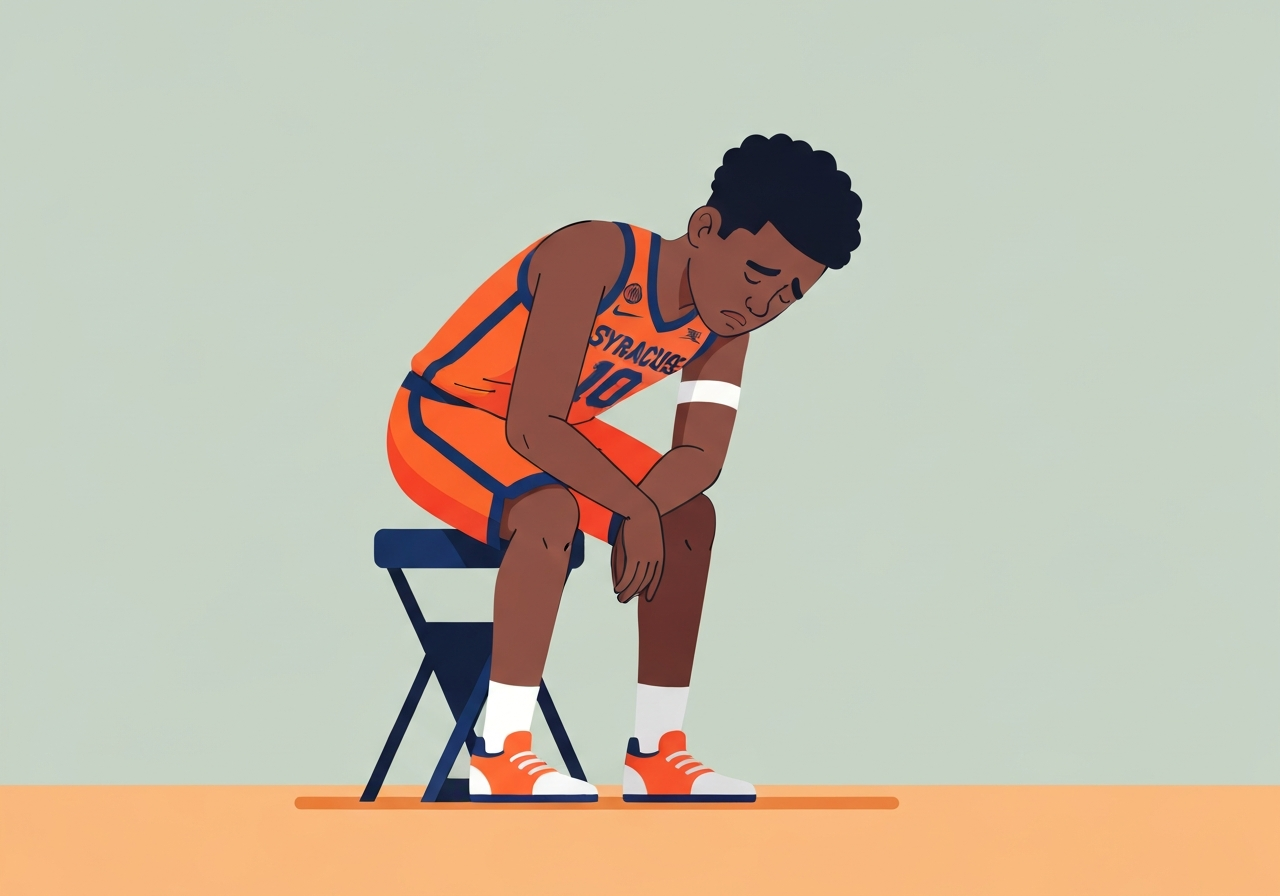
On Saturday Syracuse sat freshman guard Kiyan Anthony for the first time this season in a 72-59 loss to No. 18 Virginia. Head coach Adrian Autry told reporters there were no injury concerns and that the decision was his alone. The defeat extended Syracuse’s slide — six losses in seven games — leaving the Orange 13-11 and mired in the lower half of the ACC. The move spotlights mounting pressure on a young roster and on Anthony, the 18-year-old son of Hall of Famer Carmelo Anthony.
Key Takeaways
- Kiyan Anthony was benched for the first time this season during Syracuse’s 72-59 loss to No. 18 Virginia on Saturday.
- Syracuse has lost six of seven games and stands 13-11 overall, affecting its ACC positioning and postseason outlook.
- Autry said the benching was a coaching decision and that there were “no injury concerns,” according to ESPN reporting.
- Through 23 games Anthony is averaging 8.9 points, shooting 41.6% from the field, and playing 19.3 minutes per game.
- Carmelo Anthony, a booster who helped fund Syracuse’s practice facility, commented on social media both critically and supportively this week.
- ESPN analysts noted Anthony’s raw talent and the need for patience and development given his age and pedigree.
- Syracuse’s next game is scheduled for Wednesday against fellow ACC opponent California, providing a near-term test for the coach and roster.
Background
Kiyan Anthony entered the season with heightened attention because of his surname and the high-profile presence of his father, Carmelo Anthony, a Syracuse legend and Basketball Hall of Famer. That spotlight has amplified every swing in form for the 18-year-old freshman, creating outsized expectations around his development and minutes. Carmelo is also a booster who contributed significantly to the program’s facilities, which has drawn scrutiny when his son’s playing time becomes newsworthy.
Syracuse has struggled as a team in a competitive ACC this season, slipping in conference standing amid inconsistency on both ends of the floor. The Orange’s record of 13-11 and a recent six-loss stretch have increased pressure on coaching staff and players alike. Bench management, rotations and player development have become focal points for media, fans and evaluators watching Syracuse’s prospects for March.
Main Event
Saturday’s game ended 72-59 in favor of No. 18 Virginia, and coach Adrian Autry confirmed after the contest that he chose to sit Anthony. Autry emphasized the decision was about team needs and matchups against a physical, experienced opponent; he also said there were no injury issues behind the move. Autry framed the benching as a tactical choice rather than a disciplinary or health-related one.
The benching marked a turning point in Anthony’s freshman campaign, which has featured flashes of scoring and moments of uneven decision-making. Through 23 games Anthony has averaged 8.9 points on 41.6% shooting in 19.3 minutes per contest — numbers that reflect opportunity but also room for growth. Autry’s lineup choices against Virginia prioritized veteran defenders and a different rotation to match the opponent’s physicality.
Off the floor, Carmelo Anthony weighed in on social media during the week, reacting to Syracuse highlights and losses. He posted an initially frustrated reaction under a Syracuse Instagram clip after the team’s 87-77 defeat to No. 14 North Carolina, then later offered a more encouraging comment after his son sat out against Virginia, framing benching as part of a player’s growth. Those public exchanges added an extra layer of attention to an already sensitive situation.
Analysis & Implications
Short term, Autry’s decision communicates that minutes will be earned and that coaching judgments will not be overridden by outside pressure. That stance can stabilize room-for-error expectations for other young players and reinforce a merit-based rotation philosophy. For Anthony, temporary reductions in playing time can be constructive if paired with targeted coaching on shot selection, defensive reads and conditioning.
Longer term, the episode will be viewed through the lens of NBA scouting and draft projections. Anthony’s baseline production — 8.9 points in under 20 minutes — shows scoring potential, but evaluators will want to see consistency, maturity in decision-making and defensive engagement. A midseason benching can slow momentum but also highlight a player’s resilience if he responds with demonstrable improvement.
There are reputational and program-level implications as well. High-profile boosters who are family members can complicate narratives around fairness and autonomy; Autry’s explicit denial of outside influence aims to protect coaching authority. The program’s response in the coming weeks — how minutes are allocated, how development plans are communicated, and how public messages are managed — will shape recruiting, fan sentiment and institutional credibility.
Comparison & Data
| Category | Season (through 23 games) |
|---|---|
| Games | 23 |
| Points per game | 8.9 |
| Field goal % | 41.6% |
| Minutes per game | 19.3 |
| Team record | 13-11 (six losses in last seven) |
The table above captures Anthony’s season line alongside Syracuse’s record to provide context for Autry’s decision. The numbers show a role player profile so far; whether Anthony converts opportunity into a larger, consistent role will determine both his draft projections and Syracuse’s midterm trajectory.
Reactions & Quotes
“No injury concerns. It was just my decision,” Autry told reporters after the Virginia game, stressing that the move was tactical.
Adrian Autry, Syracuse head coach (as reported by ESPN)
“He’ll be good! THEY SAY it’s part of the journey. A little adversity don’t hurt,” Carmelo Anthony posted in response to comments about his son’s benching, expressing support.
Carmelo Anthony, Hall of Famer and Syracuse booster (Instagram)
Analysts have noted Anthony’s physical gifts and the need for patience; they stress development over immediate judgment for an 18-year-old playing in the ACC.
Terrence Oglesby and Seth Greenberg, ESPN analysts (summarized)
Unconfirmed
- Any suggestion that Carmelo Anthony directly influenced Autry’s lineup choices has not been substantiated by public evidence.
- Reports that the benching was meant as a permanent demotion rather than a game-specific tactical move are unconfirmed.
- Claims that locker-room friction or internal discipline prompted the decision have not been independently verified.
Bottom Line
Adrian Autry’s decision to bench Kiyan Anthony in a high-profile loss underscores the practical demands of ACC competition and the realities of developing a freshman under intense scrutiny. The statistical snapshot suggests promise but also clear areas for growth; how Anthony responds in practice and in the next games will be decisive for his role down the stretch.
For Syracuse, the incident is a test of coaching clarity and program governance: the staff must balance development, competitive needs and public narratives. The Orange have a near-term opportunity against California to reset momentum; observers will watch playing time, performance adjustments and team cohesion as indicators of whether this moment becomes a turning point or a deeper slide.