
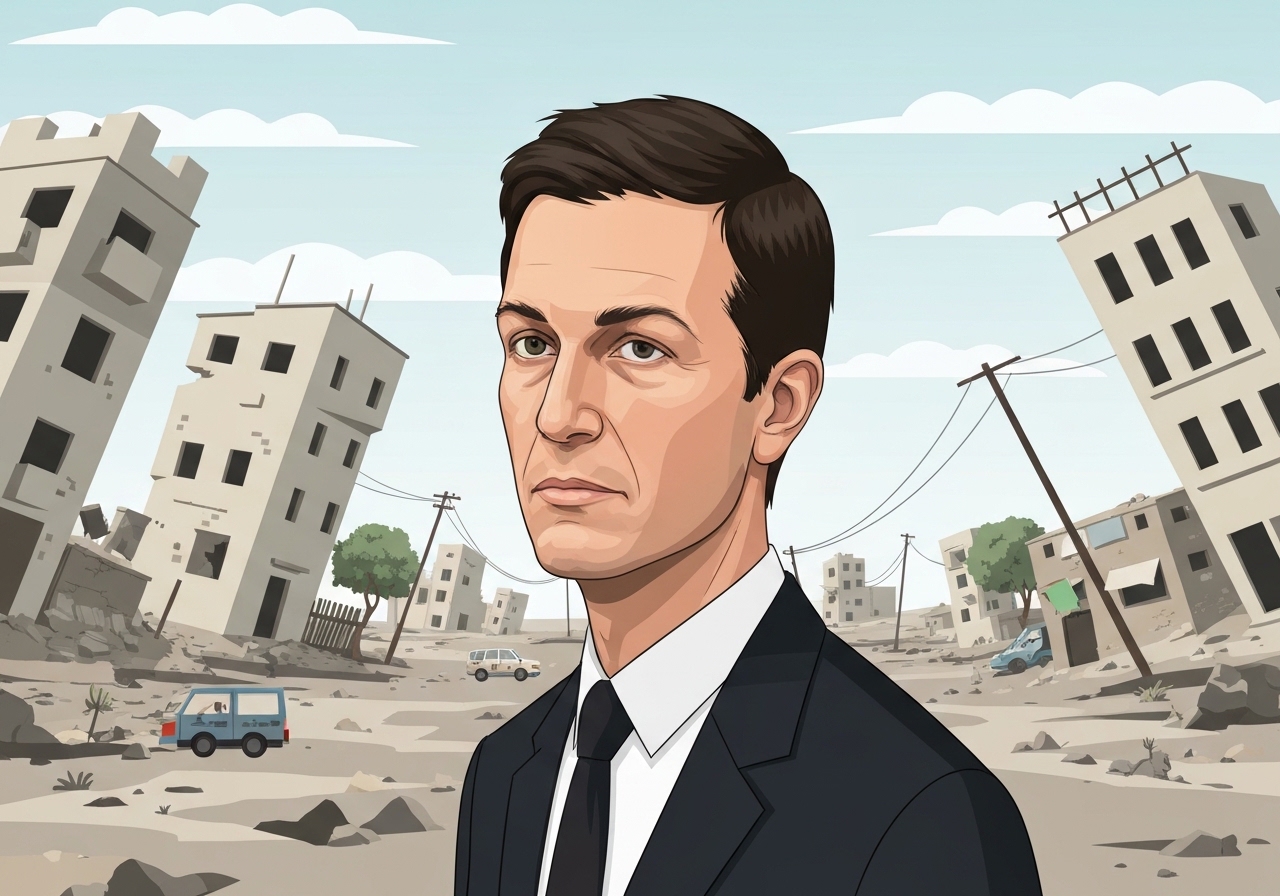
Lead: At the World Economic Forum in Davos on Thursday, Jared Kushner presented a blueprint to transform Gaza into a modern coastal economy with high-rises, a new port and tourist zones — provided there is lasting security. He argued large-scale rebuilding could proceed rapidly, even suggesting Middle Eastern cities have been rebuilt in as little as three years. That timeline and the proposed ambitions clash with U.N. and Palestinian assessments that clearing rubble, demining and rehabilitation will take many years and vast resources. The proposal landed amid an ongoing ceasefire in place since Oct. 10 and active debate over who will oversee Gaza’s future governance.
Key Takeaways
- Kushner presented his plan at Davos, proposing rapid, large-scale reconstruction of Gaza contingent on security guarantees and demilitarization.
- Gaza houses about 2 million people; the United Nations Office for Project Services estimates more than 60 million tons of rubble — enough to fill nearly 3,000 container ships — and says clearing that will take over seven years.
- The latest joint estimate from the U.N., the European Union and the World Bank places reconstruction needs at about $70 billion.
- Ceasefire terms have held since Oct. 10, though U.N. figures report at least 470 Palestinians killed in Gaza since then amid periodic Israeli fire and security incidents.
- Kushner’s slides envision phased works starting in Rafah, then Gaza City (branded “New Gaza”), plus ports, airports and zones for tourism, manufacturing and data centers, but omitted operational details on demining and interim housing.
- The plan relies on an interim U.S.-backed Palestinian committee (NCAG) to oversee demilitarization and then transfer authority to a reformed Palestinian Authority — a step Israel’s Prime Minister Benjamin Netanyahu has opposed.
- Local displaced residents expressed worry that high-end redevelopment could displace current residents or restrict their return to former homes.
Background
Gaza has been governed by Hamas since the movement took control from the Palestinian Authority in 2007. Recurrent cycles of conflict with Israel have devastated infrastructure: apartment blocks, the coastline and public services were heavily damaged during more than two years of warfare leading up to the current ceasefire. The territory’s prewar economy and transport links were already constrained after Israel destroyed Gaza’s airport more than 20 years ago.
International actors, including the United Nations, European Union and World Bank, have repeatedly warned that rehabilitation will be prolonged and expensive because of extensive rubble, contamination and unexploded ordnance. Multiple stakeholders have competing priorities: Israel cites security concerns and insists on demilitarization; Hamas and other local groups prioritize protection of civilians and political sovereignty; the Palestinian Authority seeks a role in postwar governance but lacks control in Gaza today.
Main Event
Speaking at Davos, Kushner displayed renderings of glass towers, landscaped parks and a deepwater port jutting into the Mediterranean, asserting that with security in place, cities like those could be reconstructed quickly. He framed the project as conditional on demilitarization and effective security arrangements, arguing investors and businesses will only commit if violence is curtailed. Kushner said work would begin in Rafah with workforce housing and rubble-clearing reportedly already underway there, then move on to Gaza City, which his presentation labeled “New Gaza.”
His presentation included proposals for eight residential zones, new roads, an airport, an industrial complex, data centers and tourism corridors along the coastline. Kushner did not specify how demining would be organized or where the roughly 2 million displaced residents would live during phased reconstruction, leaving a major operational gap unaddressed. He also outlined a role for a U.S.-backed Palestinian committee (NCAG) to manage demilitarization and eventual handover to a reformed Palestinian Authority.
The proposal coincided with formal ratification at Davos of the Board of Peace charter, a body intended to oversee the ceasefire and reconstruction process. Kushner positioned his plan as complementary to that body’s mission, but critics say the slides reflect a developer’s mindset and lack realistic solutions to security, governance and humanitarian constraints on the ground.
Analysis & Implications
The difference between Kushner’s optimistic timetable and U.N. technical estimates is stark and consequential. Clearing more than 60 million tons of rubble and making areas safe for civilian habitation requires heavy equipment, specialized demining teams and secure access — operations the U.N. says will take over seven years just to remove debris, before extensive rebuilding begins. If demining is delayed, reconstruction crews and returning residents would face severe safety risks that could stall investment.
Security is the plan’s linchpin, but demilitarization in Gaza is politically fraught. Hamas has said it might freeze arms as part of a process toward statehood, yet it has not detailed how forces or weapons would be handled. The existence of multiple armed groups and reports that Israel has supported rival factions during the war complicate any straightforward disarmament or integration into an NCAG framework.
Political friction between Israel and the Palestinian Authority is another barrier. Netanyahu has opposed proposals that would return Gaza to PA administration, and many Palestinians distrust the PA because of corruption and perceived cooperation with Israel. Donor confidence will be tied not only to security guarantees but also to credible, transparent governance arrangements to manage funds and contracts.
Economically, the plan’s ambition to attract advanced manufacturing and data centers faces structural hurdles: Gaza’s damaged power grid, restricted access to materials and labor mobility limits, and investor risk perceptions. Without clear guarantees for security, property rights and policing, private capital may be reluctant to fund large-scale towers or tourism projects that could be vulnerable in a fragile environment.
Comparison & Data
| Metric | Figure |
|---|---|
| Population of Gaza | ~2,000,000 people |
| Estimated rubble | 60,000,000 tons (~3,000 container ships) |
| Estimated rubble clearance time | Over 7 years (U.N. estimate) |
| Estimated reconstruction cost | $70 billion (U.N./EU/World Bank) |
The table highlights the scale mismatch between Kushner’s rapid-rebuild claims and multilateral technical assessments. Removing debris and clearing ordnance are resource- and time-intensive tasks that precede heavy construction; each phase requires separate funding, logistics and security arrangements.
Reactions & Quotes
Officials and residents offered mixed responses, stressing both the promise of investment and practical concerns about execution and inclusion.
“In the Middle East, they build cities like this … in three years,”
Jared Kushner, U.S. Middle East advisor
Before the quote, Kushner presented visual mock-ups and argued speed was feasible with security. After the quote, analysts and U.N. officials pushed back on technical timelines and safety prerequisites.
“Totally unrealistic,”
Nomi Bar-Yaacov, international lawyer and conflict-resolution expert
Bar-Yaacov criticized the plan as reflecting a real-estate developer’s viewpoint and noted Israeli security concerns about tall buildings overlooking military positions. Her comment underscores friction between visionary designs and strategic realities.
“I was planning to pitch a tent where my old house was, and gradually rebuild my life again,”
Ahmed Awadallah, displaced Gaza resident
Awadallah’s statement captures local fear of permanent displacement; many displaced families worry that high-end redevelopment will exclude them from returning to their prewar neighborhoods.
Unconfirmed
- Whether Hamas will completely disarm or how its forces would be integrated or dismantled remains uncertain and unverified.
- Precise plans for demining operations, timelines or which international bodies would lead that work were not provided and remain unclear.
- Who would housingly accommodate Gaza’s displaced population during phased reconstruction — and whether new developments would prioritize current residents — was not specified.
- Investor appetite for the high-end projects Kushner proposed is unproven given ongoing security and governance risks.
Bottom Line
Kushner’s Davos presentation sets out an ambitious, visually striking blueprint for Gaza’s future that hinges on rapid security guarantees and extensive, coordinated international effort. The proposal spotlights potential economic opportunities but downplays the technical and political obstacles of rubble clearance, demining and governance, where U.N. estimates and on-the-ground realities point to a far longer timeline and higher costs.
For reconstruction to move beyond renderings, stakeholders will need clear, sequenced plans for safety, interim shelter, transparent funding mechanisms and political agreements over who governs Gaza afterward. Watch for (1) detailed demining strategies from U.N. and partners, (2) concrete funding commitments tied to safeguards, and (3) political steps addressing whether the Palestinian Authority, NCAG or another mechanism will hold lasting authority in Gaza.