
Lead
Jared Kushner unveiled a redevelopment vision for Gaza during public appearances tied to the World Economic Forum presentation in Davos, proposing a rebuilt territory with new housing districts, industrial zones, transport hubs and a tourist coastline. The plan links reconstruction to a phased ceasefire framework that requires Hamas to decommission weapons and conditions rebuilding on areas being cleared and placed under Israeli control. It projects more than half a million jobs and major infrastructure projects but provides no clear mechanism for land titles, housing allocation or how displaced families would be rehoused. Critics in Gaza and international observers say the proposal risks erasing historic communities and raises legal and humanitarian questions.
Key Takeaways
- Gaza’s pre-war population was about 2.2 million; the territory measures roughly 25 miles long and 4–7 miles wide.
- A 2024 World Bank estimate put damage to critical Gaza infrastructure at more than $18 billion.
- Kushner’s plan divides the strip into four residential districts with large adjacent industrial and green zones and promises more than 500,000 jobs in those zones.
- The plan foresees 100,000+ permanent housing units in a reimagined “New Rafah” and about 200 new educational centers, compared with roughly 600,000 housing units and 700 schools across Gaza before the war.
- Reconstruction is conditional: it would begin only in areas where Hamas is declared disarmed or that have been emptied and are under Israeli military control, according to the plan’s stated sequencing.
- The proposal designates the entire Mediterranean coast for coastal tourism with 180 mixed-use towers, a shift that could price locals out of seaside access.
- The plan does not address land deed transfers, the legal status of property, or a transparent process for allocating new housing to displaced Palestinian families.
- Key architects named publicly include Jared Kushner and Israeli investor Yakir Gabay; both sit on a White House-appointed Gaza Executive Board that reports to the Board of Peace.
Background
Gaza has been tightly controlled and effectively besieged since 2007 after Hamas took governing control; movement of people and goods has been largely mediated through border crossings under Israeli and, intermittently, Egyptian oversight. Decades of dense urban growth left Gaza highly urbanized—UN-Habitat reported in 2024 that roughly 87% of the territory was urban area with much of the remainder refugee camps—so pre-war housing and infrastructure were concentrated and interconnected.
Prior to the recent fighting, Gaza had roughly 600,000 apartments and housing units for 2.2 million people, about 700 schools and 17 higher-education institutions. The 2023–2024 conflict left large swathes of the territory damaged or destroyed: international agencies estimate more than 90% of homes were damaged or destroyed in some reporting, and a World Bank estimate in 2024 put infrastructure damage above $18 billion. International legal scrutiny has increased: a U.N. commission described atrocities that some parties characterize as genocide; Israel disputes that characterization and faces war-crimes investigations in multiple fora.
Main Event
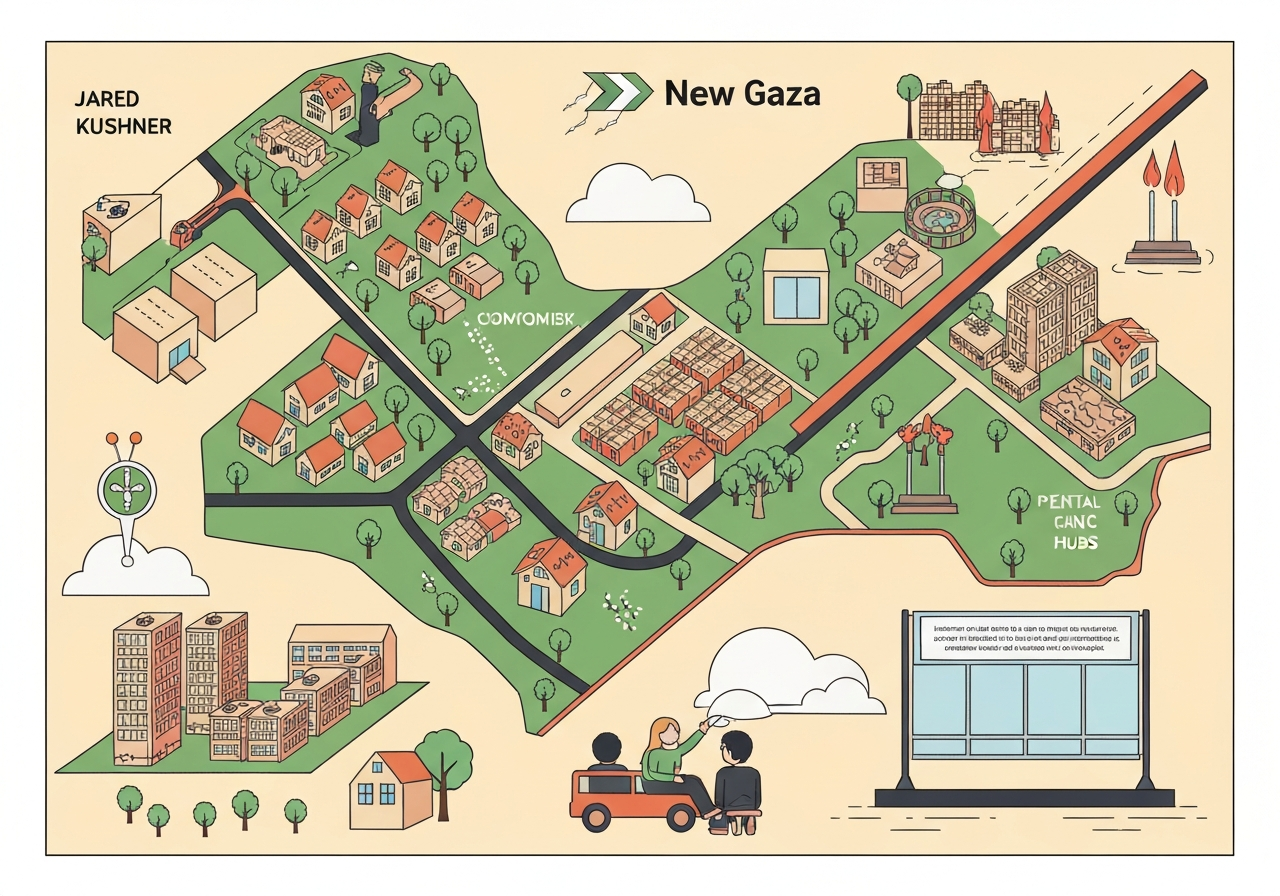
The “New Gaza” blueprint, as presented publicly by Kushner and by materials from the Board of Peace, frames reconstruction as phased and heavily planned: the south would be rebuilt first and Gaza City areas in the north would be scheduled for later phases. Visuals show four distinct residential districts—Rafah, Khan Younis, Center Camps and Gaza City—separated by expansive green belts and industrial zones connected by a limited set of main roads.
Major elements include a proposed airport, a logistics hub with train links and a port in the south, a redeveloped Rafah as a logistics and administrative center with over 100,000 permanent housing units, and a transformed coastline of 180 mixed-use towers aimed at tourism and investment. The plan projects more than half a million jobs generated by advanced manufacturing, data centers and coastal tourism zones.
Operationally, the plan ties rebuilding to security sequencing: reconstruction would proceed only in areas where Hamas is fully disarmed or where residents have been cleared and territory placed under Israeli military control. The proposal does not outline how private land titles would be verified, whether prior owners would regain property, or how families living in buildings slated for demolition would be rehoused or compensated.
Officials associated with the effort say international investors and specific national partners are being courted; they name Israeli real-estate investor Yakir Gabay as a contributor. An Israeli official, speaking anonymously, said preparations are underway in Rafah to clear unexploded ordnance and tunnels and that some temporary housing areas will be set up with donor support. Egypt has not publicly commented on the proposal and has historically rejected Israeli control of Rafah.
Analysis & Implications
Spatially reducing residential area in favor of parks, industry and tourism implies a different demographic footprint for Gaza after reconstruction. If pre-war population density is not restored or if housing allocations are limited, the result could be either prolonged displacement or coerced resettlement—outcomes with serious humanitarian and political consequences. The plan’s emphasis on major private investment projects raises questions about local access and affordability, especially for workers displaced by earlier destruction.
Conditioning rebuilding on disarmament and military control shifts leverage to the party enforcing those conditions. That sequencing may lengthen humanitarian recovery, entrench military oversight of reconstruction, and complicate international funding channels that typically require protections for property and civilians. Legal complexities around deeds and compensation could trigger long, contested claims if not clarified, and they heighten the risk of litigation in international courts or compensation mechanisms.
Regionally, the proposal could strain relations with Egypt if changes to the Rafah crossing effectively extend Israeli presence at a sensitive border. It also bypasses Palestinian governing institutions that might insist on a central role in planning and ownership of reconstruction. Politically, a plan promoted by U.S.-aligned private boards and investors may struggle to win local legitimacy unless Palestinians themselves are visibly included in design and governance.
Comparison & Data
| Metric | Pre-war / Plan |
|---|---|
| Population | ~2.2 million (pre-war) |
| Territory size | ~25 miles long; 4–7 miles wide |
| Housing units | ~600,000 pre-war; New Rafah: 100,000+ units (plan) |
| Schools | ~700 pre-war; plan: ~200 centers in New Rafah |
| Higher education | 17 institutions pre-war |
| Infrastructure damage | >$18 billion (World Bank, 2024) |
| Planned coastal towers | 180 mixed-use towers |
| Projected jobs | >500,000 (plan) |
These figures highlight gaps between pre-war capacity and the plan’s public promises: for example, New Rafah’s 100,000 housing units would cover a fraction of the 600,000 pre-war units across Gaza, raising questions about where the remaining population would live. The workforce projections also hinge on investor commitments and security guarantees that are not yet public.
Reactions & Quotes
Local residents and advocacy groups express intense skepticism about the plan’s assumptions and ownership model. One Gaza resident whose home was demolished criticized outside-led rebuilding efforts that do not prioritize returning control to residents.
“We only want one thing: Leave us to rebuild. We don’t want anything from you. Just leave us to rebuild.”
Rami Abdel-Aal, Gaza resident
The plan’s promoters describe it as a hopeful blueprint meant to spur investment and jobs once security conditions permit rebuilding.
“We’ve already started removing the rubble and doing some of the demolition… ‘New Gaza’ could be a hope, it could be a destination, have a lot of industry and really be a place that the people there can thrive.”
Jared Kushner (public remarks)
An Israeli official speaking on background told reporters that clearance operations are being accelerated in southern areas to prepare sites for temporary housing supported by donor nations, though donor commitments and timelines remain ambiguous.
“Ground in Rafah is being prepared to be cleared of unexploded ordnance and tunnels to set up temporary housing.”
Israeli official (anonymous)
Unconfirmed
- Whether Palestinian civil society or representatives were meaningfully consulted in drafting the plan; public materials do not document such consultations.
- Egypt’s formal position on moving or redesigning the Rafah crossing remains unannounced; Egyptian authorities have not publicly endorsed Israeli control at Rafah.
- Details on legal mechanisms for land title verification, deed transfers or compensation are not in the public plan materials.
- Specific investor commitments, financing structures and timelines for the promised 500,000+ jobs have not been independently verified.
Bottom Line
The “New Gaza” proposal offers a high-investment vision of a rebuilt territory with major transport, industrial and tourism components—but it leaves open essential practical and legal questions about property rights, housing allocation and who will govern reconstruction. Conditioning rebuilding on disarmament and territorial control hands significant leverage to the party supervising those conditions, with implications for sovereignty, humanitarian access and the speed of recovery.
Independent reconstruction that secures property claims, includes Palestinian governance, and ensures affordable housing and public services will be pivotal to durable stability; without those elements, a skyline of towers and parks risks producing enclaves of investment disconnected from the needs of displaced residents. Observers should watch for concrete finance commitments, documented Palestinian participation, clarified border arrangements with Egypt, and explicit legal frameworks for land and housing as the plan moves from concept to any operational phase.