
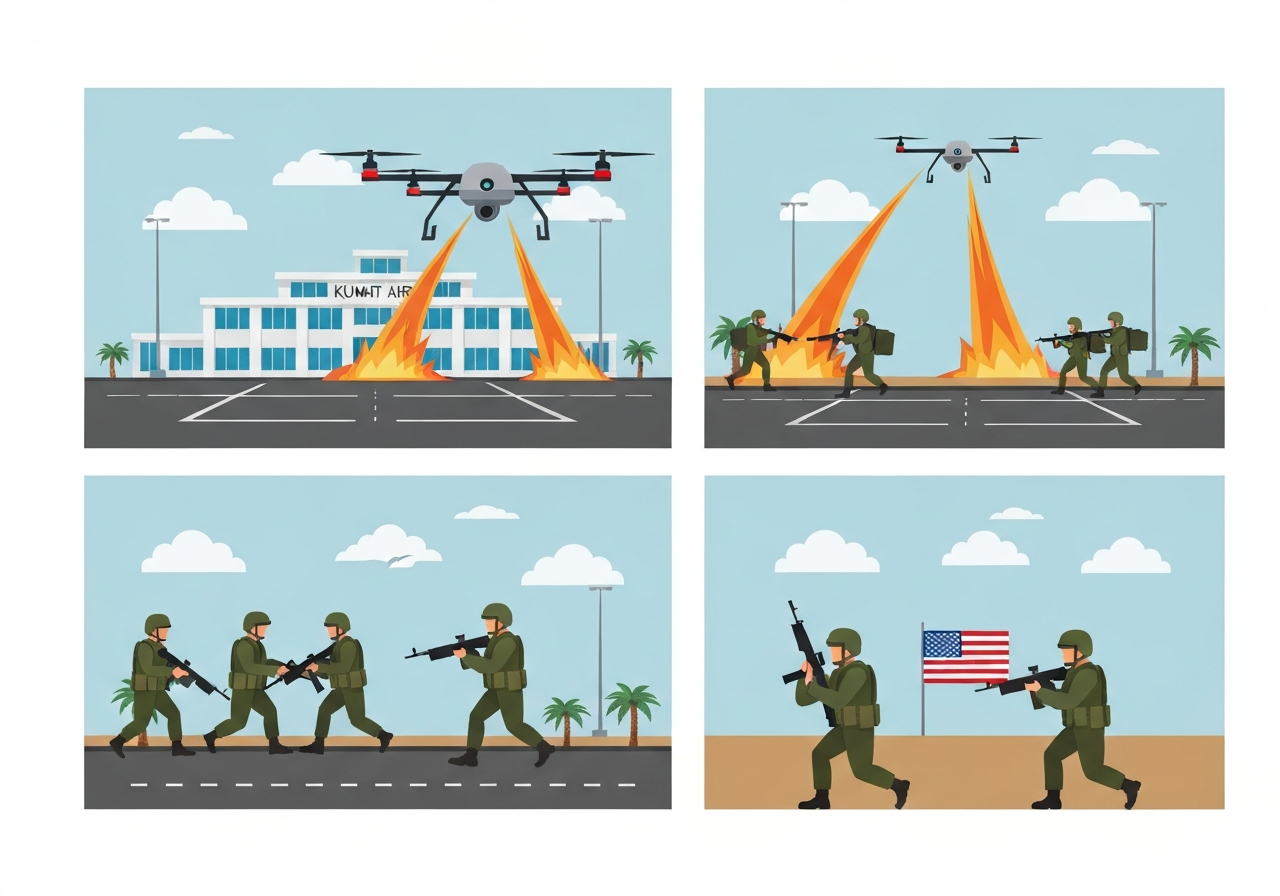
Lead: A drone strike that ignited a fire on Kuwait’s airport runway on 24 March 2026 has added a new flashpoint to an expanding Middle East conflict. Reports say emergency crews contained the blaze with limited operational disruption, while the US authorised the deployment of elements from the 82nd Airborne Division—around 1,000 personnel—to the region in the coming days. The incident comes amid a wider wave of missile and drone exchanges involving Iran, Israel, Lebanon and Gulf states, and follows international warnings about risks to shipping through the Strait of Hormuz.
Key Takeaways
- Drone strike at Kuwait International Airport sparked a runway fire on 24 March 2026; initial reporting indicates the blaze was extinguished and operations experienced limited interruption.
- The US has authorised movement of roughly 1,000 troops from the 82nd Airborne Division; orders are being written and forces were not yet reported to have departed as of the latest updates.
- Approximately 290 US service members have been wounded in operations tied to the Iran conflict; 255 have reportedly returned to duty and 10 remain seriously wounded, while 13 US personnel have been killed.
- Iran has fired missiles and launched attacks attributed at times to proxies across the region, with reported Iranian fatalities exceeding 1,500 and Lebanese deaths over 1,070 since the start of the war phase of the conflict.
- The IAEA confirmed a projectile struck the Bushehr nuclear power plant compound but Iran reported no damage or injuries and the agency said conditions remain normal.
- French and other European officials urged de-escalation and negotiations; France described the US as an “unpredictable ally” amid concerns over coordination among partners.
- Diplomatic initiatives are reported: a US 15-point proposal to Iran has circulated via back channels, but its acceptance and the extent of buy-in among regional parties remain unclear.
- Economic fallout includes rising energy-security actions: WTO cautioned about fertilizer and harvest impacts if the Strait of Hormuz is closed, and some countries declared energy emergencies.
Background
The current surge of hostilities follows months of escalating strikes, proxy attacks and naval incidents that broadened after direct US-Israeli military action against targets in Iran. Regional fault lines—between Iran and Israel, and among Gulf states tied to them—have widened, with several nations experiencing spillover strikes or drone incursions. The strategic Strait of Hormuz, through which a large share of global oil passes, has become a focal point for both military and economic pressure.
Since the outbreak of large-scale exchanges, casualty figures reported by involved parties and state media show significant human cost. Iranian state broadcasters reported more than 1,500 Iranian fatalities by 21 March 2026; Lebanon’s health ministry has reported over 1,070 deaths there. Western militaries have also reported personnel wounded and killed, feeding domestic political debates over further deployments and rules of engagement.
Diplomacy has moved in parallel with fighting. Several countries, including the US, are said to have circulated negotiation frameworks; European leaders have publicly urged Tehran to engage in talks. At the same time, several governments have prepared contingency measures for energy supply, and states hosting foreign bases—from Cyprus to the UK sovereign bases on the island—are reassessing security arrangements after recent drone incidents.
Main Event
On 24 March 2026, a drone reportedly struck the runway area at Kuwait International Airport, causing a visible fire. Kuwaiti emergency services responded and airline operations were briefly affected; initial official statements indicated no fatalities at the airport. Kuwaiti authorities are investigating the origin and vector of the drone and whether it was linked to proxy groups operating from neighbouring territories.
Concurrently, multiple outlets reported that the US president approved the partial deployment of the 82nd Airborne Division—authorised forces number below a full brigade and are expected to total fewer than 1,500 troops, with about 1,000 moving in the coming days. Orders for headquarters, staff and selected ground elements were reported to be under preparation; transport and staging details were not disclosed publicly for operational security.
Across the region, reports described continuing missile and drone exchanges. Iran was reported to have launched missiles at targets in Israel and other Gulf states in recent days, and state-linked media reported dozens of strikes against Iranian-linked locations. The International Atomic Energy Agency said it had been informed of a projectile impact at Bushehr which Iran said produced no damage and no injuries; the IAEA director reiterated calls for restraint around nuclear sites.
Political leaders reacted: French military leadership publicly warned of frictions with the US over coordination, while Lebanon faced new warnings from the Israeli Defence Forces urging evacuations in southern Beirut suburbs. Multiple countries moved to bolster contingencies for energy and civilian protection, and the Philippines declared a national energy emergency to secure fuel supplies.
Analysis & Implications
Operationally, the deployment of an elite airborne brigade element increases US rapid-response capacity in the region but also risks further inflaming local perceptions of escalation. The 82nd Airborne’s specialisation in forcible-entry operations signals a readiness to conduct short-notice ground or airfield operations, which opponents could interpret as preparation for contingency strikes or non-consensual landings.
Strategically, attacks on infrastructure such as Kuwait’s airport and on maritime chokepoints like the Strait of Hormuz carry disproportionate economic weight. Disruptions to aviation and shipping routes raise insurance and freight costs, and threaten fertilizer and food supply chains—hence the WTO’s warning that closure of Hormuz would reduce harvests and drive prices higher. Even limited, intermittent attacks prompt hedging by energy markets and national governments.
Diplomatically, the circulation of a US 15-point plan (reported to include restrictions on Iran’s enrichment activities, limits on proxy operations, and mechanisms for phased sanctions relief) signals a dual pressure-and-negotiation approach. Acceptance would require Iranian leadership to reconcile domestic political and strategic calculations; allied actors such as Israel may also need to endorse terms publicly to make a durable deal feasible.
Politically within allied ranks, public friction—such as comments from French military leadership about unpredictability—illustrates coordination strains. If partners feel sidelined, coalition cohesion for any prolonged stabilization mission could weaken, complicating intelligence sharing, basing agreements and combined operations. Meanwhile, regional states like Cyprus are seeking new security guarantees tied to foreign bases, underscoring the long-term geopolitical consequences for host countries.
| Metric | Reported figure |
|---|---|
| US wounded (approx.) | ~290 (255 returned to duty; 10 seriously wounded) |
| US killed | 13 |
| Iranian reported fatalities | >1,500 (state media, 21 Mar 2026) |
| Lebanese reported fatalities | >1,070 (health ministry) |
| 82nd Airborne elements authorised | ~1,000 personnel (partial brigade) |
These figures should be read as the best-available public tallies; battlefield reporting remains fluid and attribution of some incidents is contested.
Reactions & Quotes
Governments, militaries and regional actors issued a mix of warnings and calls for talks amid the incidents.
“We were surprised by an American ally … who is becoming increasingly unpredictable and doesn’t even bother to inform us when they decide to launch military operations.”
Fabien Mandon, French chief of staff (reported to Reuters)
France’s senior military official used strong language to describe coordination frustrations with the US, reflecting concerns among some European partners about tactical transparency and strategic consequences.
“I called on Iran to engage in good faith in negotiations… this would open a path towards de-escalation.”
Emmanuel Macron, President of France (public statement)
European political leaders have pushed publicly for talks while urging Tehran to cease attacks that endanger civilian infrastructure and international shipping.
“We’ve won this war,”
Donald Trump (press remarks)
The US president claimed progress in negotiations and cited alleged concessions; those claims were challenged by Iranian officials who denied contact had occurred, highlighting a gap between public political messaging and verifiable diplomatic steps.
Unconfirmed
- Claims by the US president that direct talks with Iranian leaders are ongoing and that Tehran has agreed to never seek nuclear weapons are not corroborated by Iranian officials and remain unverified.
- Attribution of the Kuwait airport drone to any specific state or proxy actor has not been publicly confirmed by an independent investigation.
- The extent to which Israel has consented to or endorsed the reportedly transmitted US 15-point plan has not been publicly verified.
Bottom Line
The Kuwait airport strike and the partial deployment of 82nd Airborne elements underscore the conflict’s expansion beyond immediate battlefields into civilian infrastructure and regional mobility nodes. Even limited damage to airports or shipping lanes can have outsized economic and humanitarian effects, amplifying global ripple effects on fuel and food security.
Diplomatic tracks and battlefield actions are proceeding in parallel, producing mixed signals: proposals for negotiation exist alongside preparations for additional military posture. The gap between public political claims and independently verifiable facts means near-term volatility is likely; international actors should prioritise transparency around troop movements and protection of civilian infrastructure to avoid miscalculation.