
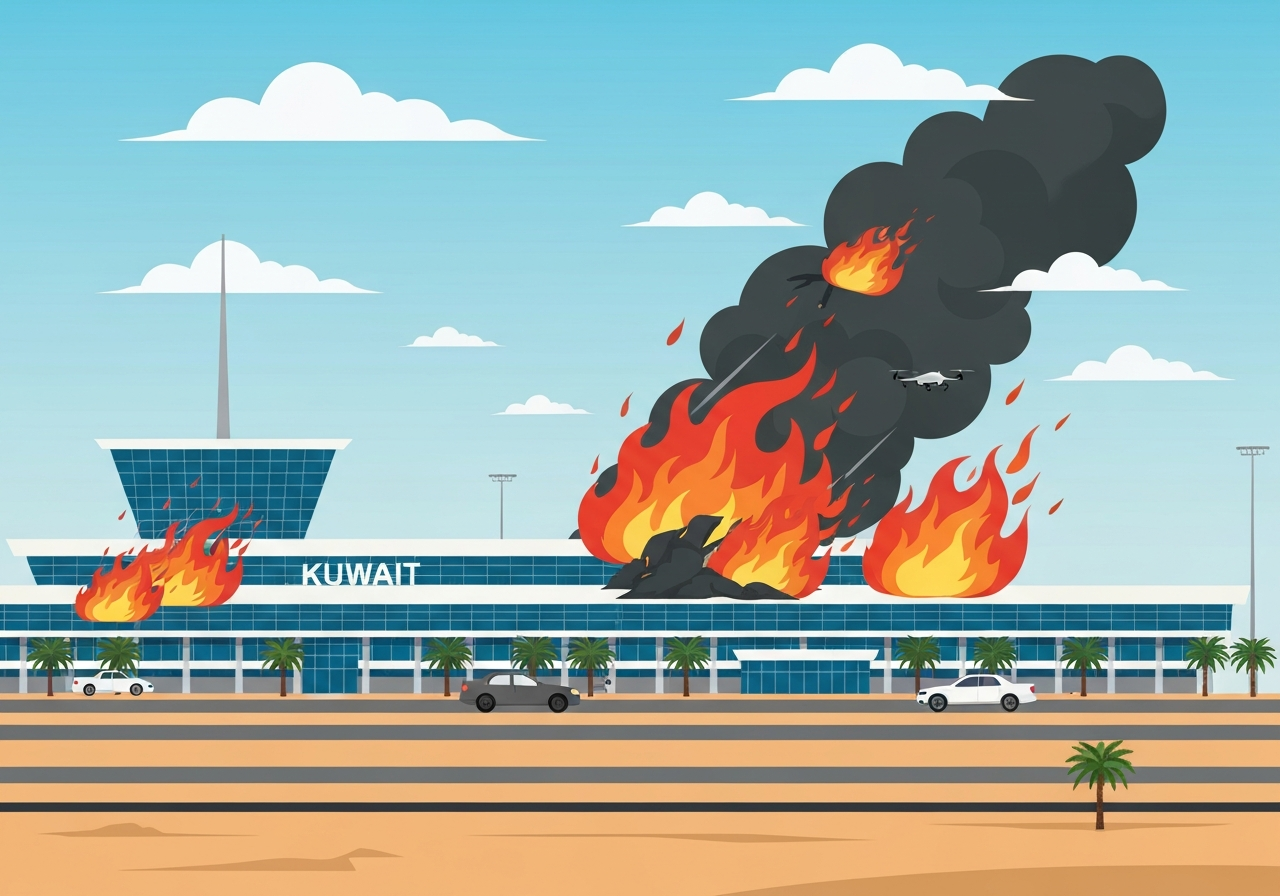
A drone strike that ignited a blaze at Kuwait International Airport on Tuesday has intensified regional tensions as US leaders approve a deployment of more than 1,000 members of the 82nd Airborne Division to the Middle East. Reports say the airport fire followed an unmanned attack; there were no immediate official casualty totals. At the same time, US and allied officials are handling a widening conflict that includes missile and drone strikes across the Gulf, disputed claims of talks with Tehran, and new troop movements that could alter calculations on the ground.
Key takeaways
- Drone attack at Kuwait International Airport caused a runway fire on Tuesday; Kuwaiti authorities and local reporting described the blaze but provided limited casualty information.
- The US approved sending more than 1,000 soldiers from the 82nd Airborne Division; the deployment will be below a full brigade (under 1,500 troops), with orders being prepared.
- US Central Command reported roughly 290 US service members wounded in operations against Iran so far; officials said 255 have returned to duty and 10 remain seriously wounded.
- The IAEA confirmed a projectile struck the Bushehr nuclear plant site but said Iran reported no damage or injuries and the plant is operating normally.
- Multiple states continue to report cross-border strikes and drone activity: missiles and drones have struck or been reported over Israel, Kuwait, Jordan and Bahrain in recent days.
- Washington reportedly delivered a 15-point proposal to Tehran intended to halt hostilities, though Iranian acceptance and the plan’s full distribution are unclear.
- France’s military leadership warned the US has become an “unpredictable ally,” reflecting growing friction among Western partners over operations in the region.
- Regional consequences include disruptions to shipping through the Strait of Hormuz and fresh calls for strengthened base security in Cyprus and elsewhere.
Background
The broader confrontation traces to sustained US-Israeli strikes and retaliatory Iranian missile and drone launches that have escalated into a wider Gulf theatre. Over recent weeks state and media tallies attribute more than 1,500 Iranian deaths and heavy Lebanese civilian losses as combat has spread across national borders. Strategic choke points such as the Strait of Hormuz and critical infrastructure including airport runways and energy facilities have been repeatedly threatened, prompting emergency measures by multiple governments.
Allied responses have varied: some NATO members pressed for de-escalation while others increased regional posture. Cyprus, citing drone incidents near UK sovereign bases on its soil, has asked London to renegotiate security arrangements for Akrotiri and Dhekelia after an unmanned vehicle reached RAF Akrotiri’s runway in early March. At the same time, diplomatic channels reportedly carried a US 15-point proposal to Iran addressing nuclear, missile and proxy concerns, but acceptance remains indeterminate.
Main event
On Tuesday an unmanned aerial vehicle impacted or struck a section of Kuwait International Airport, producing a runway fire and forcing immediate emergency responses. Kuwaiti emergency services contained the blaze and airport authorities temporarily suspended some operations; official casualty figures were not released at the time of reporting. Local media and international wire services described the incident as part of a wave of drone and missile activity across the Gulf that day.
Separately, US sources said the White House approved the deployment of more than 1,000 troops drawn from the 82nd Airborne Division to the region. Orders for headquarters, staff and select ground elements are being prepared; officials emphasized the movement does not yet involve a full airborne brigade, which normally numbers over 3,000 soldiers. The unit is noted for forcible-entry parachute operations and rapid response tasks.
Concurrently, the International Atomic Energy Agency reported that a projectile struck the Bushehr nuclear power plant complex after Tehran informed the agency; Iran told the IAEA there was no damage to the facility and no injuries. The agency reiterated calls for restraint to avoid nuclear-safety risks as hostilities unfold.
On the diplomatic front, French leaders pressed Tehran to enter negotiations in good faith and stressed the need to preserve freedom of navigation and civilian infrastructure. Washington has circulated a multi-point plan—reported to number 15 items—aimed at constraining Iran’s nuclear and proxy capabilities while offering sanctions relief and civil nuclear assistance in exchange for steps such as decommissioning enrichment sites and guaranteeing transit through the Strait of Hormuz.
Analysis & implications
The Kuwait airport strike is likely to sharpen regional risk assessments for commercial aviation and logistics hubs, prompting airlines and cargo operators to reroute flights and increase insurance and security precautions. Even a limited runway fire can cause multi-day disruptions; repeated incidents would further constrain regional mobility and inflate costs for trade and energy shipments.
The partial deployment of the 82nd Airborne signals Washington’s intent to bolster deterrence and reassure partners while preserving political flexibility. A force under 1,500 troops reflects a calibrated posture—sufficient to reinforce bases and conduct rapid operations, but short of a large-scale ground commitment. Still, the presence of elite airborne forces can be read by Tehran and proxies as escalatory, increasing the chance of miscalculation.
Diplomatic proposals such as the reported 15-point plan, if genuine and negotiable, could provide a basis for bargaining that reduces kinetic exchanges. Key obstacles include verification of Iranian compliance on its nuclear programme and proxy networks, Israeli security concerns, and domestic political constraints in Washington and Tehran. Absent robust monitoring and binding guarantees, any agreement risks being partial or short-lived.
Economically, episodic closures or threats to the Strait of Hormuz can drive oil and insurance premiums higher, with knock-on effects on global fuel markets and inflation. Policymakers in energy-dependent countries are already enacting emergency measures—such as the Philippines’ bid for US waivers to import sanctioned crude—underscoring how military dynamics translate quickly into national economic policy choices.
Comparison & data
| Category | Reported figure | Source context |
|---|---|---|
| US service members wounded | ~290 (255 returned to duty; 10 seriously wounded) | US Central Command / media reporting |
| US combat deaths | 13 | Media tallies |
| Iranian fatalities (state figures) | >1,500 (reported 21 March) | Iran state broadcaster |
| Lebanese fatalities (health ministry) | >1,070 | Lebanese health ministry / media |
These figures come from official and media sources and reflect the fluidity of battlefield reporting. Casualty totals can change as verification continues; state figures should be weighed against independent tallies and on-the-ground reporting.
Reactions & quotes
“We were surprised by an American ally… who is becoming increasingly unpredictable,” a senior French military official said, reflecting concerns in Paris about allied coordination.
Fabien Mandon / French armed forces (reported)
France’s comment came during a defence forum in Paris and signals growing diplomatic friction among Western partners over unilateral operational choices in the region.
“Evacuate immediately,” an Israeli military spokesperson warned residents in southern Beirut as operations targeted facilities described as Hezbollah infrastructure.
IDF spokesperson (social media post)
The evacuation notice underscores the toll on Lebanese civilians and the expanding geographic footprint of military operations that is displacing hundreds of thousands of people.
Unconfirmed
- Presidential claims of direct negotiations with Tehran and assurances that Iran has agreed never to pursue nuclear weapons remain disputed by Iranian officials and lack independent verification.
- The extent to which Tehran has received, accepted, or circulated the reported 15-point US proposal is unclear; media accounts differ on which Iranian officials, if any, have seen the plan.
- Initial reports of casualties from the Kuwait airport fire were limited; full casualty and damage assessments from Kuwaiti authorities were not available at the time of reporting.
Bottom line
The Kuwait airport strike and the announced US troop movement together mark both an operational and a diplomatic inflection point: kinetic activity is increasing the cost of regional commerce and civilian safety, while allied militaries and governments recalibrate for greater instability. Short deployments and diplomatic overtures may contain immediate risks, but they also risk entrenching a longer-term pattern of intermittent escalation.
Close, transparent verification and multilateral channels will be essential to prevent misreading of intentions. For now, commercial operators, regional partners and international institutions face a volatile mix of military action and tentative diplomacy that is likely to keep markets, security planners and humanitarian agencies on high alert.