
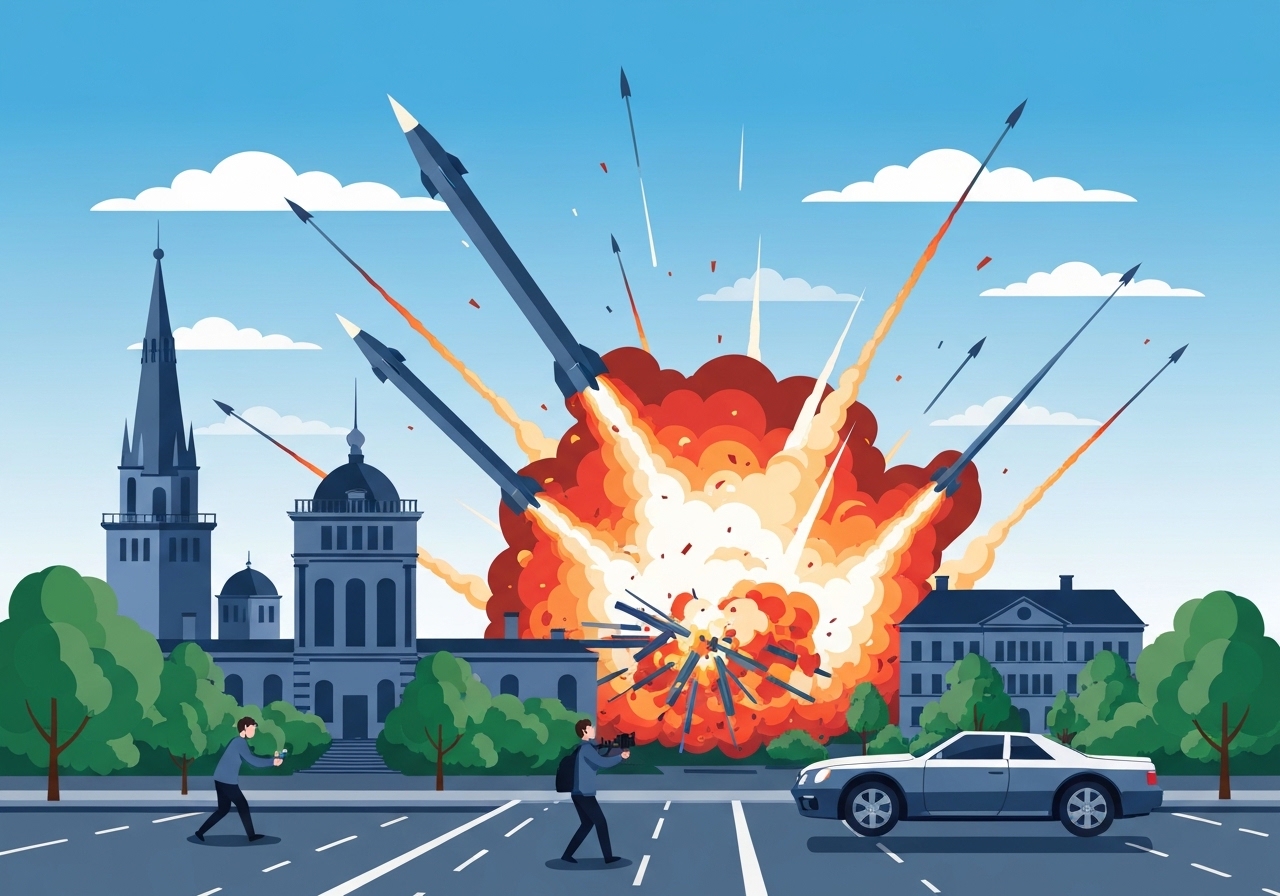
Early on Saturday, Kyiv endured one of its heaviest missile assaults in months as air-raid sirens and explosions ripped through the capital just hours after Ukrainian, Russian and U.S. delegations opened trilateral talks in Abu Dhabi. Reporters sheltering overnight described the barrage as “very, very massive,” while city residents faced renewed power outages and disruptions to heating and water supplies. The attack’s timing — coinciding with high-stakes negotiations — prompted diplomatic alarm and public fears that Moscow intended to influence the summit by force. Ukrainian officials and Western diplomats said the strikes worsened an already severe winter energy crisis and complicated the fragile prospect of a ceasefire.
Key Takeaways
- Russia launched a large-scale missile barrage on Kyiv early Saturday, described by local reporters as one of the heaviest assaults in months.
- The strikes came hours after Ukraine, Russia and the United States began their first trilateral talks in Abu Dhabi since February 2022.
- Ukraine’s delegation to the talks is led by Rustem Umerov; Russia’s by GRU chief General Igor Kostyukov.
- Ukrainians in many districts faced major power outages and shortages of heat and water amid an acute winter energy crisis.
- EU and U.S. officials are discussing up to $800 billion in public and private rebuilding funds tied to a long-term plan and a European Commission 18-page proposal.
- U.S. and allied officials warned that strikes during negotiations complicate diplomatic efforts and may signal a negotiating strategy.
- American participants in Abu Dhabi included Special Envoy Steve Witkoff and senior advisers; one U.S. official said the timing “complicates everything.”
Background
Since Russia launched its full-scale invasion in February 2022, Kyiv and other Ukrainian cities have periodically been subjected to missile and drone strikes targeting infrastructure and population centers. The conflict has entered its fourth winter, with repeated attacks on the power grid producing chronic outages that hampered heating and water in urban areas. Diplomatic efforts have moved fitfully between battlefield pressures and intermittent talks; until now, trilateral meetings involving Ukraine, Russia and the United States were rare. The Abu Dhabi meetings aimed to sketch parameters for ending the almost four-year war, with eastern territorial questions and security guarantees among the most fraught items on the table.
Multiple international actors have signaled interest in Ukraine’s eventual reconstruction, and Brussels and Washington have publicly discussed multi-hundred-billion-dollar packages to underwrite rebuilding and integration. The European Commission circulated an 18-page plan describing investment goals and a proposed 10-year fast track for EU accession, while Washington has outlined a 20-point peace framework. Still, officials from the EU and U.S. caution that such reconstruction financing hinges on an enduring ceasefire — a condition that remains unmet as strikes continue.
Main Event
Air-defense sirens began before dawn and explosions followed as Russian forces fired a broad barrage toward Kyiv, forcing thousands into shelters for hours. Kyiv Post correspondents who spent the night underground reported widespread shaking and a barrage they characterized as unusually intense for recent months. City utility operators and municipal officials said that the strikes damaged elements of the energy grid, producing rolling blackouts and localized loss of heating in residential neighborhoods.
The bombardment occurred a few hours after delegations from Ukraine, Russia and the United States convened in Abu Dhabi for talks intended to outline possible steps toward a negotiated settlement. Ukraine’s delegation was led by Rustem Umerov, secretary of the National Security and Defense Council, and included senior generals who planned to brief the president after each session. Russia’s delegation was headed by General Igor Kostyukov of the GRU. On the American side, the team included Special Envoy Steve Witkoff and senior advisers; participants described the timing of the strikes as disruptive to discussions underway.
Ukrainian officials said they would continue negotiations while also pressing to protect civilians and key infrastructure. In Kyiv, emergency services were dispatched to assess damage to power substations and to restore water and heating where possible. Municipal authorities urged residents to conserve energy and to remain in shelters until all-clear signals were given, while international partners expressed alarm at an attack that coincided with diplomatic outreach.
Analysis & Implications
The overnight strike highlights a recurrent dilemma in wartime diplomacy: battlefield actions can be used to influence negotiations even as envoys attempt dialogue. Western diplomats and Ukrainian officials interpreted the timing as a deliberate signal that Moscow retains the capacity to inflict pain while negotiating, complicating trust-building measures. If the strikes were intended to strengthen Russia’s hand at the table, they also risk hardening Ukrainian demands and rallying additional international political and material support for Kyiv.
Domestically, renewed damage to the energy grid deepens an acute winter emergency. Repeated attacks on power and heat infrastructure force difficult choices for municipal authorities and humanitarian agencies, and increase civilian vulnerability at scale. International reconstruction pledges — including discussions of up to $800 billion and EU accession fast-tracking measures — become harder to realize if active hostilities continue, since large-scale investment and integration efforts generally require stable security conditions.
For U.S. and EU policymakers, the incident complicates the calculus for assistance. Some policymakers may interpret escalatory strikes as justification for expedited or expanded aid to bolster Ukraine’s defenses and civilian resilience, while others may fear that sharper support risks intensifying the conflict. The pattern of “bomb then bargain,” as some diplomats described it, suggests any negotiated outcome will have to reckon with repeated coercive tactics that influence public and political calculations on all sides.
Comparison & Data
| Item | Relevant Detail |
|---|---|
| Invasion start | February 2022 (nearly four years) |
| Reconstruction proposal | EU 18-page plan; U.S. 20-point peace plan referenced |
| Potential funding | Up to $800 billion in public/private funding under discussion |
| Recent assault | One of the heaviest missile barrages on Kyiv in months (early Saturday) |
The table summarizes key reference points tied to the current diplomatic push: the war’s nearly four-year duration, the high-level policy proposals from Brussels and Washington, the scale of contemplated reconstruction funding, and the immediate trigger — a heavy missile strike on Kyiv. Taken together, those data points illustrate the tension between long-term reconstruction ambitions and short-term battlefield dynamics that continue to shape outcomes.
Reactions & Quotes
Diplomats and commentators framed the attack as a deliberate signal timed to the Abu Dhabi talks and warned it could influence the pace and content of negotiations.
This is how the Kremlin negotiates — with missiles.
Senior European diplomat (anonym.)
The diplomat offered the comment in Washington, saying anonymously that the strikes were intended as a coercive message to delegations in Abu Dhabi. Officials noted that such actions risk undermining confidence-building and push allied capitals to reassess support measures.
With ongoing negotiations in Abu Dhabi, it’s hard not to read this as a signal of Russia’s intentions toward peace.
Meaghan Mobbs (commentator)
Mobbs, who noted her family connection to a former U.S. envoy, expressed on social media that the barrage could prod stronger U.S. aid decisions. U.S. and allied sources said they were monitoring developments and assessing whether the strikes would change assistance or diplomatic sequencing.
Unconfirmed
- Any direct linkage between the Abu Dhabi talks and explicit orders from Moscow to time the strike to the summit remains unconfirmed by on-record Russian statements.
- Initial damage assessments are incomplete; exact figures for infrastructure losses and civilian casualties following the overnight barrage have not been publicly verified.
Bottom Line
The early-Saturday missile barrage on Kyiv underscored the central paradox facing the Abu Dhabi talks: efforts to broker a diplomatic pathway run headlong into persistent battlefield coercion. While high-level discussions and multi-hundred-billion-dollar reconstruction plans indicate international appetite for a post-war strategy, repeated strikes on civilian infrastructure make any near-term ceasefire and large-scale investment more difficult to secure. Diplomats now confront the twin tasks of protecting civilians and determining whether engagement at the negotiating table can proceed amid ongoing attacks.
For Kyiv residents, the immediate priorities remain restoring power, heat and water and ensuring humanitarian access. For international actors, the coming days will test whether diplomatic momentum can survive the psychological and logistical shocks of attacks timed to negotiations — and whether support packages can be structured to deter further coercion while enabling long-term recovery if a durable pause in fighting is reached.
Sources
- Kyiv Post — local media report on the overnight missile barrage and coverage of the Abu Dhabi trilateral talks (media)