
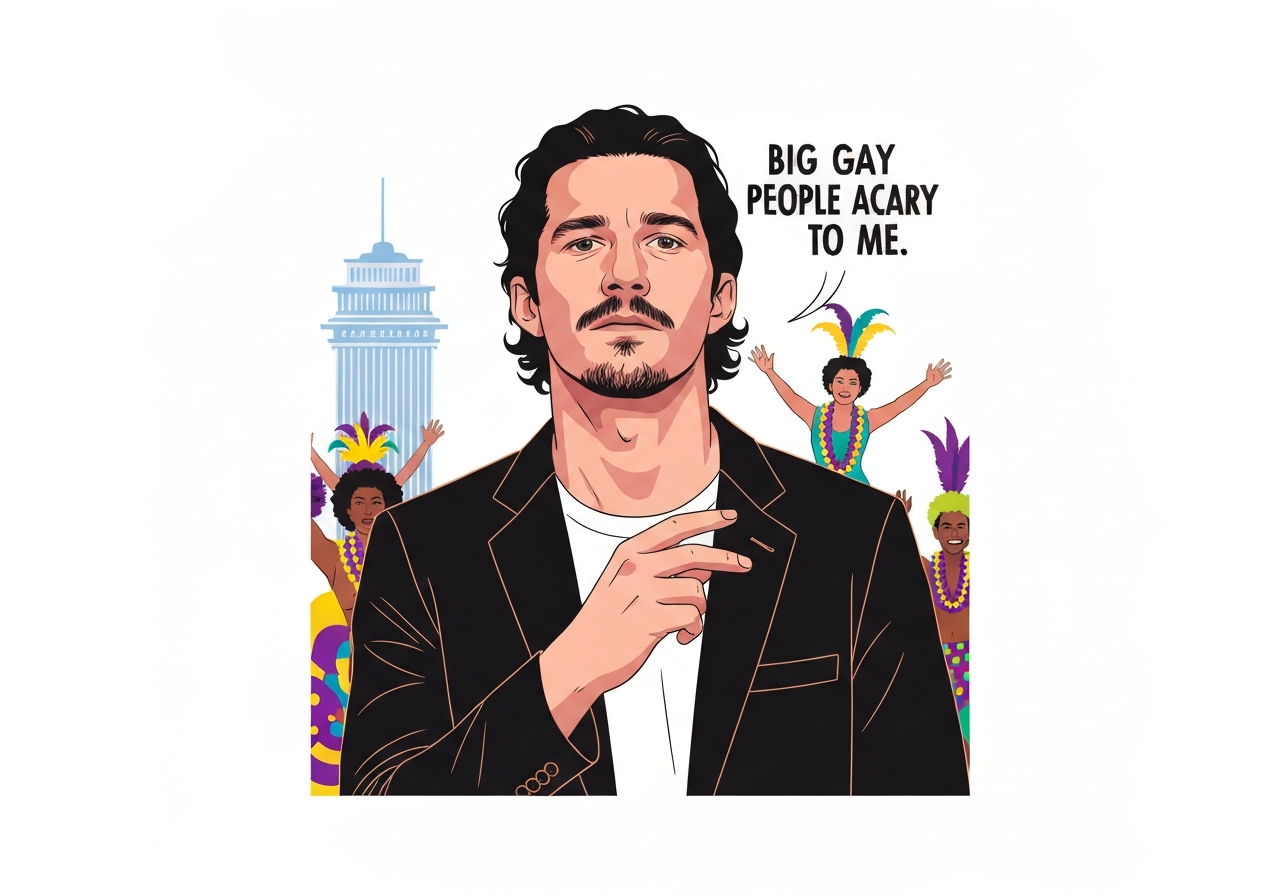
Lead: Actor Shia LaBeouf, 39, has linked his arrest during New Orleans’ recent Mardi Gras celebrations to a fear of “big gay people,” according to an interview published Saturday. LaBeouf was detained after an altercation on Royal Street in which police say he struck two people; he was later charged with two counts of simple battery. In the interview with YouTuber Andrew Callaghan, LaBeouf acknowledged his comment may be homophobic while describing being frightened by a group near him. Authorities say the actor was held down at the scene until officers arrived and was arrested after receiving hospital treatment for unspecified injuries.
- Arrest and charges: LaBeouf was arrested in New Orleans during Mardi Gras and charged with two counts of simple battery after an incident on Royal Street in which police say he hit two people.
- What he said: In a Callaghan interview released Saturday, LaBeouf said, “big gay people are scary to me,” and admitted the remark could be homophobic.
- Physical details: Police reported that LaBeouf allegedly punched one person in the nose and was restrained by bystanders until officers arrived.
- Medical treatment: LaBeouf received treatment at a hospital for unspecified injuries and was arrested upon discharge, per police statements.
- Prior incidents: The actor has prior legal and civil disputes: a 2017 arrest for public drunkenness (AP reported racist remarks then) and a 2020 civil suit by his ex-partner FKA Twigs that settled out of court last year.
- LaBeouf’s framing: He described being drunk and at Mardi Gras and framed the episode as partly a product of intoxication and chaotic circumstances.
- Victim details: Police identified two people as having been struck; available public reports do not confirm the sexual orientation of those involved.
- Legal status: The charges are simple battery counts; investigation details and any potential additional charges remain subject to the New Orleans Police Department’s ongoing procedures.
Background
Shia LaBeouf rose to public attention as a child actor on the Disney Channel’s Even Stevens and later became widely known for starring roles in major films such as the Transformers series. In recent years he has been a polarizing public figure, mixing high-profile creative projects with several well-documented personal and legal controversies. Those prior episodes inform public and legal scrutiny when new incidents arise.
Legally, the actor’s record includes a 2017 arrest on suspicion of public drunkenness; contemporary accounts reported that he made racist remarks at the time, a matter he later addressed in apology statements while attributing some behavior to addiction struggles. In 2020 he faced a civil lawsuit from his former partner, British singer FKA Twigs, alleging assault and other harms; that case was settled out of court the following year. Those prior matters contribute to how commentators and the public interpret subsequent allegations.
Main Event
According to police accounts made public after the Mardi Gras incident, the confrontation occurred outside a Royal Street business amid the crowded festival environment. Officers said LaBeouf struck two people; one victim was allegedly punched in the nose and bystanders held LaBeouf down until police could take him into custody. The New Orleans Police Department’s statement indicated he was taken to a hospital for treatment of unknown injuries before being formally arrested.
In the Callaghan interview released Saturday, LaBeouf described the proximate cause of his fear and frustration as physical contact from people nearby. He said that when he was alone and felt groups touching his leg, he became frightened and reacted. He also acknowledged intoxication and the chaotic conditions of Mardi Gras as factors shaping his behavior that night.
LaBeouf’s language in the interview included explicit references to gay people as frightening — phrased as “big gay people are scary to me” — and he followed that admission by saying that his comments might be homophobic. He also tried to contextualize the remarks by saying he was drunk and that the festival atmosphere amplified misjudgments.
Police charged LaBeouf with two counts of simple battery based on the incident report. Officials have not publicly released full witness statements or a complete timeline of events, and any pending investigation or potential court filings will add further detail as proceedings move forward.
Analysis & Implications
LaBeouf’s on-camera admission that he finds “big gay people” frightening shifts the story from a simple assault allegation to one with explicit bias implications. If victims or witnesses were targeted on the basis of sexual orientation, the episode could attract civil-rights scrutiny and additional legal consequences beyond simple battery. As of now, public records and police releases do not specify whether the incident will be treated as a hate crime.
For LaBeouf personally, the remarks and the arrest compound a pattern of public controversies that have already affected his reputation and career opportunities. Past legal settlements and the actor’s own public acknowledgments of substance struggles mean that employers, collaborators and audiences may weigh both the factual record and his explanations when deciding how to respond.
On a broader social level, the episode highlights how festival settings like Mardi Gras — characterized by high alcohol consumption and dense crowds — can elevate the risk of confrontations and misinterpretation. It also underlines how public figures’ offhand comments, especially those that target marginalized groups, tend to reverberate widely and prompt institutional responses from employers, advocates and law enforcement.
Comparison & Data
| Year | Incident | Outcome (public) |
|---|---|---|
| 2017 | Arrest on suspicion of public drunkenness; reported racist remarks | Public apology; charges reportedly dropped (news reports) |
| 2020 | Civil suit by ex-partner alleging assault and other harms | Case settled out of court (2023) |
| 2024 (Mardi Gras) | Arrest in New Orleans; accused of hitting two people | Charged with two counts of simple battery; investigation ongoing |
The table summarizes the publicly reported incidents and outcomes tied to LaBeouf that are relevant to interpreting the latest arrest. While the 2017 and 2020 matters reached resolution in different ways, the 2024 case remains subject to investigation and possible prosecution. Numbers and dates above are drawn from public reporting and statements from law enforcement and news organizations.
Reactions & Quotes
“When I’m standing by myself and three gays are next to me touching my leg, I get scared. I’m sorry. If that’s homophobic, then I’m that.”
Shia LaBeouf, in interview with Andrew Callaghan
“LaBeouf then reportedly assaulted another person — punching him in the nose.”
New Orleans Police Department (police statement reported by media)
Those two short excerpts illuminate the two frames dominating public reaction: LaBeouf’s own acknowledgment of fear and homophobic phrasing, and the police account emphasizing physical assault. Observers across civil-rights groups, entertainment industry circles and legal analysts are likely to weigh both the statements and corroborating evidence as the case progresses.
Unconfirmed
- Whether the people LaBeouf described in the interview were the same individuals he is accused of striking remains unconfirmed by public records.
- There is no public confirmation that the victims were targeted because of sexual orientation; police statements to date do not specify motive.
Bottom Line
The immediate story combines a physical-allegation — two simple battery counts after a Royal Street confrontation during Mardi Gras — with highly charged public remarks in which LaBeouf described fear of “big gay people.” Those two elements together broaden the incident’s stakes: it is both a criminal matter and a flashpoint for discussions about bias and accountability for public figures.
What happens next will depend on evidence gathered by authorities, potential witness statements, any prosecutorial decisions about motives or enhanced charges, and how LaBeouf and his representatives choose to respond publicly. Given his prior legal and civil history, this episode is likely to attract sustained media attention and scrutiny from advocacy groups, legal analysts and industry partners.
Sources
- NBC News — news report summarizing police statements and LaBeouf interview (news)
- The Associated Press — reporting on LaBeouf’s 2017 arrest and related public statements (news)