
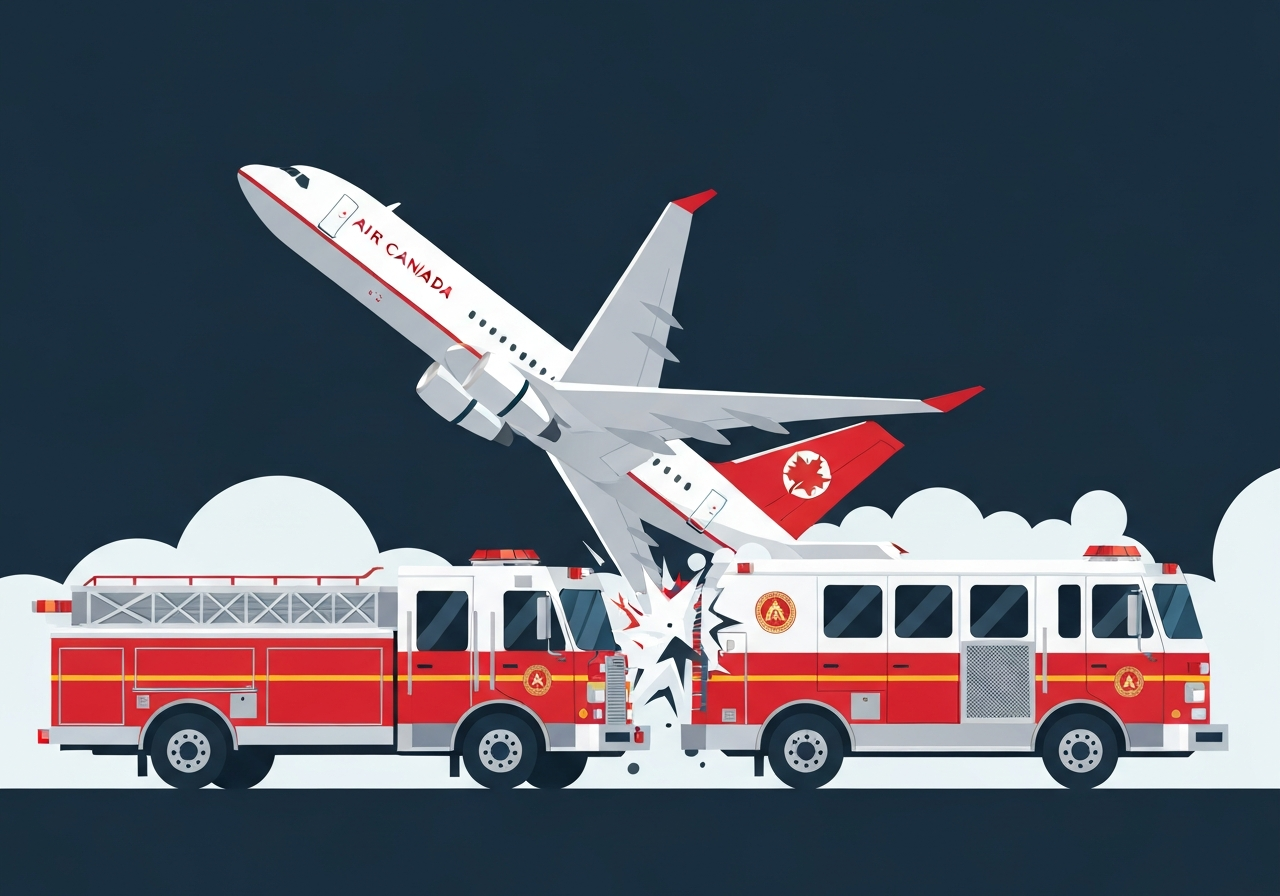
Lead: Late Sunday night at LaGuardia Airport, an Air Canada Express CRJ-900 operated by Jazz Aviation collided with a Port Authority fire truck on Runway 4, killing the aircraft’s pilot and co-pilot and injuring dozens. The flight, arriving from Montreal as AC8646, struck the vehicle at about 11:38 p.m.; first responders documented major cockpit damage and a toppled emergency vehicle. Officials say the ground vehicle had requested and received permission to cross taxiway Delta before the impact, and the NTSB has taken charge of the formal investigation. The airport remained closed into Monday, disrupting hundreds of flights and stranding travelers.
Key Takeaways
- The accident involved an Air Canada Express CRJ-900 (Jazz Aviation) arriving from Montreal; 72 passengers and four crew were on board.
- The pilot and co-pilot were killed at the scene; two Port Authority police officers and an estimated 41 passengers and crew sustained injuries.
- Preliminary reports from FlightRadar24 put the aircraft’s speed between 93 and 105 mph at impact.
- Nine injured people were described as having significant injuries; 32 others were treated and released by hospitals.
- The ground vehicle had been cleared to cross Runway 4 at taxiway Delta and was reportedly en route to a United Airlines aircraft that had reported an odor on board.
- Airspace operations at LaGuardia were suspended; the FAA listed the field closed into Monday afternoon and hundreds of flights were canceled or diverted.
- The National Transportation Safety Board will lead the probe with assistance from Air Canada, Jazz Aviation and Port Authority teams.
Background
LaGuardia is one of the busiest domestic airports in the United States, handling dense short-haul traffic between the New York metro area and Canada. Ground-vehicle operations on active runways and taxiways are tightly regulated and coordinated by airport operations and air traffic control; deviations can have immediate safety consequences. In recent years, several high-profile runway incursions nationwide have prompted renewed attention to coordination protocols, vehicle routing and controller-vehicle communications.
Jazz Aviation operates regional flights on behalf of Air Canada; the CRJ-900 type is commonly used for short international hops such as Montreal–New York. Port Authority emergency vehicles routinely respond to in-flight reports—ranging from odors to medical issues—which can require crossing active runways under ATC direction. The regulatory framework gives the NTSB primary investigatory authority for collisions involving civil aircraft.
Main Event
According to FDNY and Port Authority reports, firefighters and police responded after a Jazz Aviation CRJ-900 landed on Runway 4 and collided with a Port Authority fire truck at approximately 11:38 p.m. local time on Sunday. Video released by witnesses shows severe deformation at the aircraft’s nose and cockpit area, with cables and debris visible; an emergency vehicle was seen lying on its side nearby.
Air traffic control audio published by local outlets records a controller telling the ground vehicle to stop—”Stop, Truck 1. Stop”—moments before the impact and then rapidly working to divert other traffic. Officials say the vehicle had requested to cross taxiway Delta and had been cleared just prior to the collision; investigators will examine timing and message acknowledgment.
On board the plane were 72 passengers and four crew members. Emergency responders removed occupants from the fuselage; a flight attendant was thrown from her seat and onto the runway and was transported to hospital in stable condition. Local hospitals treated dozens of people; 32 were released and nine were classified with more serious injuries.
Analysis & Implications
The immediate operational impact is substantial: LaGuardia’s closure forced cancellations and diversions across the Northeast air network, affecting hundreds of flights and prompting airlines to offer rebooking options via Newark and JFK. Airport closures at peak times compound economic costs and ripple through connecting networks, increasing passenger delay minutes and airline recovery complexity.
From a safety and regulatory standpoint, the collision highlights vulnerabilities in runway-incursion prevention. Investigators will closely examine controller-to-vehicle communications, vehicle routing procedures, cockpit crew awareness, surface surveillance tools such as ASDE-X or multilateration systems, and human factors that can affect split-second decision-making on both the ground and in the cockpit.
Legally and operationally, the incident will likely trigger reviews by the Port Authority, FAA and carriers about dispatch rules for emergency responders on movement areas. If procedural gaps or equipment limitations are discovered, corrective actions could include updated crossing protocols, expanded use of stop bars and alerts, or additional training requirements for controllers and ground crews.
Comparison & Data
| Category | Count |
|---|---|
| Passengers on board | 72 |
| Crew | 4 |
| Fatalities (pilots) | 2 |
| Injured (passengers, crew, officers) | 43 |
| Serious injuries | 9 |
| Treated & released | 32 |
This table summarizes counts released by Port Authority and FDNY officials. The numbers consolidate published figures for onboard occupants, fatalities and injuries; investigators may adjust totals as reviews and medical reports are completed. The CRJ-900 striking a ground vehicle at near-landing speeds produces a high-energy impact, which explains the extent of cockpit damage and the severity of some injuries.
Reactions & Quotes
Port Authority leadership provided operational updates and casualty figures while coordinating with responding agencies; officials emphasized support for victims and a full investigation. Local passengers described traumatic scenes during evacuation and injuries sustained as people braced for impact and attempted to exit the aircraft.
“One of our friends was like several rows back from us … his nose was totally broken and bleeding on his face,”
Passenger interviewed by WABC Eyewitness News
The passenger account captures immediate human impact and the chaotic evacuation; video and photos corroborated visible passenger injuries and aircraft deformation at the nose section.
“Stop, Truck 1. Stop,”
Air traffic control recording
The terse recording has been cited publicly; investigators will time-stamp communications against radar and video to establish the sequence and whether commands were received or could have been acted upon.
“Please keep the victims, families and response teams in your prayers,”
U.S. Transportation Secretary Sean Duffy (social media)
Federal officials said Secretary Duffy planned to visit LaGuardia; the NTSB will lead the technical probe and the FAA will coordinate regulatory follow-up.
Unconfirmed
- Whether the vehicle driver acknowledged the last-stop instruction before the collision remains under investigation and is not yet independently verified.
- The preliminary speed range of 93–105 mph reported by FlightRadar24 is based on early analysis and subject to confirmation by NTSB instrumentation and flight data recorder review.
- Any mechanical failure on the aircraft or vehicle has not been publicly confirmed pending forensic inspections and is therefore undetermined.
Bottom Line
The collision at LaGuardia is a rare but severe instance of a runway-vehicle incursion with tragic loss of life and many injuries; it will prompt a detailed technical and procedural investigation by the NTSB. Early evidence points to a narrow window of time in which vehicle clearance, controller commands and aircraft landing operations converged—establishing a precise timeline will be central to assigning causal factors.
For travelers, the immediate consequence is widespread disruption across New York-area airports and a surge of rebookings and diversions; airlines and authorities have activated contingency measures to assist passengers. Longer term, expect enhanced scrutiny of surface movement rules, technology use on airports, and training for both controllers and emergency responders to reduce runway-incursion risk.
Sources
- WABC/ABC7 New York (local television reporting and eyewitness accounts)
- National Transportation Safety Board (federal investigatory agency)
- Federal Aviation Administration (airport status and airspace operations)
- Port Authority of New York & New Jersey (airport operator)
- FlightRadar24 (aircraft tracking service; preliminary speed analysis)