
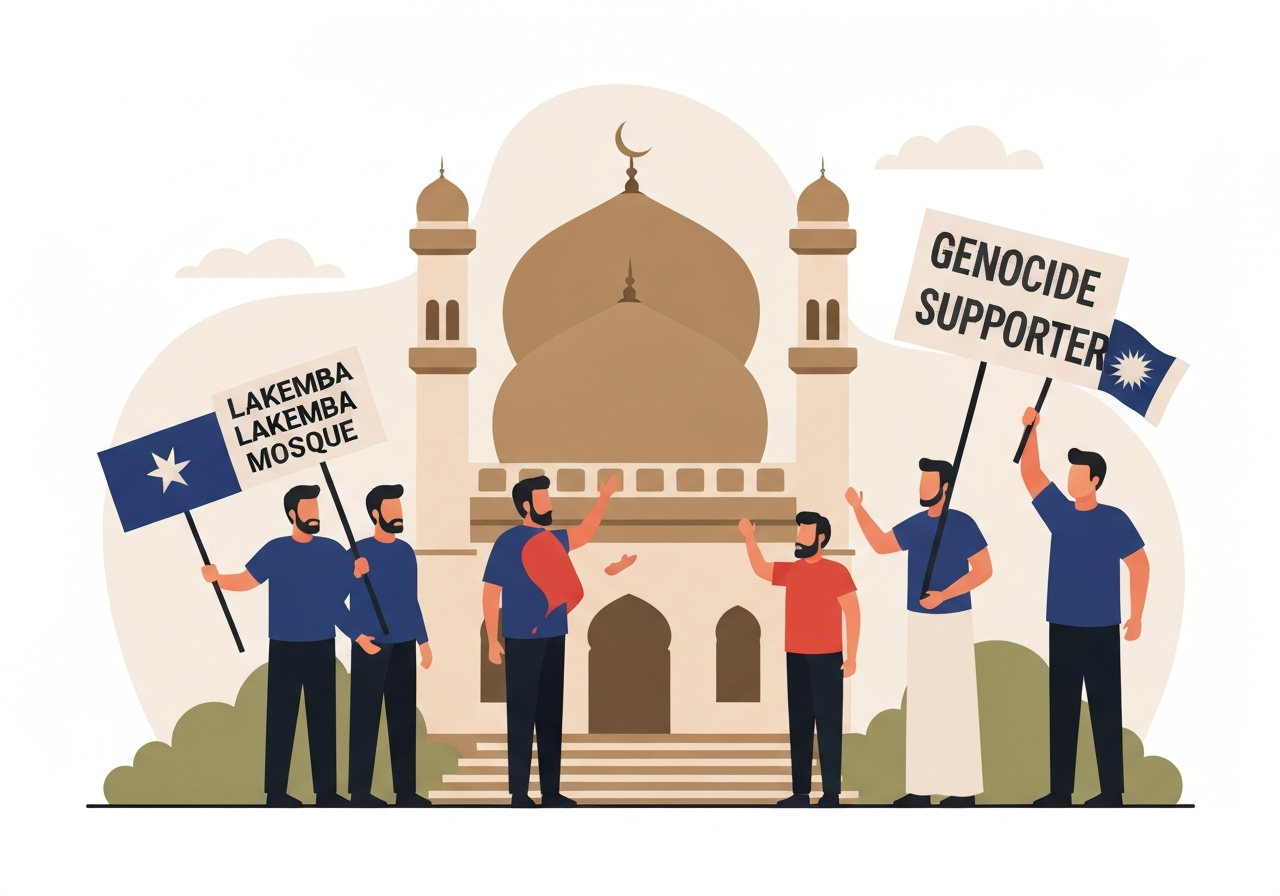
Lead: Australian Prime Minister Anthony Albanese and Home Affairs Minister Tony Burke were confronted by vocal protesters during an Eid al-Fitr visit to Lakemba Mosque in Sydney overnight Thursday. Worshippers shouted, booed and called the leaders ‘genocide supporters’ amid anger over the Gaza war and Canberra’s recent ban on Hizb ut-Tahrir. Security removed at least one heckler, and community members moved to calm the crowd. Despite the disruption, Albanese described the overall visit as ‘incredibly positive’ when speaking to reporters.
Key Takeaways
- Anthony Albanese and Tony Burke visited Lakemba Mosque in Sydney overnight Thursday to mark Eid al-Fitr; the visit was disrupted by protesters.
- Protesters shouted accusations including ‘genocide supporter’ and booed while some worshippers attempted to calm the scene.
- A security guard physically removed at least one heckler during the disturbance; no injuries have been reported in available accounts.
- Albanese said the incident involved ‘a couple of people heckling in a crowd of 30,000,’ framing the disruption as a small minority within a large community event.
- The unrest is linked by some participants to the government’s decision to designate Hizb ut-Tahrir as a banned hate organization following the Bondi attack that killed 14 people.
- Earlier tensions included protests during Israeli President Isaac Herzog’s visit to Australia, where 27 demonstrators were arrested after clashes with police.
Background
The visit took place at Lakemba Mosque, one of Sydney’s largest Muslim places of worship, during Eid al-Fitr, the festival concluding Ramadan. Eid prayers typically attract large congregations and political leaders often attend to offer community outreach and recognition. This year’s visit occurred against heightened domestic tensions after a deadly attack in Bondi that killed 14 people and increased public concern about communal safety.
Federal authorities recently moved to proscribe Hizb ut-Tahrir as a banned organization, citing concerns addressed in legislation advanced after the Bondi attack. That decision has been controversial: some Jewish community leaders and others welcomed steps seen as tackling extremism, while parts of the Muslim community have raised civil-liberties concerns and questioned the scope and timing of the ban.
Main Event
According to video and eyewitness reports, a group of attendees at the Lakemba Mosque visit booed and shouted at Albanese and Burke, accusing them of supporting Israel’s actions in Gaza. At least one attendee urged the crowd to stop filming and to remain calm, saying Eid is a joyful day. Visual footage showed a security guard tackling a heckler to the ground and escorting that person out of the mosque.
As the leaders prepared to leave, protesters continued to voice their anger, chanting phrases including ‘Shame on you’ and ‘genocide supporter.’ Albanese subsequently told reporters community members helped defuse the disruption and emphasized that the hecklers were a minority within a large gathering. Officials did not report arrests linked to the mosque disturbance in the initial reports provided to press.
The disturbance reflected broader public divides over Canberra’s stance on the Gaza war: while the government has expressed support for Israel’s right to self-defense, it has also signaled concern for Palestinian civilians and called for de-escalation. Those mixed signals have left many community members frustrated on both sides of the debate.
Analysis & Implications
The incident underscores deep polarization in Australia over the Gaza war and how domestic security measures intersect with communal relations. Labeling Hizb ut-Tahrir as a banned organization followed a traumatic domestic attack and was intended to address violent extremist risks, but the move has simultaneously inflamed perceptions among some Muslims that the government is targeting political or religious expression.
Politically, the episode places the Albanese government in a difficult position: it must demonstrate responsiveness to Jewish community safety concerns after the Bondi killings while also managing legitimate anger in sections of the Muslim community. That balancing act risks criticism from both sides, as seen in recent public responses and arrests at prior protest events.
From a security perspective, the mosque disturbance highlights the operational challenge of protecting democratic access at community events while preserving free expression and faith-based spaces. Heavy-handed responses risk further alienation, yet inadequate security can allow hostile disruptions that harm community cohesion and leaders’ ability to engage.
Looking ahead, the protest could influence how future political visits to religious sites are managed, prompting clearer protocols on security, community liaison and communications both before and after such visits. It may also affect ongoing debates over proscription laws and how they are perceived by different communities.
Comparison & Data
| Event | Figure | Context |
|---|---|---|
| Bondi attack fatalities | 14 | Deadly attack cited as catalyst for new legislation |
| Crowd size referenced by PM | 30,000 | Albanese used this figure to contextualize heckling |
| Arrests during Herzog visit | 27 | Large Sydney rally where clashes with police occurred |
The numbers above provide quick context: the Bondi attack’s 14 fatalities prompted legislative momentum, Albanese referenced a 30,000-strong community context when characterizing the disruption, and authorities arrested 27 people during protests at a recent state visit by Israeli President Isaac Herzog. These figures help frame both the scale of public gatherings and the security responses those events can provoke.
Reactions & Quotes
Community response was mixed: some attendees intervened to calm the crowd while others vocally protested government policy. Officials framed the incident as limited in scale compared with the size of the gathering.
“If you got a couple of people heckling in a crowd of 30,000, that should be put in that perspective.”
Anthony Albanese, Prime Minister of Australia
Albanese used the remark to emphasize that the disruptive group was a small fraction of the attendees and that many community members supported his presence and helped manage the situation.
“Dear brothers and sisters, keep calm a little bit. It is Eid. It is a joyful day.”
Worshipper and mosque attendee (onsite)
An on-site attendee can be heard urging restraint and calling attention to the religious significance of the day, efforts that helped reduce tensions and allow the event to proceed.
Unconfirmed
- Whether the hecklers were organized by any formal group or acted independently remains unverified based on available reporting.
- No independent verification yet confirms the total number of people directly involved in heckling versus the wider crowd; estimates cited are from political remarks and eyewitness footage.
Bottom Line
The Lakemba Mosque incident reveals the sharp tensions in Australian public life over foreign policy, domestic security measures and community relations. While the disruption was visible and newsworthy, leaders and many worshippers framed it as a limited disturbance amid a large, largely peaceful gathering during an important religious festival.
For policymakers the episode is a reminder that responses to security threats must be coupled with clear community engagement and transparent communication to avoid fuelling further division. How Canberra proceeds with proscription policy, policing at public events, and outreach to both Jewish and Muslim communities will shape social cohesion in the months ahead.