
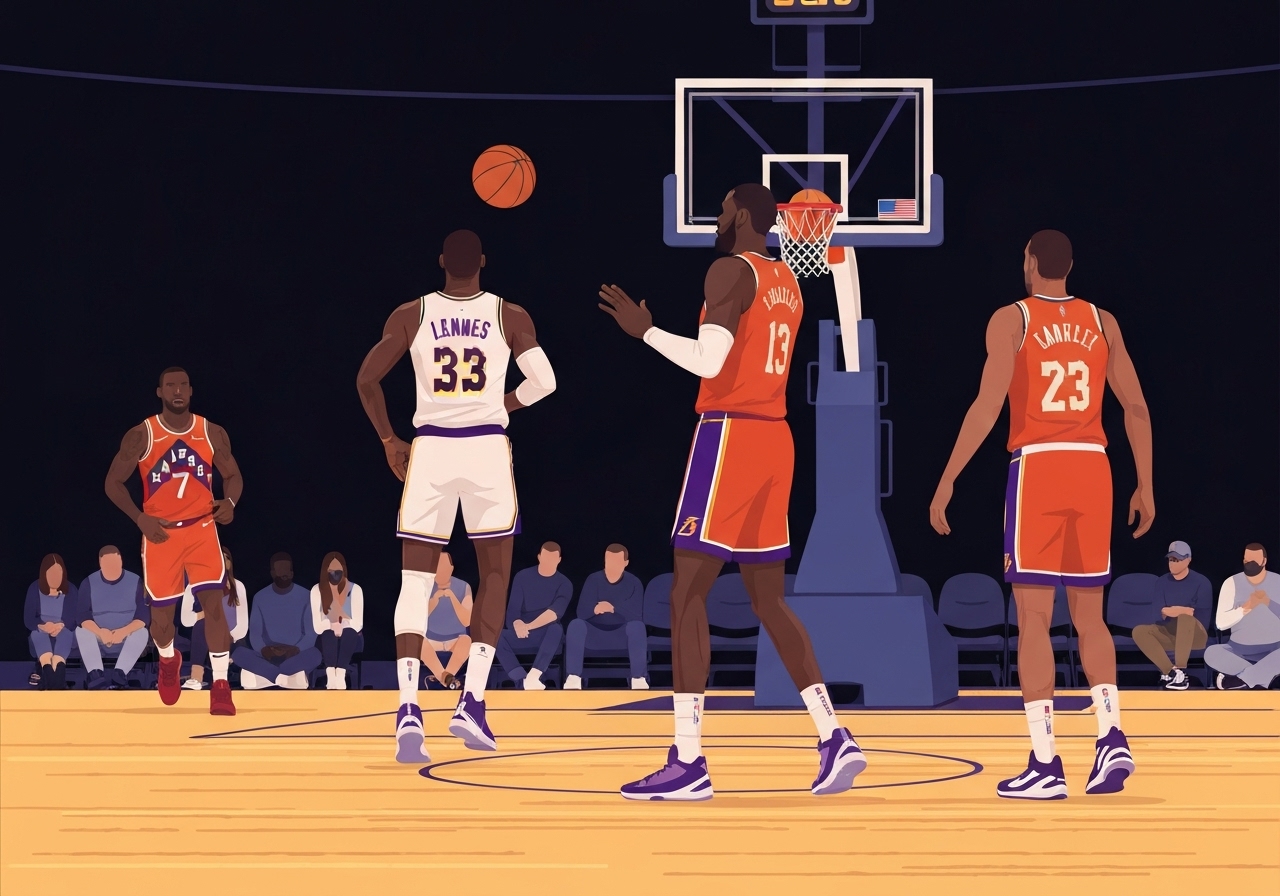
Lead: On December 5, 2025, in Toronto, LeBron James saw his record run of consecutive regular-season double-digit scoring games end at 1,297 as the Los Angeles Lakers beat the Toronto Raptors 123-120. Held to eight points, James nonetheless delivered the decisive assist, feeding Rui Hachimura for a buzzer three that sealed the victory. He downplayed the personal milestone afterward, insisting the team result mattered more than any individual streak. The outcome preserved the Lakers’ win while closing an 18-year chapter in NBA history.
Key Takeaways
- LeBron James’ 1,297-game streak of regular-season double-digit scoring ended on December 5, 2025, when he finished with eight points in a 123-120 Lakers win over the Raptors.
- James recorded the game-winning assist, setting up Rui Hachimura’s three-pointer as time expired to decide the contest.
- Through much of the night James struggled from the field, shooting 3-of-15 and entering the fourth quarter with six points.
- He tied the game with a basket at 1:46 remaining, then missed a 14-foot attempt with 1:01 left that would have extended the streak.
- Coach J.J. Redick and teammates described James’s final pass as consistent with his career-long decision-making and unselfish play.
- The 1,297-game run surpasses Michael Jordan’s 866, Kareem Abdul-Jabbar’s 787 and Karl Malone’s 575 as the longest such streak in NBA records.
- Prior to this game, James had reached 10 points by the start of the fourth quarter 1,266 times during the streak.
Background
LeBron James began the streak on January 6, 2007, and maintained it through nearly two decades of regular-season play across multiple teams and eras. The run became a defining durability and consistency metric, with James regularly producing scoring outputs regardless of role, team roster or coaching changes. Historically, only a handful of all-time greats compiled extended strings of double-digit games, with Jordan, Abdul-Jabbar and Malone among the previous leaders; none approached James’s 1,297 mark.
Beyond raw scoring, the streak served as a narrative about James’s sustained elite performance and adaptability—his ability to produce scoring while also creating opportunities for teammates. Teams and opponents adjusted defenses around him, yet he repeatedly found ways to reach double figures. The streak’s longevity made it a recurring subplot each season and a benchmark compared across generations of players.
Main Event
In Toronto on December 5, James battled a cold shooting night, entering the fourth quarter with six points on 3-of-15 shooting. He returned at 5:23 left in the game when the result and his streak both hung in the balance. He scored with 1:46 remaining to knot the score, keeping his chances alive.
With 1:01 left James missed a 14-foot jumper that would have pushed him to double digits. In the final possession, Austin Reaves delivered the ball to James with seconds remaining. Rather than force a shot, James swung the ball to the left corner to Rui Hachimura, who drained the three at the buzzer to give the Lakers the 123-120 victory.
James’s reaction on the court was celebratory rather than rueful; he raised his arms in recognition of the winning play. Postgame, he repeatedly emphasized team success over individual milestones, saying simply that he had no particular thoughts about the streak ending and that the team result was what mattered most.
Analysis & Implications
Statistically, the end of the streak closes a chapter on an unprecedented indicator of scoring consistency. For analysts, the decisive context is not only the final total but how James adjusted to game flow: when his shooting was off he shifted to playmaking, producing the assist that decided the game. That versatility has been a hallmark of his career and will continue to shape how teams game-plan against him.
From a team perspective, the play underlines the Lakers’ capacity to win tight games without relying on a single scoring outburst from their star. That could influence coaching rotations and late-game design choices, signaling trust in role players like Hachimura and Reaves to make high-leverage shots when James opts to facilitate.
Public and market perception may frame the streak’s end as symbolic rather than substantive: James remains one of the league’s most impactful players even with this particular streak concluded. For opponents and roster builders, the practical takeaway is that James is as willing to cede a scoring opportunity to secure a win—an attribute that affects matchup planning and personnel allocation around him.
Comparison & Data
| Player | Consecutive Double-Digit Games |
|---|---|
| LeBron James | 1,297 |
| Michael Jordan | 866 |
| Kareem Abdul-Jabbar | 787 |
| Karl Malone | 575 |
The table shows the scale of James’s streak relative to historical peers. Analysts note that sustaining double-digit outputs over calendar shifts, team changes and aging curves magnifies the achievement; James’s 1,297-game stretch more than doubles Jordan’s total and dwarfs other Hall of Famers’ runs.
Reactions & Quotes
“None. We won.”
LeBron James, Lakers player
James offered a terse postgame reaction, prioritizing the team’s victory over discussion of the personal streak ending. That succinct response framed the moment as secondary to the result.
“He did it like he’s done so many times.”
J.J. Redick, Lakers coach
Coach Redick described the final sequence as consistent with James’s career approach—making the play that gives his team the best chance to win even when personal milestones are at stake.
“He’s such an unselfish player. He had the opportunity but because of who he is, he made the unselfish play.”
Jake LaRavia, Lakers center
Teammates framed the ending as emblematic of James’s leadership and selflessness, highlighting how the final assist fit an established pattern rather than a dramatic departure.
Unconfirmed
- Whether James consciously decided not to pursue a final shot that would extend the streak is not independently verified beyond his public statements.
- No internal team messages or private coaching conversations about last-possession design have been released to confirm strategic intent.
Bottom Line
The conclusion of LeBron James’s 1,297-game double-digit scoring streak is historically significant but did not affect the Lakers’ immediate objective: a road win in Toronto. The final play—James passing to Rui Hachimura for the buzzer beater—illustrates how his game has evolved from pure scoring to a balance of scoring and high-level facilitating.
For legacy discussion, the streak’s end is a milestone that will be measured alongside James’s other career achievements rather than diminishing them. For the Lakers this season, the episode underscores trust in role players and in James’s decision-making in crunch time, a dynamic that could influence end-of-game possessions going forward.
Sources
- The Guardian — media report on game and quotes (news outlet)