
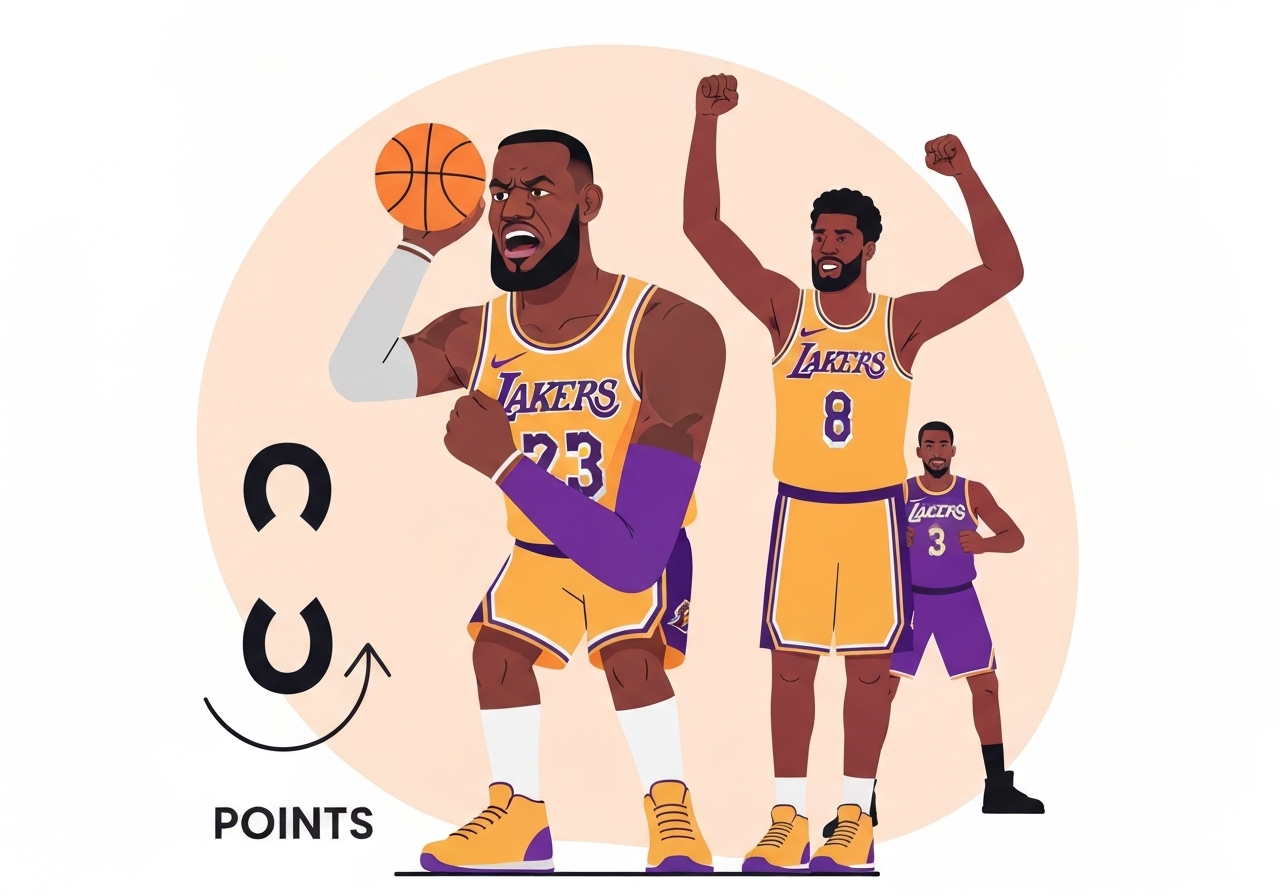
Lead: On Dec. 4, 2025 in Toronto, LeBron James saw his NBA-record run of consecutive regular-season double-digit scoring games end at 1,297 as he was held to eight points in the Los Angeles Lakers’ 123-120 victory over the Raptors. Rather than force shots to extend the streak, James made the game-winning play, assisting Rui Hachimura’s buzzer 3 to seal the win. He downplayed the personal milestone afterward, saying simply that the only thing that mattered was the team result. The outcome preserved the Lakers’ win while closing a remarkable durability chapter in James’ career.
Key Takeaways
- LeBron James’ streak of 1,297 consecutive regular-season games with 10+ points ended on Dec. 4, 2025 in Toronto; he finished with eight points in a 123-120 Lakers win.
- James recorded a game-winning assist to Rui Hachimura, who hit a left-corner 3 at the buzzer to decide the game.
- Through most of the fourth quarter James had six points on 3-of-15 shooting and missed a 14-foot attempt with 1:01 remaining that would have extended the streak.
- The streak began on Jan. 6, 2007 and stands far ahead of the next-longest runs: Michael Jordan (866), Kareem Abdul-Jabbar (787) and Karl Malone (575).
- Kevin Durant becomes the active leader with a streak of 267 consecutive double-digit games following James’ streak ending.
- James repeatedly emphasized team play over personal milestones, saying he had “None” to report about the streak ending and that the Lakers won — that was enough.
- Entering Thursday, James had reached 10 points by the fourth quarter in 1,266 of those streak games, illustrating how frequently the mark was met well before game end.
Background
LeBron James’ consecutive double-digit scoring streak had become one of the NBA’s most enduring records, stretching back to Jan. 6, 2007. Over 18-plus seasons the streak survived roster changes, coaching shifts and seasons with varying roles for James, reflecting both scoring consistency and availability. The run eclipsed previous long streaks by wide margins: Michael Jordan’s 866-game run, Kareem Abdul-Jabbar’s 787 and Karl Malone’s 575, making James’ mark a statistical outlier in league history.
Beyond personal achievement, the streak was a narrative touchstone for how teams used James: as primary scorer, playmaker and leader. Lakers coach JJ Redick and teammates often referenced James’ scoring reliability in game planning, and opponents adjusted defensively with schemes aimed at limiting his touches. The streak’s end therefore matters both as a historical datum and as a moment that highlights how team outcomes and situational decisions sometimes override individual milestones.
Main Event
The decisive sequence unfolded in the final minute after a game-long battle in Toronto. James checked back in with 5:23 left in the fourth with six points on 3-of-15 shooting; he tied the game with a score at 1:46. With 1:01 remaining he missed a 14-foot attempt that would have pushed him to double digits, leaving him on eight for the night. On the final possession, Austin Reaves delivered the ball to James, who elected to pass to Rui Hachimura in the left corner rather than take a contested shot.
Hachimura hit the 3-pointer as time expired, giving Los Angeles a 123-120 win. James immediately raised his arms in celebration; his decision to pass rather than shoot became the defining image of the night. After the game he minimized the streak’s end when asked, saying, “None. We won,” emphasizing the team’s result over personal numbers.
Coach JJ Redick and teammates framed James’ choice as consistent with his career-long approach. Redick noted James’ awareness of his point total late in games while praising the decision to make the right play. Center Jake LaRavia called James “such an unselfish player,” saying the team benefitted from his choice to set up Hachimura instead of trying to secure the individual mark.
Analysis & Implications
Statistically, the streak’s termination closes an unprecedented chapter in NBA durability and scoring consistency. A 1,297-game run is exceptional both for its length and for the era-spanning context: it covered seasons with different teammates, load-management conversations and changing offensive roles. The raw number highlights James’ combination of health, productivity and centrality to team offense across nearly two decades.
Practically, the moment underlines a principle teams face late in tight games: the optimal on-court decision for winning can conflict with individual milestones. James’ pass demonstrated prioritizing the team’s chance to win over the personal record, a choice coaches generally encourage but that also removes dramatic narrative opportunities. For the Lakers, the result — a win in Toronto — is the immediate priority, and it came at the cost of an all-time streak remaining intact.
From a legacy perspective, the streak was already firmly part of James’ historical case; its end does not diminish his standing as the NBA’s career points leader or alter his statistical achievements. However, the event may shift focus toward other available metrics and milestones for assessing late-career impact, such as shot selection, playmaking on winning possessions and championship-related outcomes.
Comparison & Data
| Player | Consecutive 10+ Point Games | Notes |
|---|---|---|
| LeBron James | 1,297 | Ended Dec. 4, 2025 |
| Michael Jordan | 866 | Second-longest run |
| Kareem Abdul-Jabbar | 787 | All-time top three |
| Karl Malone | 575 | Fourth-longest |
| Kevin Durant (active) | 267 | New active leader |
The table puts James’ streak in historical context: his total exceeds the next-best mark by more than 400 games. That gap signals both durability and sustained offensive relevance. The new active leader, Kevin Durant, remains far behind, illustrating how exceptional James’ run was. For coaches and front offices, such comparisons reinforce how rare multi-season consistency at a high level has become in the modern, load-managed NBA.
Reactions & Quotes
Teammates and staff framed the decision to pass as emblematic of James’ career approach: prioritizing winning over individual accolades. Teammates emphasized respect for the choice and relief at the game’s result, while coaches reflected on both the competitive instincts and the situational awareness James showed.
“None. We won.”
LeBron James
James’ concise response after the game underscored his view that the team outcome outweighed the streak. He reiterated that making the right play — regardless of how it affects personal milestones — is his standard operating procedure.
“LeBron is acutely aware of how many points he has at that point. He did it like he’s done so many times.”
JJ Redick, Lakers head coach
Redick’s comment highlighted intent and routine: that James monitors his own scoring but prioritizes team success. Redick also referenced a belief in competitive fairness — if you make the correct play, the game often rewards you — a sentiment he expressed after the buzzer-beater.
“He’s such an unselfish player. He had the opportunity but because of the player he is … he made the unselfish play, passed it to Rui and we won the game.”
Jake LaRavia, Lakers center
LaRavia’s reaction reflected a teammate’s perspective, praising James’ decision-making and noting its immediate payoff. That sentiment was common among Lakers players on the bench and in the locker room after the win.
Unconfirmed
- Whether James intentionally avoided taking a potential streak-extending shot on the final possession as a deliberate long-term decision; James’ comments emphasize team focus, but intent beyond that was not independently verified.
- Any internal coaching instruction specifically aimed at deprioritizing James’ scoring to preserve his health or minute management late in the season was not disclosed publicly and remains unconfirmed.
Bottom Line
The end of LeBron James’ 1,297-game double-digit scoring streak on Dec. 4, 2025 is historically significant but not career-defining in isolation: it closes an unparalleled run of scoring consistency while simultaneously highlighting James’ team-first approach in a late-game situation. The buzzer-beating assist to Rui Hachimura reframes the night as a victory-first narrative rather than a record-focused one.
For the Lakers, the practical outcome is a road win and evidence that late-game decision-making favored team success. For the league and stat-keepers, the streak remains a marker of exceptional durability; its termination creates space for new narratives about how superstars balance personal milestones with team objectives in the modern NBA.