
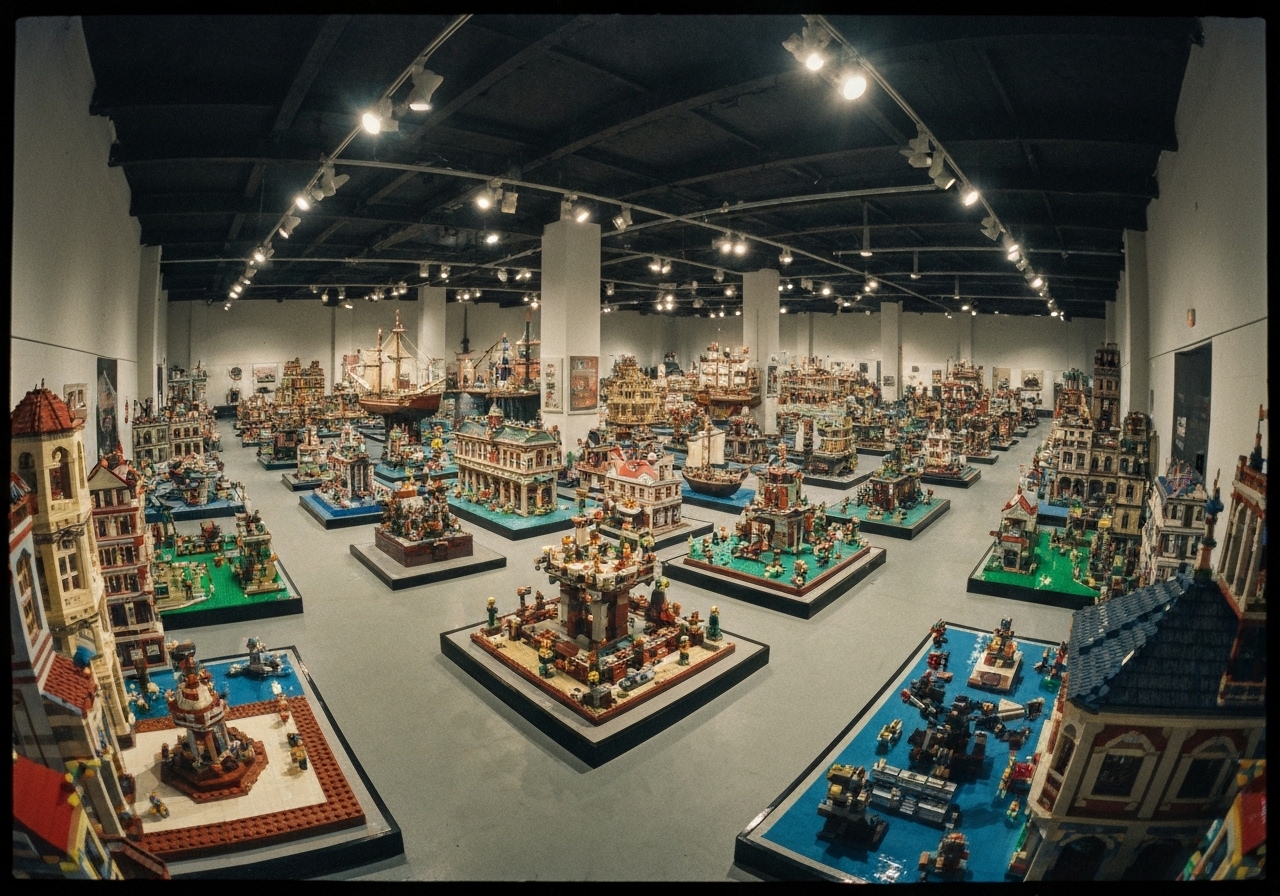
In Billund, Denmark, CBS News was granted a rare tour of a museum at the heart of the LEGO Group’s origin story, a staff-only collection that traces the brand’s evolution from mid-20th-century bricks to today’s multimillion-piece showcases. The exhibit sits adjacent to founder Ole Kirk Kristiansen’s original home and preserves early sets, including a 1955 play town that established LEGO’s enduring “system” — the idea that bricks of different eras remain physically compatible. Visitors can see decades-old functioning models, such as a 1970s drawbridge castle, alongside modern monumental builds in nearby LEGO House, including the 50-foot, 6-million-brick Tree of Creativity. Yet the company’s success coexists with an environmental dilemma: most LEGO production still relies on petrochemical-based plastics, a constraint the firm says has complicated its search for a durable, lower-emissions alternative.
Key Takeaways
- Location and access: The museum is in Billund, Denmark, adjacent to Ole Kirk Kristiansen’s original home and is normally open only to LEGO employees; CBS News obtained special access on December 20, 2025.
- Historical continuity: LEGO’s so-called “system” dates to 1955, when the company assembled a play town that established cross-generational brick compatibility.
- Collection highlights: The museum houses some of the earliest bricks (1950s) and functional sets like a 1970s drawbridge castle; LEGO House holds roughly 25 million bricks overall.
- Largest builds: LEGO House contains the Tree of Creativity, about 50 feet tall and built from more than 6 million bricks, and occupies nearly 130,000 square feet.
- Design capacity: The company employs roughly 700 designers worldwide, according to André Doxey, the LEGO Group’s first American Head of Design.
- Scale of production: LEGO produces approximately 60 billion bricks each year, a figure cited by CBS News reporting from industry data.
- Environmental challenge: A data platform cited in reporting estimated that every ton of LEGO produced may require about two tons of petrochemical inputs in manufacturing processes.
- Sustainability efforts: LEGO says it has tested more than 600 materials and aims for 60% of purchased materials from sustainable sources by the end of the year, but key brick components remain petrochemical-based.
Background
The LEGO Group’s roots are in Billund, where Ole Kirk Kristiansen founded a woodworking and toy business that later evolved into the plastic-brick company recognized worldwide today. The company name derives from the Danish phrase “leg godt” — “play well” — reflecting an early and persistent focus on imaginative play. That philosophy underpinned the 1955 creation that formalized LEGO’s ‘‘system’’: standardised, interlocking elements designed to remain compatible across generations, a principle that shaped product decisions and consumer loyalty for decades.
Growth over the second half of the 20th century moved LEGO from modest wooden and plastic toys to an expanding portfolio of themed sets, licensed properties and large-scale architectural builds. Alongside product expansion, the firm invested in brand spaces: LEGO House, opened in Billund in recent years, functions as both a visitor attraction and a live demonstration of the company’s design and engineering capabilities. These investments reinforce the cultural and commercial ecosystem that supports collectors, families and the growing adult fan community known as AFOLs (Adult Fans of LEGO).
Main Event
CBS News’ visit to the employee-only museum provided a consolidated view of LEGO’s material history and design ethos. On display were original bricks from the 1950s and a small early “play town,” demonstrating the firm’s founding idea that compatibility across parts would extend play value. The collection includes working artifacts — not just preserved models — such as a drawbridge castle from the 1970s that still functions as intended.
Nearby showcases in LEGO House translate that same system into enormous, contemporary works: roughly 25 million bricks are distributed across exhibits, and the Tree of Creativity alone contains over 6 million bricks and rises almost 50 feet. These builds are the product of the company’s in-house design teams; André Doxey told CBS News there are about 700 designers globally contributing to product lines and experiential displays.
Design methods have also shifted. Many new sets are conceived in digital environments to speed prototyping and production, though some senior designers still emphasize the tactile process of building with bricks. Milan Madge, a Design Master, said children’s perspectives remain the primary inspiration, even as the company addresses an adult market that seeks more complex models.
Despite the celebratory tone of the exhibits, sustainability questions permeated the visit. Reporting cited an external data platform that models petrochemical inputs and estimated a high material intensity in LEGO manufacturing. The company confirmed it has tested hundreds of material alternatives but has paused certain recycling experiments and dropped a ‘‘bottles to bricks’’ initiative in 2023 after finding the proposed material increased emissions relative to existing plastics.
Analysis & Implications
LEGO’s long-term resilience rests on three linked factors: technical compatibility across product generations, strong brand storytelling, and investments in experiential spaces that convert nostalgia into commerce. The 1955 system created both a product standard and an emotional anchoring: a brick bought today connects physically and sentimentally to one bought decades ago, reinforcing repeat purchases and collector habits.
However, that very durability — a design brief to make bricks that last and interlock precisely — complicates substitution of fossil-based feedstocks. Safety, dimensional tolerance (the company cites accuracy within less than a hair’s width), and longevity are non-negotiable for toys aimed at children. That raises a technical trade-off: many lower-carbon polymers or recycled mixes may not yet meet the rigorous standards for mechanical fit, colorfastness and long-term wear.
Commercially, the adult fan segment represents a growing revenue stream for higher-priced, complex sets, but company leadership continues to position children as the core audience. Balancing product lines for different age groups affects material choices and packaging, and could influence how quickly new materials are adopted across categories. Corporately, sustainability targets (such as the stated 60% sustainable-sourced materials goal) will be measured against persistent production volumes — about 60 billion bricks annually — which magnify any incremental emissions or resource impacts.
On a systemic level, LEGO’s challenge typifies a broader manufacturing dilemma: legacy product standards can lock in material pathways that are technically difficult and expensive to change. Progress likely requires parallel advances in polymer science, scaled recycling infrastructure, and transparent lifecycle accounting to ensure alternative materials truly reduce greenhouse gas emissions without compromising consumer safety or product life.
| Metric | Figure / Note |
|---|---|
| Annual bricks produced | About 60 billion bricks per year (reported) |
| LEGO House footprint | Nearly 130,000 square feet |
| Tree of Creativity | ~6 million+ bricks; ~50 feet tall |
| Historical system established | 1955 play town — first full compatibility system |
| Materials testing | More than 600 materials tested (company statement) |
| Petrochemical estimate | ~2 tons of petrochemical inputs per ton of LEGO (data platform cited) |
The table puts key production and design facts side by side to illustrate scale. When output is measured in tens of billions of bricks annually, even small material- or process-level emissions matter. The data platform estimate about petrochemical inputs highlights why LEGO’s material choices have outsized climate implications, but comparability across studies varies with methodology.
Reactions & Quotes
You don’t have to be a designer. You just have to be brave, creative and curious, and give it a try.
André Doxey, LEGO Group (Head of Design)
Doxey framed the company’s core appeal as creative freedom more than technical expertise, a message that aligns with LEGO’s long-term marketing to children and adults alike.
LEGO bricks are made for children, so they must meet extremely high quality and safety standards. They must also be durable, and are precision-engineered to accuracy of less than a hair’s width.
LEGO Group (official statement to CBS News)
The company emphasized quality and safety as constraints on material substitution, noting extensive testing has so far limited its ability to switch to alternatives without compromising standards.
Other materials have shown potential, but have not met our strict quality, safety and durability requirements, or would not have helped reduce our carbon footprint.
LEGO Group (sustainability comment)
LEGO framed its decision-making in lifecycle terms, suggesting the company’s material choices are governed both by product performance and net environmental impact.
Unconfirmed
- The estimate that every ton of LEGO requires roughly two tons of petrochemical inputs comes from a third-party data platform cited in reporting and may rely on modeling assumptions that vary by study.
- Details on the exact material formulation tested in the discontinued “bottles to bricks” initiative and the specific lifecycle calculations showing higher emissions were not published in full by the company and therefore cannot be independently verified here.
- The precise size and growth rate of the AFOL (Adult Fans of LEGO) market were described qualitatively in reporting but lack a single, publicly disclosed industry-wide metric to confirm scale.
Bottom Line
The museum tour in Billund makes clear why LEGO has retained cultural and commercial momentum for decades: a rigorous engineering standard, a culture of hands-on design, and compelling public-facing experiences preserve both product utility and emotional attachment. The 1955 system remains a foundational asset, underpinning interoperability that keeps old and new customers connected to the brand.
At the same time, LEGO faces a hard technical and strategic problem on sustainability. Its commitment to durable, child-safe bricks creates real barriers to rapid material substitution, and large-scale production — roughly 60 billion bricks yearly — amplifies any environmental impacts. Progress will require collaborative advances in materials science, transparent lifecycle assessments, and scaled supply-chain solutions that demonstrably lower emissions without undercutting safety or longevity.
For consumers and observers, the museum is a reminder that product design choices echo across generations: the very qualities that made LEGO culturally durable are the same factors that complicate its transition to lower-carbon materials.