
Lead
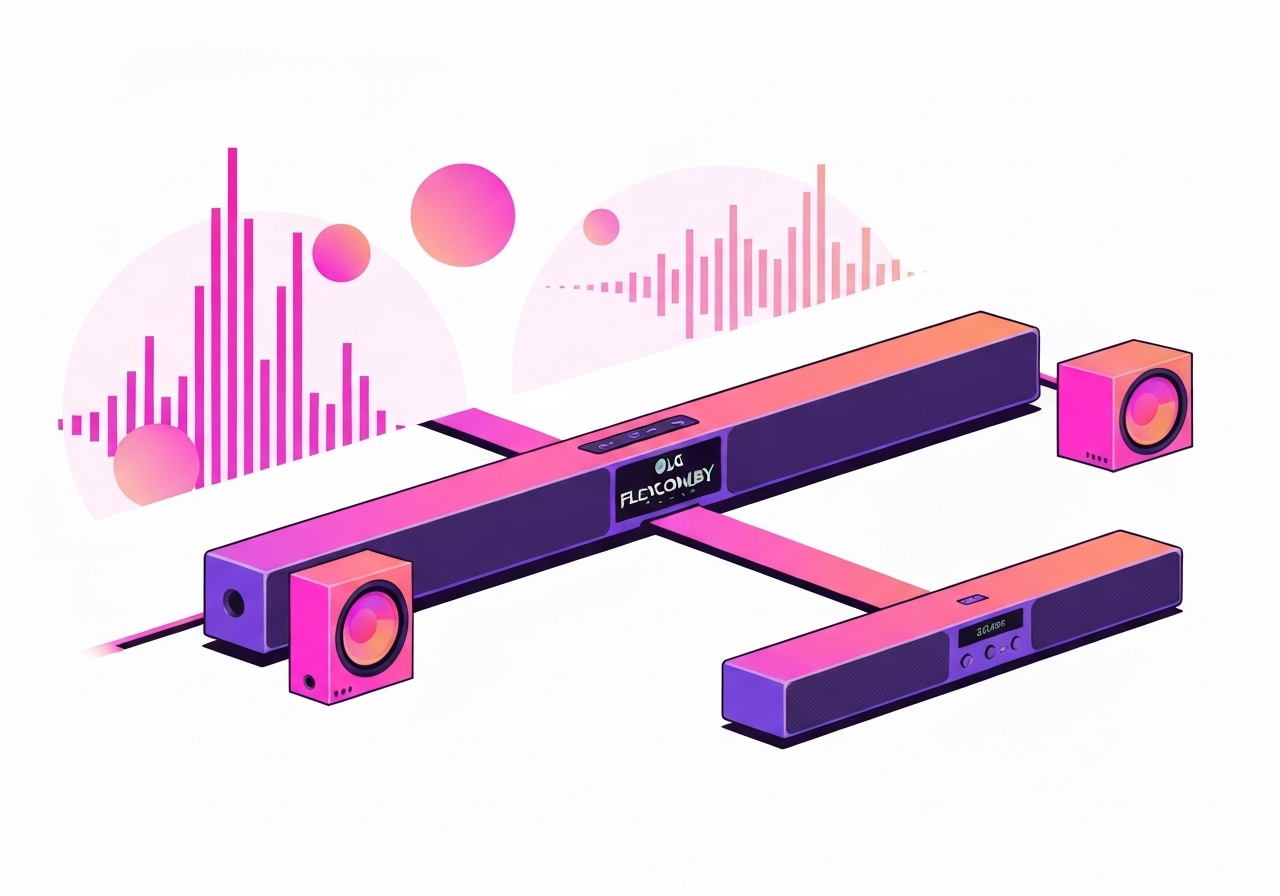
LG has teamed with Dolby to bring the first FlexConnect soundbar to market, unveiling the H7 as part of a new modular audio family at CES 2026. The H7 uses the Alpha 11 Gen 3 processor — the same chip in LG’s latest OLED and Micro RGB LED TVs — and joins the M5 and M7 surround speakers plus the W7 subwoofer in what LG calls the Sound Suite. The system is designed to work with a wide range of TVs (including select 2025 LG OLEDs and the 2026 premium lineup) or as a standalone audio hub, and LG says the suite can scale up to a possible 13.1.7-channel setup.
Key Takeaways
- LG revealed the H7 FlexConnect soundbar at CES 2026, running on the Alpha 11 Gen 3 chip used in its latest OLED and Micro RGB LED TVs.
- The Sound Suite will include the H7 soundbar, M5 and M7 surrounds, and W7 subwoofer; all drivers use Peerless Audio components.
- LG claims the system supports up to four surround speakers plus a subwoofer, enabling up to a 13.1.7-channel configuration in its fullest form.
- Unlike TCL’s earlier FlexConnect rollout with the Z100, LG’s implementation allows more connected surrounds and does not require a specific 2025 TV series to operate.
- Setup is said to be quick: short calibration tones detect speaker placement, similar to the TCL Z100’s fast process, and LG adds ultra-wideband-based Sound Follow to adjust the sweet spot by listener position.
- LG reports 27 different speaker configuration options, from two-speaker stereo up to the full soundbar + surrounds + sub arrangement.
- John Higgins, a senior AV reviewer with over 20 years’ experience, expects hands-on demos at CES and plans a full review when the system ships.
Background
Dolby’s FlexConnect technology first arrived earlier this year in TCL’s Z100 wireless speakers, aiming to simplify multi-speaker wireless Atmos setups without requiring HDMI eARC connections for each satellite. TCL’s initial approach made trade-offs: it limited connected devices to four total speakers (including any sub) and required a 2025 QM-series TCL TV for full functionality. Those constraints meant users had to choose between broader room coverage with an extra speaker or stronger bass via a subwoofer.
LG’s entry comes amid growing demand for flexible, room-filling home audio that avoids complex wiring while preserving Dolby Atmos object-based surround. The AV market has seen several manufacturers push modular and wireless speaker ecosystems to compete with traditional AVR-based systems. For LG, integrating FlexConnect into a branded Sound Suite ties the company’s TV chip expertise and speaker hardware into a single ecosystem that can be optimized for its displays — but also operate independently.
Main Event
At CES 2026 LG introduced the H7 soundbar as the flagship element of the Sound Suite. The H7 runs on the Alpha 11 Gen 3 processor — the same silicon used in LG’s top-tier TVs and Micro RGB LED sets — which LG says enables advanced decoding and room processing for Atmos content. The H7 acts as the lead device: it can pair with the M5 and M7 surrounds and the W7 subwoofer over Dolby’s FlexConnect protocol to form a larger channel configuration.
LG emphasized compatibility: while the Sound Suite pairs seamlessly with compatible LG TVs — including the 2026 premium lineup and 2025’s C5 and G5 OLEDs — a compatible LG TV is not required. The H7 can be used with any television or even as a standalone audio hub, managing wireless connections to surrounds and a subwoofer. LG notes that the system supports 27 different speaker layouts, giving users flexibility from two-channel stereo to the full multi-speaker array.
On calibration, LG follows a trend toward rapid, automated setup. Reported behavior mirrors the TCL Z100 experience: once satellites are placed and powered, the system plays a short musical test clip and then claims to identify speaker positions and apply room-appropriate processing. LG adds an ultra-wideband (UWB) capability called Sound Follow that dynamically shifts the sweet spot based on listener position, which LG says improves perceived imaging for moving listeners.
Analysis & Implications
LG’s rollout addresses two consistent consumer pain points: wireless multi-speaker complexity and restrictive TV dependencies. By allowing the H7 to act as the network’s controller, LG removes the requirement for a specific TV brand or model to host FlexConnect, broadening the potential user base. The ability to scale up to four surrounds plus a sub — rather than the four-device cap TCL imposed — also reduces the early-generation trade-off between coverage and bass.
Technically, using Alpha 11 Gen 3 silicon in the soundbar gives LG headroom for advanced processing and object rendering that matches its TV ecosystem’s capabilities. That vertical integration could yield better lip-sync, format handling, and tuning when used with LG displays, but the real-world benefit will depend on software tuning and loudspeaker performance — not just the SoC. Peerless Audio components are a positive hardware signal, but component branding alone does not guarantee final voicing or room performance.
From a market perspective, LG’s Sound Suite positions the company as a larger audio ecosystem player rather than a TV maker adding optional speakers. If LG prices and distributes the H7 and companion units competitively, it could accelerate adoption of wireless Atmos setups for living rooms that cannot accommodate full wired arrays. However, consumer uptake will hinge on price, ease of firmware updates, and the degree of post-setup customization LG permits for things like sub level and channel balance.
Comparison & Data
| Feature | TCL Z100 (earlier) | LG Sound Suite (H7 & companions) |
|---|---|---|
| Max connected devices | 4 (including sub) | Up to 5 (soundbar + 4 surrounds + sub) — LG claims up to 13.1.7 |
| TV dependency | Requires 2025 QM-series TCL TV | Works with any TV; full integration with 2025 C5/G5 and 2026 premium LG TVs |
| Chipset | Not specified in TCL announcement | Alpha 11 Gen 3 (same as LG OLEDs/Micro RGB LED) |
| Calibration | Quick musical clip calibration | Quick clip + UWB-based Sound Follow for sweet spot adjustment |
The table highlights functional differences reported so far: LG increases device scalability and removes strict TV requirements while adding a UWB-based listening-position feature. These are meaningful platform distinctions, but objective performance (e.g., measured frequency response, THD, room coupling) will determine real-world value and remains to be independently verified.
Reactions & Quotes
Industry commentary and the reporting source emphasize the practical implications for consumers and reviewers. Below are short, attributed excerpts and the surrounding context.
“I’ll be hearing the system at CES and plan on reviewing the system when it’s available to see how well the technology translates into a home.”
John Higgins, senior AV reviewer
This statement frames the hands-on expectation: a senior reviewer with over 20 years in AV intends to test the H7 and its companions in a full review following CES demos. That review will be important for verifying claims about calibration speed, Atmos imaging, and the effectiveness of Sound Follow.
“LG says there are 27 different speaker configurations possible,”
LG (as reported)
LG’s reported flexibility — from stereo pairs to the full multi-channel array — is a selling point for buyers wanting a modular path. How easy it is to move between configurations and whether firmware updates expand or limit those options will factor into user satisfaction.
Unconfirmed
- Exact pricing and launch date for the H7, M5, M7 and W7 are not yet announced and remain unconfirmed.
- Details about post-setup customization (for example, granular subwoofer level control or advanced room-correction options) have not been fully disclosed by LG.
- Independent measurements of the system’s acoustic performance and achievable channel counts in real homes are not yet available pending hands-on reviews.
Bottom Line
LG’s Sound Suite, led by the H7 FlexConnect soundbar, is a notable step toward a more flexible, TV-agnostic wireless Atmos ecosystem. By expanding the number of allowable surround speakers and offering UWB-based listener tracking, LG addresses key limitations seen in earlier FlexConnect deployments and targets users who want modular growth without heavy wiring.
That said, hardware specs and connectivity claims must be validated in independent listening tests and measurements. Pricing, firmware features, and ease of long-term updates will determine whether the Sound Suite becomes a mainstream alternative to wired AVR systems or a premium niche for LG owners and early adopters.
Sources
- The Verge — LG and Dolby FlexConnect report (news report)