
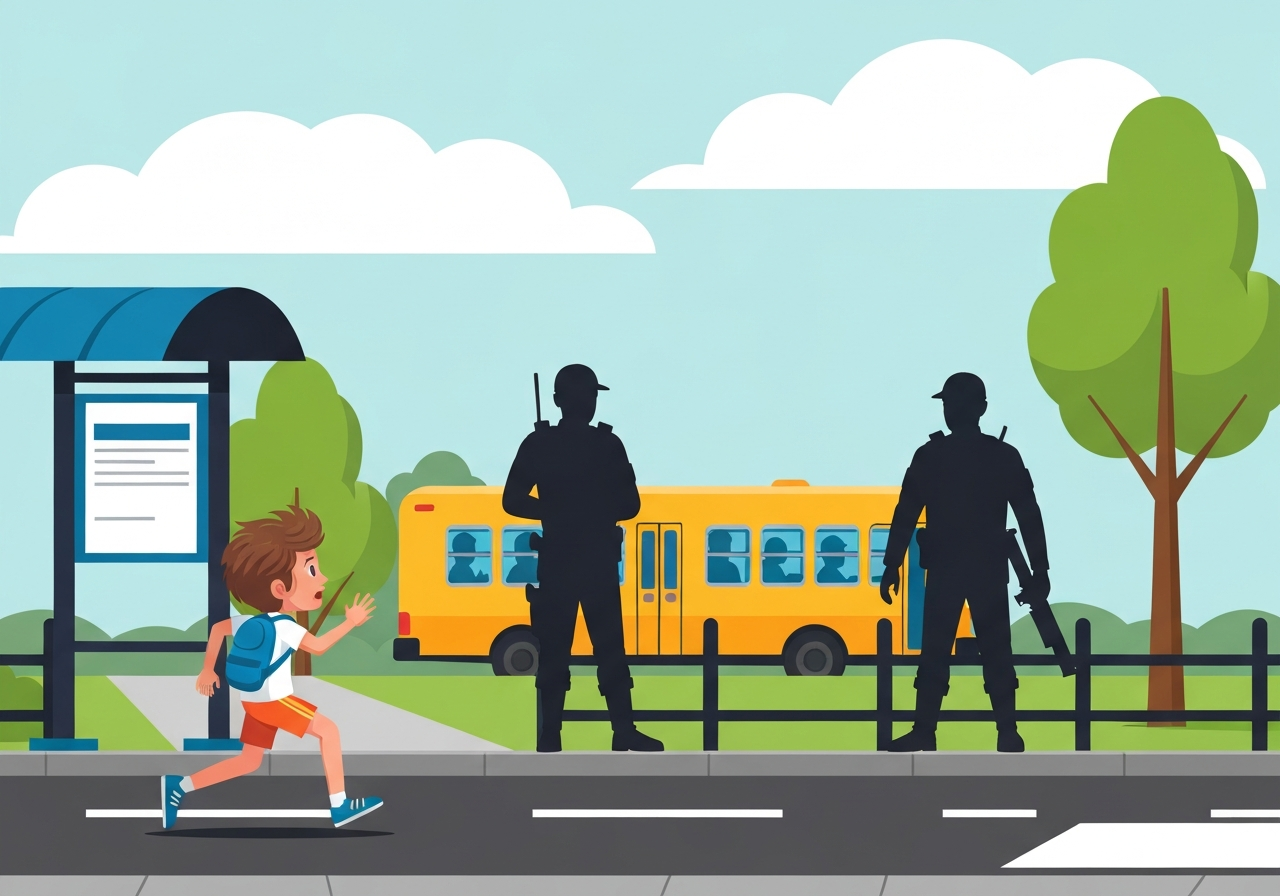
Lead: On the morning of Thursday, February 13, 2026, a U.S. Immigration and Customs Enforcement (ICE) enforcement action near a Lindenwold, New Jersey apartment complex sent fourth- and fifth-grade students running from a nearby school bus stop. A 10-year-old boy identified as Dylan — a U.S. citizen — told reporters classmates shouted “ICE” and fled; video shows him pounding on his home door as agents followed. The Lindenwold School District said the presence of multiple enforcement vehicles caused fear and confusion and that drivers circled back to deliver as many children as possible. Community members and elected officials called for clarity from federal authorities as counselors were made available to students.
Key Takeaways
- Incident date: February 13, 2026 — an ICE operation occurred near an apartment complex adjacent to a Lindenwold school bus stop.
- Affected students: fourth- and fifth-graders were waiting at the stop when people in the area began shouting that ICE was present.
- First-person account: a 10-year-old boy, Dylan, described classmates running and agents following him toward his home; doorbell and home security video corroborate his flight.
- District response: Lindenwold School District reported enforcement vehicles caused fear and said bus drivers circled back multiple times to transport students safely.
- Community reaction: residents protested the next day and New Jersey Rep. Donald Norcross demanded transparency from DHS about the operation.
- Support offered: the district said counseling services are being provided to any students in need.
Background
Lindenwold is a borough in Camden County, New Jersey, where families from mixed immigration statuses live in close proximity to schools and transit. Over recent months residents told local reporters they had noticed more ICE activity in the neighborhood; those perceptions contributed to heightened concern when enforcement vehicles appeared near school routes. Federal immigration enforcement operations occur across many U.S. municipalities in varying forms, from targeted workplace raids to community-based actions — each with different legal authorities and local responses. Schools and districts typically coordinate with families and local law enforcement around safety plans, but parents and students frequently report anxiety when enforcement happens in or near residential areas.
Local school districts have legal and ethical obligations to protect student safety and privacy, while federal agencies say enforcement actions targeting noncitizens are part of immigration law implementation. In this community, the overlap between residential complexes and school bus stops created a point of friction, with parents, students and elected officials seeking immediate information about who was targeted and whether any students or families were detained. The Lindenwold School District’s decision to publicly describe the scene and offer counseling reflects growing attention to the psychological effects of enforcement visible to children.
Main Event
According to interviews and video reviewed by reporters, the morning began like any other: students waited for their bus at a designated stop near an apartment complex. The moment changed when some people at the complex began shouting that ICE agents were present; those shouts triggered an immediate, panicked run by several children toward nearby homes. A home security clip obtained by media shows Dylan banging on his front door and pleading with his mother to let him inside because he feared agents might try to enter.
The Lindenwold School District posted to families that “the presence of multiple enforcement vehicles caused significant fear and confusion, and several students ran from the bus stop.” District officials emphasized the bus driver circled back multiple times to ensure as many children as possible reached school safely. The district also stressed that “ICE Agents are NOT at the Lindenwold School District,” differentiating the enforcement location from school property itself.
CBS News reported that the outlet reached out to the Department of Homeland Security (DHS) for comment; at the time of publication DHS had not issued a public statement confirming the operational details. Community members organized a protest the afternoon following the incident, citing concern for families and children who witnessed the enforcement activity. Local residents and parents described a sense of ongoing unease prompted by what they characterized as rising enforcement in the area.
Analysis & Implications
Visible immigration enforcement near places where children congregate can have immediate and longer-term effects on child well-being, even if students themselves are not the enforcement targets. Research in public health and child psychology shows that sudden frightening events can induce stress responses that disrupt school attendance, concentration and sleep — concerns that Lindenwold officials sought to address by offering counseling. The district’s rapid communication and support services are consistent with trauma-informed responses schools increasingly adopt after community shocks.
At a policy level, the incident spotlights tensions between federal enforcement prerogatives and local governments’ obligations to protect minors and maintain safe learning environments. Elected officials who demanded transparency framed the issue in terms of accountability: if DHS operations are lawful and narrowly targeted, local leaders argue the public should be informed to limit collateral harm. Conversely, advocates for enforcement say operational secrecy can be necessary for effectiveness and safety, a claim that often clashes with community demands for information.
Economically, local neighborhoods that perceive higher enforcement risk may experience indirect harms — reduced participation in local commerce, challenges in workforce retention among immigrant families, and broader community distrust of institutions. Politically, episodes like this can become rallying points in legislative debates over immigration enforcement priorities, sanctuary policies and federal-state cooperation. For Lindenwold, the near-term focus will be on rebuilding trust between families, schools and any federal actors involved, while monitoring student attendance and mental health indicators in the coming weeks.
Comparison & Data
| Item | Detail |
|---|---|
| Date | February 13, 2026 |
| Location | Apartment complex near Lindenwold school bus stop, Lindenwold, NJ |
| Affected students | Fourth- and fifth-graders waiting at the stop |
| District action | Posted to families, provided counseling, buses circled back |
This table summarizes the confirmed elements of the February 13 incident as reported by local officials and media. While there is growing anecdotal reporting of increased ICE presence in some neighborhoods, comprehensive, locally broken-down federal data on community-area enforcement events is not routinely published in a way that captures school-adjacent incidents, complicating direct comparisons across locales.
Reactions & Quotes
Parents, elected officials and the district offered swift reactions calling for clarity and student support. The following excerpts convey the range of responses and are accompanied by context from interviews or official messages.
“We all were scared.”
Dylan, 10-year-old witness (student account)
Context: Dylan, a U.S. citizen, described classmates shouting the word “ICE” and running; a home video shows him urgently seeking shelter inside. His remarks capture the immediate fear among students that morning and the reasons district staff moved to make counseling available.
“DHS has to come forward, be transparent. If you’re doing ‘the right thing,’ then there should be no problem.”
Rep. Donald Norcross (U.S. Representative, New Jersey)
Context: Rep. Norcross publicly demanded detailed information from the Department of Homeland Security, urging federal transparency to reassure constituents and reduce community anxiety about enforcement actions near schools.
“The presence of multiple enforcement vehicles caused significant fear and confusion, and several students ran from the bus stop.”
Lindenwold School District (official communication to families)
Context: The district also clarified that the enforcement activity did not occur on school property and reiterated steps taken by bus drivers and staff to keep students safe while notifying families of counseling resources.
Unconfirmed
- Whether any household members were detained or formally arrested during the operation — no public record provided by DHS or local law enforcement at the time of reporting.
- The precise number of federal agents or enforcement vehicles involved and their specific operational objectives — DHS had not released an official account when media inquiries were made.
- Claims of a sustained, measured increase in ICE activity in the neighborhood prior to this event are based on resident reports and have not been independently quantified by federal datasets.
Bottom Line
The February 13, 2026 ICE operation near a Lindenwold school bus stop produced immediate fear among waiting fourth- and fifth-grade students, prompted district outreach and counseling offers, and triggered calls for federal transparency from elected officials. Confirmed facts include the date, location, the age group affected, and the district’s account that bus drivers circled back to transport students; key operational details from DHS remain publicly unconfirmed.
For residents and policymakers the central issues are twofold: how to minimize harm and fear when enforcement occurs near children, and how much information federal agencies should share with local communities without compromising lawful enforcement objectives. In the coming days, attendance figures, counseling uptake and any formal statements from DHS will be important indicators of how the community recovers and whether additional policy responses follow.
Sources
- CBS News (news report; original coverage of the incident)
- Lindenwold School District (official district communications and family notifications)
- U.S. Department of Homeland Security (official; media contact and statements)
- Rep. Donald Norcross office (official representative statement and constituent communications)