
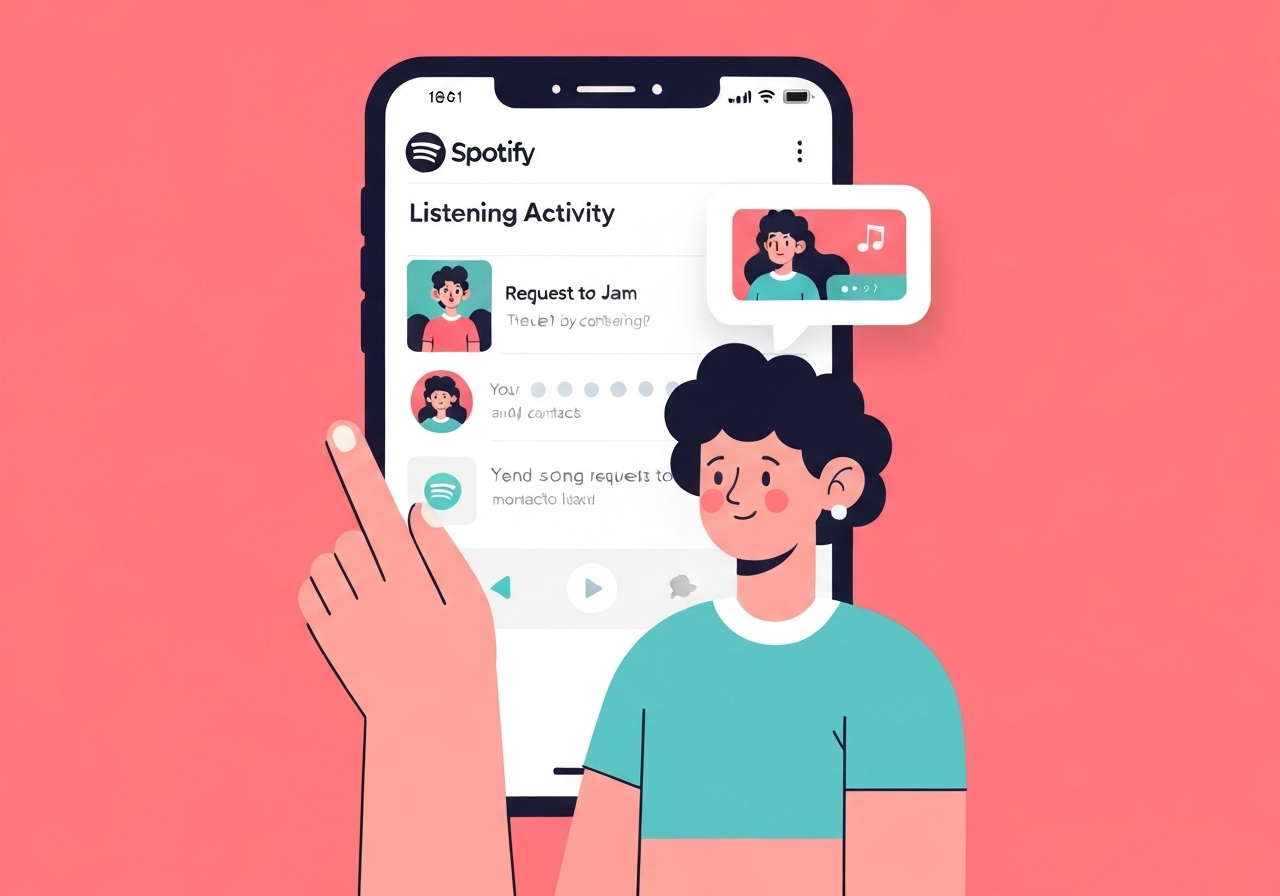
Lead: Spotify has introduced two social-features—Listening activity and Request to Jam—inside Messages to surface real-time listening and make it easier to start shared listening sessions. The updates expand on Messages, which launched last year and has since enabled nearly 40 million users to send about 340 million messages. Listening activity is opt-in and shows what friends are playing now (or their most recent track), while Request to Jam lets Premium users invite contacts into a live Jam session. Both features are rolling out on iOS and Android in Messages-enabled markets and should be broadly available by early February.
Key Takeaways
- Messages has reached almost 40 million users who have exchanged nearly 340 million messages since launch last year, demonstrating strong engagement with in-app social sharing.
- Listening activity is opt-in, shows real-time playback (or the most recently played song), and is visible only to contacts you have already messaged on Spotify.
- Request to Jam lets Premium users send a remote Jam invite from a Messages chat; invitees can accept or decline and, if accepted, become the Jam host.
- When a Jam is active both participants can add tracks to a shared queue, see each other’s display names, and view suggested songs based on combined tastes.
- Jam daily active users have more than doubled year over year, a growth Spotify cites as a driver for the new invite flow.
- Listening activity is available to all users with Messages access; Free users can join a Jam only when invited by a Premium user. Both features are for users aged 16 and up.
Background
Spotify introduced Messages within its app last year to let listeners share music, podcasts and audiobooks directly with friends and family. The company says the feature quickly attracted millions of users and hundreds of millions of message interactions, signaling demand for deeper social functionality inside the player. That usage trend aligns with broader platform strategies across streaming services to increase in-app retention by enabling social discovery and collaborative playback.
Jam—Spotify’s synchronous listening mode—has been available for users wanting to listen together remotely, and Spotify reports that daily active use of Jam has more than doubled year over year. Still, the company acknowledged a friction point: it can be difficult for friends to know when others are available to listen. The new Messages features aim to close that gap by surfacing presence and simplifying invitations without leaving the chat experience.
Main Event
Listening activity is an opt-in privacy-controlled feature that shows what you’re currently playing in real time inside Messages’ chat UI; when you’re not actively listening, the most recently played track will appear. Users enable the feature in Privacy and social settings via the Messages side drawer next to the “View profile” button. Once turned on, activity appears in the side drawer chat rows and at the top of Messages threads, and tapping a friend’s activity lets you add the track to your library, start playback, open the track menu, or react with one of six emojis.
Request to Jam is built into Messages so Premium users can request a remote Jam from the chat header. The recipient receives an invite and can accept or decline; if accepted, the recipient becomes the Jam host. During a Jam both participants can queue tracks into a shared playlist, listen in sync and exchange messages while playback is active. Pending invitations time out after a few minutes if not responded to, and participants may leave a Jam at any time.
Both features are limited to contacts you have already messaged on Spotify, and privacy controls remain in the user’s hands: you choose which contacts can see your listening activity and can disable it whenever you wish. The rollout targets Messages-enabled markets on iOS and Android now, with broader availability in those markets expected by early February.
Analysis & Implications
Functionally, these updates deepen Spotify’s in-app social layer by combining passive presence (listening activity) with an active invitation mechanic (Request to Jam). That pairing reduces friction between discovery and shared experience: users can spot what friends are listening to and convert that glimpse into a synchronous session with just a tap. For engagement metrics this should increase time spent in the app, interactions per user, and the number of shared-queue sessions—signals platforms use to justify product prioritization.
From a business perspective, Request to Jam also creates a Premium-led interaction that Free users can join only when invited by Premium subscribers. That structure may serve two purposes: preserve certain capabilities for paying customers while offering Free users a taste of the synchronous experience, potentially nudging conversion. The net impact on churn and trial-to-subscription conversion will depend on how often shared listening translates into repeat co-listening behavior.
Privacy and user control are central to adoption. Making listening activity opt-in and limited to existing message contacts addresses obvious concerns, but broader questions remain—such as whether presence signals will alter user behavior or lead to increased social pressure to share. Spotify’s explicit opt-in model reduces regulatory and reputational risk, though the company will need to monitor how users actually configure visibility settings over time.
Comparison & Data
| Metric / Feature | Value / Availability |
|---|---|
| Messages users | ~40 million (since launch) |
| Messages exchanged | ~340 million |
| Jam daily active users | More than doubled YoY |
| Listening activity | Opt-in; visible to existing message contacts |
| Request to Jam | Invite from Premium user; Free users can join when invited |
| Platforms | iOS and Android (Messages-enabled markets) |
These figures show Messages is already an active social channel on Spotify and that Jam is a growing synchronous use case. The table highlights how Spotify ties new social features to existing usage patterns and subscription tiers, an approach that can magnify both engagement and monetization while maintaining explicit consent controls.
Reactions & Quotes
Spotify framed the updates as a way to make listening together easier and more immediate, emphasizing the connection between discovery and shared listening.
“Listening activity gives users a real-time look at what friends are listening to, and Request to Jam makes it simple to turn those moments into shared listening sessions.”
Spotify (official announcement)
Company communications also highlighted Jam’s growth as rationale for integrating invites into Messages so friends can find each other when availability aligns.
“Jam daily active users have more than doubled year over year, and the new invite flow helps people join each other quickly.”
Spotify (official announcement)
Unconfirmed
- Whether desktop (macOS/Windows/web) versions of Messages will receive Listening activity and Request to Jam on the same schedule is not specified in the announcement.
- The exact timeout duration for pending Jam invitations is described only as “a few minutes,” and no precise number of seconds/minutes was provided.
- Details on the algorithmic signals used to generate “suggested songs based on combined taste profiles” were not disclosed publicly.
Bottom Line
Spotify’s Listening activity and Request to Jam fold presence and invitation into the chat experience, lowering the barrier between seeing what friends play and listening together in real time. The move builds on clear usage: nearly 40 million Messages users and roughly 340 million messages indicate an active social layer Spotify can deepen with minimal friction.
For listeners, the changes make discovery and co-listening more immediate; for Spotify, they create more moments where users interact inside the platform—potentially increasing engagement and supporting subscription strategies. Observers should watch adoption patterns, privacy-setting choices and whether the features appear on desktop or other surfaces after the initial mobile rollout.
Sources
- Spotify Newsroom — Official announcement (official announcement)
- Listening activity demo video (official media)
- Request to Jam demo video (official media)