
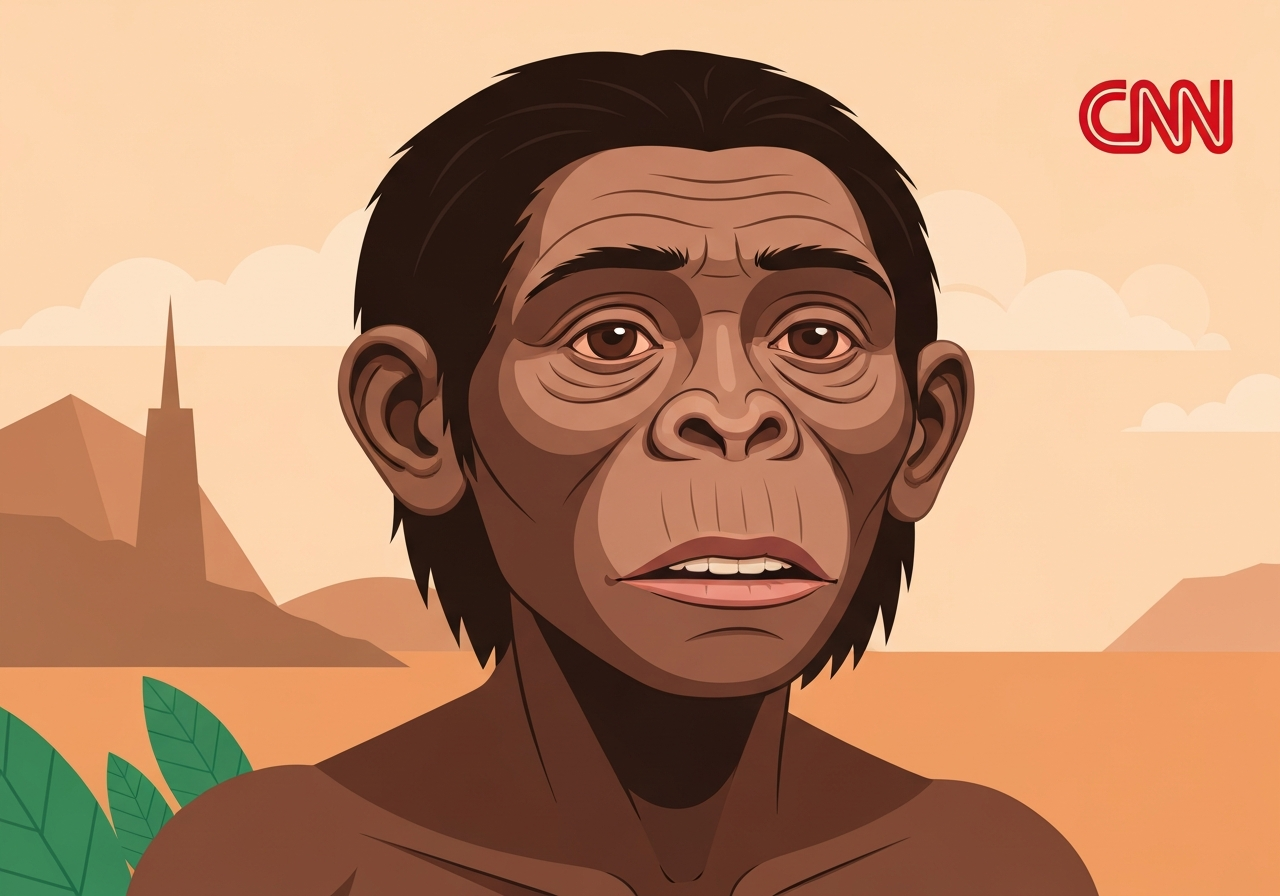
Lead: Scientists have digitally reassembled the crushed skull of ‘‘Little Foot,’’ a nearly 3.67 million‑year‑old Australopithecus specimen excavated from Sterkfontein Caves, South Africa, revealing the upper face and orbital region for the first time. The fossil, recovered after work that began in the 1990s and whose excavation spanned roughly 20 years, is about 90% complete and is the most intact Australopithecus skeleton known from southern Africa. High‑resolution synchrotron scans at Diamond Light Source and supercomputing reconstruction at the University of Cambridge produced over 9,000 images and terabytes of data used to render the facial bones in 3D. The reconstruction allows direct anatomical comparison with other Australopithecus fossils and modern great apes, informing debates about early hominin variation and connectivity across Africa.
Key takeaways
- Little Foot dates to about 3.67 million years ago and was excavated from the Sterkfontein Caves, part of the Cradle of Humankind World Heritage Site in South Africa.
- The skeleton is ~90% intact, making it the most complete Australopithecus specimen from southern Africa and roughly 50% more complete than Lucy (Australopithecus afarensis).
- Physical deformation of the skull prevented conventional reconstruction; researchers used nondestructive synchrotron X‑ray scanning to collect over 9,000 high‑resolution images and terabytes of data for digital reassembly.
- Comparative 3D analyses show Little Foot’s face size falls between gorilla and orangutan, with shape similarities to orangutan and bonobo orbital morphology, and closer affinities in some measures to East African Australopithecus specimens.
- The study focuses on facial adaptations (vision, breathing, feeding) rather than settling Little Foot’s species assignment, which remains contested (prometheus, africanus or another taxon).
- The skull left South Africa for the first time to undergo scanning at the Diamond Light Source (Harwell, UK), with image processing performed on a Cambridge supercomputer.
- Authors plan further digital correction of the braincase to estimate endocranial volume and probe cognitive implications.
Background
In the 1990s paleoanthropologist Ronald Clarke identified a handful of small bones in the University of the Witwatersrand collection and later exposed the near‑complete skeleton now called Little Foot from the Sterkfontein Caves northwest of Johannesburg. Excavation and preparation of the articulated remains required exceptional time and care; the full recovery and preparation took about 20 years, reflecting both the specimen’s completeness and the difficulty of working in cave deposits. Little Foot’s preservation level — estimated at roughly 90% intact — makes it an unusually informative reference among Australopithecus fossils, especially for craniofacial anatomy.
The Sterkfontein site sits within the Cradle of Humankind, a region with a dense record of hominin fossils and complex taphonomic histories. South African fossils from this region have long been central to debates about early hominin diversity and biogeography, but skulls are often crushed by overburden movement and sediment compaction, which complicates morphological interpretation. Because cranial distortion can obscure diagnostic features relevant to feeding, vision and brain size, new methods that reverse deformation without physical reconstruction are valuable for reexamining old specimens.
Main event
Researchers transported Little Foot’s skull to the United Kingdom so the specimen could be scanned at the Diamond Light Source synchrotron at Harwell, Oxfordshire. The facility produced bright, nondestructive X‑rays that yielded more than 9,000 high‑resolution images; those data — amounting to multiple terabytes — were processed on a supercomputer at the University of Cambridge to produce a 3D rendering of individual facial bones. Digital realignment placed displaced bone fragments into anatomically plausible positions, revealing the previously hidden upper face and orbital region.
With the reconstructed face in hand, the team conducted comparative shape and size analyses against three other Australopithecus specimens (one from South Africa, two from Ethiopia) and a sample of modern great apes. The reconstructed face’s overall dimensions were intermediate between a gorilla and an orangutan, while certain morphological measurements — notably orbital shape — aligned more closely with orangutan and bonobo patterns. Unexpectedly, some craniofacial metrics more closely matched East African Australopithecus fossils despite Little Foot’s South African origin.
Authors emphasize that the study was designed to evaluate possible functional adaptations expressed in the face (for vision, respiration and feeding) rather than to resolve species attribution. They note the face preserves anatomical regions that can inform hypotheses about sensory capacities and dietary mechanics. Next steps described by the team include digitally correcting deformation of the neurocranium to estimate braincase volume and explore implications for cognitive evolution.
Analysis & implications
The digital restoration strengthens the view that early hominin morphology did not evolve as isolated, regionally fixed packages; instead, researchers interpret variation as a mosaic affected by shared ancestry and local ecological pressures. Little Foot’s mixture of traits similar to both South and East African fossils supports a model of connectivity across African populations during the Pliocene, rather than strict regional endemism. If corroborated by additional specimens, this pattern would complicate attempts to draw neat species boundaries based solely on cranial shape.
Functionally, recovering the orbital region and upper face opens new avenues for testing hypotheses about vision and diet. Larger or differently shaped orbits can reflect shifts in visual demands or brain organization related to visual processing — variables that can be linked to habitat use or foraging strategies. Likewise, facial form bears on masticatory performance and respiratory anatomy, providing biomechanical context that isolated postcranial bones cannot supply.
On taxonomy, the reconstruction does not settle whether Little Foot belongs to Australopithecus prometheus, Australopithecus africanus, or represents a separate lineage; that debate persists because morphological characters and geochronology have produced competing interpretations. The team’s cautious framing — emphasizing morphology and adaptation rather than taxonomic pronouncement — reflects contemporary paleoanthropological practice, which increasingly relies on integrative datasets (morphology, chronology, paleoecology) to infer relationships.
Comparison & data
| Specimen | Age (Ma) | Completeness | Notes |
|---|---|---|---|
| Little Foot | 3.67 | ~90% | Most complete southern African Australopithecus; skull digitally restored |
| Lucy (A. afarensis) | 3.2 | ~60%* | Famous East African specimen; less complete than Little Foot |
*Lucy’s completeness is commonly quoted near 40–60% depending on counting method; Little Foot has been described as roughly 50% more complete than Lucy using comparable measures. The table summarizes preserved completeness and accepted age estimates used in the new analysis; completeness percentages reflect composite skeletal counts reported by researchers.
Reactions & quotes
Colleagues praised the technical achievement while urging caution on taxonomic and chronological claims. The reconstruction was described as a rare opportunity to access facial anatomy otherwise lost to deformation.
“Only a handful of Australopithecus fossils preserve an almost complete face, making Little Foot a rare and valuable reference point,”
Amélie Beaudet (lead author, University of the Witwatersrand, statement)
Another outside expert highlighted shared ancestry as an expected explanation for trait similarities across populations.
“These similarities reflect common descent and the complexity of variation in Australopithecus,”
Zeray Alemseged (University of Chicago, email comment)
A researcher skeptical of some age estimates emphasized that uncertain dating complicates evolutionary interpretations.
“Different dating methods have yielded varied ages for Little Foot, so evolutionary claims tied to a specific older date are premature,”
Jesse Martin (La Trobe University, email comment)
Unconfirmed
- The exact species attribution of Little Foot (prometheus, africanus, or a distinct lineage) remains unresolved and contested among specialists.
- Precise geochronology for the specimen is debated: different dating techniques have produced varying age estimates that affect evolutionary interpretations.
- Functional inferences (e.g., expanded visual cortex implied by orbital metrics) are provisional until neurocranial reconstructions and further comparative study are completed.
Bottom line
The digital reassembly of Little Foot’s face is a technical and scientific milestone that preserves the original fossil while unlocking anatomical regions obscured by geological deformation. Because the skeleton is unusually complete and ancient (3.67 Ma), the new facial data add valuable points of comparison across African Australopithecus material and modern apes. Yet the reconstruction does not by itself resolve long‑running debates over taxonomy or exact dating; those questions require integrated chronological, morphological and contextual evidence.
Going forward, digital correction of the braincase and expanded comparative samples will be crucial to translate anatomical detail into robust inferences about cognition, sensory ecology and population connectivity across the Pliocene landscape of Africa. For now, Little Foot stands as one of the best‑preserved windows onto early hominin facial anatomy and the complex patterning of our deep past.