
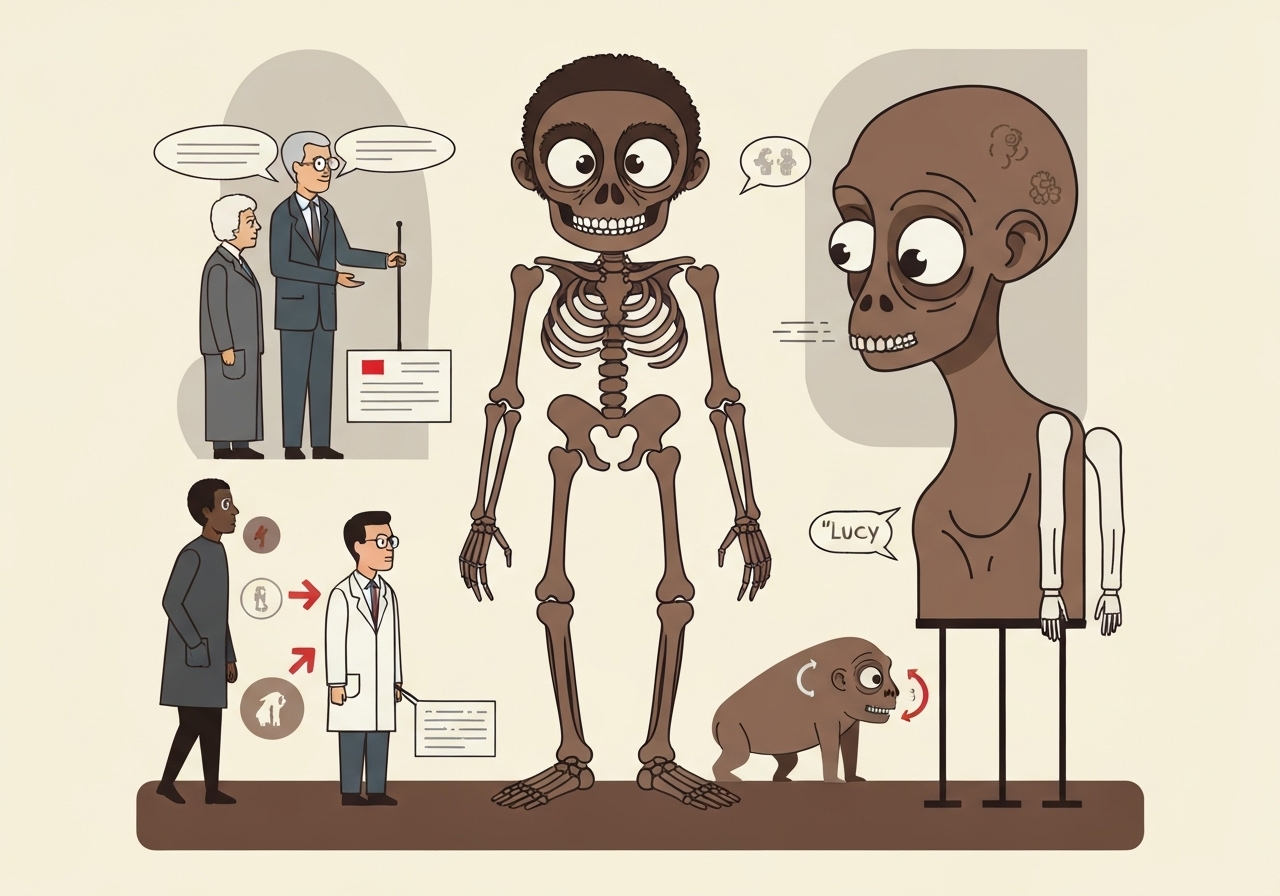
Lead: A recent paper in the journal Nature has reignited intense debate over whether the iconic 3.2-million-year-old Australopithecus afarensis specimen known as “Lucy” really stands as the direct ancestor of Homo. The new study links previously enigmatic fossil material — including the 3.4-million-year-old “Burtele foot” — to Australopithecus deyiremeda, a species that lived alongside A. afarensis in eastern Africa 3.5–3.3 million years ago. Some researchers argue the paper supports a model in which A. anamensis (4.2–3.8 Ma) is the deeper ancestor of later hominins, while others say the evidence does not overturn Lucy’s long-held status. The controversy highlights how a growing and complex fossil record makes identifying a single direct ancestor difficult.
Key takeaways
- The Nature paper (published last month) assigns new tooth and jaw fragments to Australopithecus deyiremeda and connects those fossils to the previously described Burtele foot.
- Some authors of the new study and external experts propose A. anamensis (circa 4.2–3.8 Ma) could be the common ancestor of several later australopiths, potentially displacing A. afarensis (Lucy) as the primary candidate.
- Other specialists, including Yohannes Haile‑Selassie, emphasize traits in A. afarensis—such as more human-like feet—as continuing evidence that Lucy’s species remains a strong candidate for ancestry to Homo.
- Debate centers on whether shared traits reflect common descent or convergent evolution; proponents of convergent evolution argue similar adaptations may have evolved independently in separate lineages.
- Geographic and temporal ranges matter: A. afarensis persisted across East Africa from ~3.9–3.0 Ma, while South African A. africanus and eastern species show different distributions and timelines.
- The oldest currently known Homo fossil is a 2.8 Ma jaw from Ethiopia, but molecular and model-based estimates place the origin of Homo earlier by ~0.5–1.5 million years.
- Resolution is likely to depend on new fossil discoveries; authors and critics agree the record is still fragmentary and interpretations remain provisional.
Background
The search for human ancestors has been active for a century. Raymond Dart’s 1925 description of the Taung Child (Australopithecus africanus) initially positioned South African australopiths as direct ancestors of Homo. That view shifted after the discovery of Lucy (A. afarensis) at Hadar, Ethiopia, in 1974: Lucy’s 3.2-million-year-old skeleton showed clear evidence of habitual bipedalism combined with a small brain, suggesting an intermediate form between the last common ancestor with chimpanzees and later hominins.
Through the late 20th century, comparative assessments of available fossils commonly placed A. afarensis as the likely precursor to the Homo lineage. Since then, however, finds across East and South Africa have multiplied, revealing a bushier australopith diversity that complicates a single-lineage narrative. Newer discoveries — including fragmentary jaws, teeth and limb elements — have prompted repeated re-evaluation of relationships among australopith species and between australopiths and early Homo.
Main event
The new study published in Nature presents additional tooth and mandibular fragments that researchers assign to Australopithecus deyiremeda and link to an unusual foot specimen discovered previously at the Woranso‑Mille site in Ethiopia (the Burtele foot). The authors argue the combined dental and pedal evidence supports recognizing A. deyiremeda as anatomically distinct from contemporaneous A. afarensis, indicating multiple hominin species coexisted in East Africa around 3.5–3.3 Ma.
Based on phylogenetic analysis and character assessments, some researchers involved in the paper suggest A. deyiremeda and South African A. africanus share more primitive features with A. anamensis than either does with A. afarensis. From that perspective, A. anamensis could be the deeper ancestor that gave rise to several descendant lineages, including those that eventually led to Homo.
Not all authors or outside experts agree on the interpretation. Co-author Thomas Cody Prang and others emphasize the combination of ancestral and derived traits in A. deyiremeda that make it a plausible contributor to later hominin diversity, while lead author Yohannes Haile‑Selassie stresses that the more human-like foot anatomy in A. afarensis favors its role as ancestor to later species.
The paper has generated immediate pushback and vigorous discussion. Critics point out the fragmentary nature of the record, the sensitivity of phylogenetic matrices to character selection and coding, and the continuing possibility that similar traits arose independently in different lineages (convergent evolution), which would complicate simple ancestor–descendant assignments.
Analysis & implications
If A. afarensis is not the direct ancestor of later hominins, main implications include a reframing of how key humanlike traits evolved: habitual bipedalism, foot morphology conducive to terrestrial locomotion and certain limb proportions might have appeared several times, or in different sequences, across contemporaneous species. That complicates narratives that treat Lucy’s anatomy as a single evolutionary step toward Homo.
A shift toward A. anamensis (or a pan‑African pool of australopith diversity) as the ancestral source would influence models of where and how Homo emerged. Because East Africa’s fossil record extends earlier in time than many South African deposits, an East African origin for Homo becomes more parsimonious under some phylogenetic scenarios, reinforcing the significance of sites in Ethiopia and Kenya for early Homo research.
Practically, the debate underscores methodological limits: phylogenetic reconstructions based on fragmentary fossils are sensitive to which traits are considered primitive or derived. Future work will depend on new fossils, refined character definitions, improved statistical approaches and greater sampling across sites and ages to test alternative topologies and timing estimates.
Comparison & data
| Species | Age (Ma) | Key traits |
|---|---|---|
| A. anamensis | 4.2–3.8 | Primitive dentition, possible bipedal adaptations |
| A. afarensis (Lucy) | 3.9–3.0 | Habitual bipedalism, human-like foot traits, small brain |
| A. deyiremeda | 3.5–3.3 | Mosaic of climbing-adapted and derived pedal/dental features |
| A. africanus | ~3.3–2.1 | South African specimens; mix of arboreal and terrestrial traits |
The table summarizes central temporal ranges and salient anatomical notes cited in recent discussions. It illustrates overlapping ages and a mosaic of traits across species — the primary reason paleontologists now describe hominin evolution in terms of branching, reticulation and, at times, convergent changes rather than a single linear progression.
Reactions & quotes
Some specialists view the new analysis as transformative because it challenges a five‑decade consensus about Lucy’s iconic status. Proponents point to the combined dental and pedal evidence for A. deyiremeda as a concrete basis for rethinking relationships among Pliocene hominins.
“If correct, A. afarensis will lose its iconic status as the ancestor of all later hominins,”
Fred Spoor, University College London (evolutionary anatomy)
Spoor’s comment reflects the interpretation that A. anamensis may sit deeper in the tree and give rise to multiple descendant lineages. That position carries significant implications for textbook narratives and for how researchers prioritize new excavations and analyses in East Africa.
Other researchers caution against rapid revision. They argue that fragmentary material and differing analytical choices can produce divergent trees, and that some traits in A. afarensis remain strong evidence of an ancestral connection to Homo.
“The new discovery is not altering our picture of human evolution in any way, in my opinion,”
Zeray Alemseged, University of Chicago (paleoanthropology)
Alemseged’s view exemplifies the conservative response: maintain the working hypothesis that A. afarensis is a key candidate until more decisive fossils appear. This disagreement between specialists highlights a healthy scientific process in which new data prompt robust testing and debate rather than immediate consensus.
Unconfirmed
- Whether A. anamensis is definitively the direct ancestor of Homo remains unconfirmed due to limited overlapping fossil material and differing phylogenetic codings.
- The precise phylogenetic placement of A. deyiremeda relative to both A. afarensis and A. africanus is still provisional and sensitive to new finds and character interpretations.
- Claims that features in A. afarensis evolved entirely independently from Homo (convergent evolution) are plausible but not yet conclusively demonstrated.
Bottom line
The Nature paper amplifies an existing shift in paleoanthropology: the Pliocene hominin record is more diverse and complex than earlier linear models suggested. While some researchers interpret the new material as displacing Lucy’s species from a direct ancestral role, others maintain that A. afarensis still retains key humanlike features that favor its ancestral candidacy.
Ultimately, resolving who — if anyone single species — is the direct ancestor of Homo will likely require more complete fossils and broader sampling across sites and ages. In the meantime, the debate sharpens methods, priorities and field strategies, and it reframes human origins as a braided, regionally interconnected process rather than a single straight line.
Sources
- Live Science — reporting on the Nature study (journalism)
- Nature — peer‑reviewed journal (publisher site for the cited paper)
- Arizona State University, Institute of Human Origins — institutional profile for Yohannes Haile‑Selassie (academic)
- University College London — faculty profile for Fred Spoor (academic)