
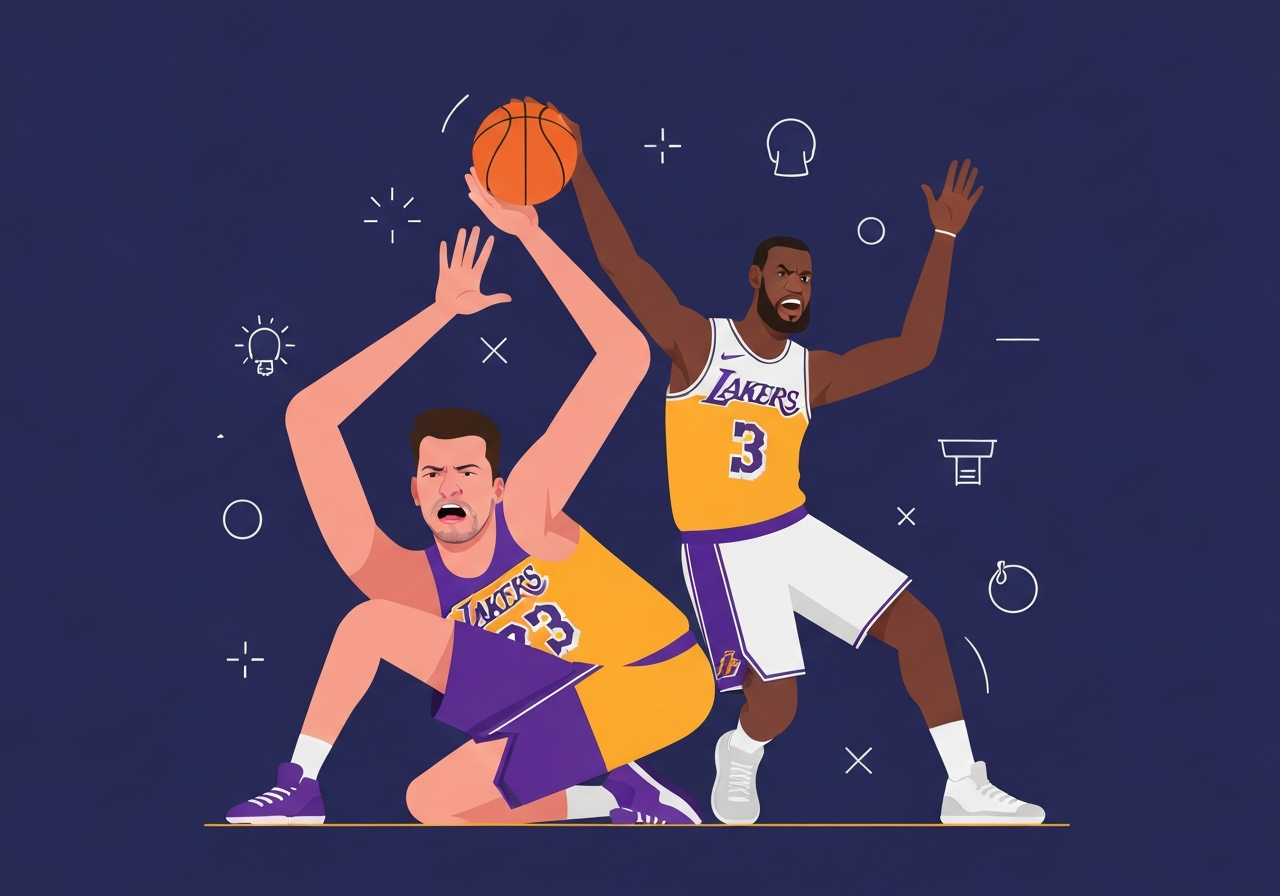
Lead: On Feb. 25, 2026 in Los Angeles, the Lakers fell 110-109 to the Orlando Magic after a misexecuted sideline inbounds set in the final seconds failed to produce a quality shot. Orlando took the lead when Wendell Carter Jr. converted a putback with 6.7 seconds remaining, prompting a Lakers timeout. On the subsequent inbounds, LeBron James found Luka Doncic open beyond the 3-point line, but Doncic declined the initial attempt and the sequence unraveled. James’ 27-foot fadeaway 3 at the buzzer missed, sealing the one-point loss.
Key Takeaways
- The Magic beat the Lakers 110-109 on Feb. 25, 2026; Wendell Carter Jr.’s putback with 6.7 seconds left produced the go-ahead basket.
- Luka Doncic finished 8-for-24 overall and 2-for-10 from three while setting a season-high with 15 assists.
- LeBron James took the final shot — a 27-foot fadeaway triple — with 2.9 seconds on the clock; it rimmed out at the buzzer.
- The Lakers squandered a 12-point second-half advantage and lost for the first time this season after leading following three quarters (previously 25-0).
- James missed a key free throw with 44.7 seconds remaining that would have pushed L.A. to a three-point lead; Desmond Bane answered with a 3 on the next possession.
- After Paolo Banchero’s missed jumper with 10.5 seconds left, the Lakers failed to secure the defensive rebound; Carter’s putback followed.
- The loss dropped L.A. to 4-4 across an eight-game homestand; the team travels to Phoenix on Thursday and Golden State on Saturday.
Background
The Lakers entered the matchup having owned an unusual streak: they had been 25-0 when leading after three quarters this season. That baseline elevated expectations for closing ability and late-game execution. Facing a young, switchable Orlando defense anchored by Banchero and Carter, L.A. nevertheless built a 12-point edge in the second half before momentum shifted. The roster mix — veteran finishers like LeBron James alongside a ball-dominant Luka Doncic — creates both high-end late-game options and occasional friction over shot selection.
Orlando’s season has emphasized energy, offensive versatility and offensive rebounding in late possessions; Wendell Carter Jr. embodies that approach and has frequently produced second-chance points. The Magic’s defensive plans for the Lakers emphasize closing driving lanes and forcing contested perimeter attempts with rotations from Paolo Banchero and Jonathan Isaac. The matchup spotlighted how a single defensive rebound or missed free throw can alter endgame calculus between two evenly matched teams.
Main Event
With 6.7 seconds left and Orlando leading 110-109 after Carter’s putback, Los Angeles called timeout to design a sideline inbounds. The play initially put the ball in LeBron James’ hands; he flipped it to Luka Doncic on the left wing beyond the arc. Doncic, seeing a long 3 and with 2.9 seconds left on the clock after attacking the ball, elected not to fire immediately — he said he felt slightly long and wanted to take one dribble closer.
As soon as Doncic halted his dribble he was met by Paolo Banchero and Anthony Black, who converged and forced a quick decision. Doncic pivoted and swung the ball back to LeBron, who caught it on the wing with Jonathan Isaac in front of him. James turned and launched a 27-foot fadeaway 3 as time expired; the attempt missed, and Orlando celebrated a one-point victory.
The sequence capped a stretch of late-game miscues for the Lakers. Earlier, with 44.7 seconds left, James missed a free throw that would have extended the lead to three; Orlando’s Desmond Bane responded with a go-ahead 3-pointer on the following possession. After Banchero missed a potential go-ahead pull-up with 10.5 seconds left while L.A. led by one, the Lakers failed to secure the rebound, allowing Carter’s decisive putback.
Analysis & Implications
At the simplest level, the loss exposes the thin margin for error in NBA finishes and highlights how execution, rebound control and free-throw shooting converge. The missed free throw by James and the subsequent defensive rebound lapse were equally consequential to the final miscue on the inbounds play. Teams that close games effectively combine reliable late free-throw conversion, secure rebounding and unambiguous role clarity on designed plays; the Lakers underperformed in all three areas on Tuesday.
The Doncic decision not to shoot on the initial receipt is illustrative of a broader chemistry question for a team blending two primary ball-handlers. Doncic cited distance and time management in his postgame comments and took responsibility for picking up his dribble; James described the possession as having “a good look” but noted the passer’s balance and rhythm were off. Those exchanges are factual and measured, but they point to the need for clearer microrole definitions in endgame sets — who shoots immediately, who creates, who clears space.
Strategically, Orlando’s late rotations were textbook: challenge the initial perimeter threat and funnel the ball into strong-side help where offensive rebounds can be manufactured. Carter’s putback was a direct product of that emphasis. For the Lakers, the loss may prompt adjustments in sideline inbounds timing, spacing and who is designated to take the final attempt — especially given LeBron’s missed free throw earlier and Doncic’s season-long shooting variance from deep.
Comparison & Data
| Situation | Detail |
|---|---|
| Final score | Orlando Magic 110, Los Angeles Lakers 109 |
| Key late stat | Wendell Carter Jr. putback — 6.7 seconds left |
| Doncic shooting | 8-for-24 overall, 2-for-10 from 3, 15 assists (season high) |
| LeBron free throw | Missed one with 44.7 seconds remaining |
| Lead blown | 12-point second-half advantage erased |
| Historic note | First loss this season when leading after three quarters (previously 25-0) |
The table underscores how discrete moments — a missed free throw, an unsecured defensive board, a late inbounds choice — aggregated into the defeat. Numerically, Doncic’s 15 assists reflect playmaking success even as his shooting efficiency was low; the Lakers must weigh creation versus finishing when assembling late possessions.
Reactions & Quotes
Team and player responses were candid while avoiding recrimination. Lakers players noted frustration with the homestand results but emphasized forward focus.
“I know I was open, but I just thought I was a little bit far. Tried to take one dribble closer. And I probably shouldn’t have picked up the ball and just tried to attack.”
Luka Doncic
Doncic acknowledged he declined the initial long 3 and accepted responsibility for ending up double-teamed. He also confirmed he did not speak to LeBron about the play after the game and emphasized the lessons he takes from the moment.
“I thought he had a good look… I was kind of off-balance when he gave it to me. I thought he had a great look. That’s my POV.”
LeBron James
James downplayed internal blame, noting his perspective that the shot looked promising but that rhythm and balance were factors. His remarks framed the development as a situational breakdown rather than a personal failure by Doncic.
“It’s a bit upsetting. We still got a lot of chances to just get in as good of a position as we can… It was tough losses and played against some really good teams.”
Deandre Ayton
Center Deandre Ayton put the loss in the context of the broader homestand; he stressed the team’s opportunity to recalibrate before the upcoming road trip.
Unconfirmed
- There is no public confirmation of whether the final play was a predetermined inbounds set or an improvised option called during the timeout.
- It is unconfirmed whether an alternate shooter was assigned on the play design or whether players were expected to read the defense and decide in real time.
Bottom Line
The Lakers’ 110-109 loss to the Magic came down to a sequence of small errors — a missed free throw, a failed defensive rebound and a late inbounds decision — rather than a single monumental failure. While Doncic produced a season-high 15 assists, his 8-for-24 shooting and 2-for-10 mark from deep undermined late-game spacing, and LeBron’s missed free throw earlier amplified the consequence of the final exchange.
For Los Angeles the immediate task is procedural: tighten late-inning roles, secure defensive rebounds, and reduce unforced timing mistakes on sideline sets. Orlando’s approach — forcing the ball into help and hunting offensive rebounds — is a repeatable blueprint that other opponents can emulate; for the Lakers, the loss should prompt both schematic tweaks and emphasis on practice reps that simulate these high-pressure scenarios ahead of the road swing to Phoenix and Golden State.
Sources
- ESPN report — sports media game coverage and quotes