
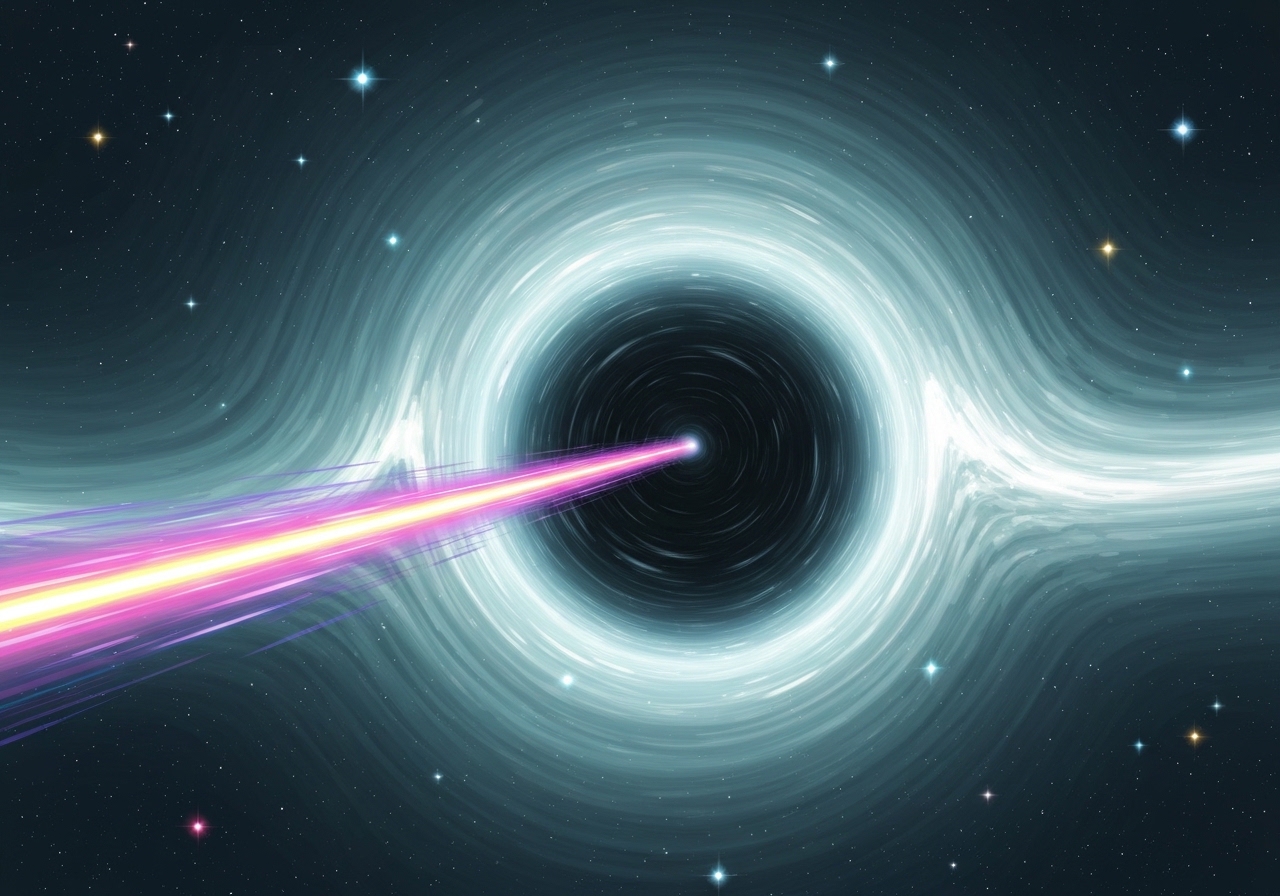
Using new Event Horizon Telescope (EHT) observations from 2021, astronomers have linked a 3,000‑light‑year‑long relativistic jet to material immediately surrounding M87*, the supermassive black hole first imaged in 2019. The source lies at the center of galaxy Messier 87, about 55 million light‑years away, and has a mass equivalent to roughly 6.5 billion suns. Modeling and high‑resolution very long baseline interferometry (VLBI) data indicate radio emission that was absent in 2017–2019 appears in 2021 from a compact zone less than 0.1 light‑year from the black hole, consistent with the base of the jet. The findings, published 28 January in Astronomy & Astrophysics, offer direct observational links between the black hole’s bright ring — its so‑called shadow — and the jet it launches.
Key Takeaways
- The jet connected to M87* extends roughly 3,000 light‑years from the galaxy core, as traced back by EHT observations and complementary radio data.
- M87* resides in Messier 87 at ~55 million light‑years distance and has an estimated mass of 6.5 billion solar masses, as used in the study’s modeling.
- VLBI observations made by the EHT in 2021 revealed radio emission features not present in EHT data from 2017–2019, pinpointed to within 0.1 light‑year of the black hole.
- The compact emission aligns with the southern arm of a jet previously mapped in longer‑wavelength radio images, suggesting a physical connection to the black hole’s immediate environment.
- The team used multi‑frequency, high‑resolution imaging and modeling to associate the bright ring (the observed shadow) with the jet’s launching region.
- Results were released in a peer‑reviewed article on 28 January in Astronomy & Astrophysics and involve EHT collaborators and institutions including MPIfR and NRAO.
Background
M87* became the first black hole to be imaged when the EHT released a ring‑shaped portrait in April 2019, produced from synchronized radio telescopes across the globe using VLBI. That image revealed a luminous annulus of super‑heated plasma around a dark central region — often called the black hole’s shadow — and immediately focused attention on how such systems launch narrow, powerful jets. Jets from active galactic nuclei like M87 can extend thousands of light‑years and carry energy that influences star formation and gas dynamics across their host galaxies.
The challenge has been connecting structures seen on vastly different scales: the horizon‑scale ring imaged by the EHT and the kiloparsec‑scale jet traced in conventional radio maps. The EHT’s 2021 campaign produced higher‑fidelity, multi‑frequency VLBI data that enhanced sensitivity to compact radio features near the shadow. Researchers from institutions including the Max Planck Institute for Radio Astronomy (MPIfR) and the National Radio Astronomy Observatory (NRAO) led modeling efforts to locate missing radio emission and test whether it can be associated with the jet base.
Main Event
In analyzing the 2021 EHT data, the team identified radio emission components absent from earlier EHT datasets (2017–2019). Through image reconstruction and forward modeling, they determined that these components are best explained by a compact source very close to the black hole — less than 0.1 light‑year away. That compact region spatially corresponds to the inner segment of the jet seen in longer‑wavelength radio observations, particularly matching a southern arm of the jet structure.
The authors report that linking the newly detected compact emission with the shadow’s bright ring allows them to place the probable jet origin at the innermost accretion/jet interface. While the exact geometry and magnetic configuration remain model‑dependent, the data provide a direct observational anchor connecting horizon‑scale features to the outward flow of relativistic plasma. The identification rests on combining the EHT’s VLBI maps with existing radio interferometry that traces the jet to kiloparsec scales.
Following this analysis, the team plans additional multi‑epoch and multi‑frequency EHT campaigns to resolve temporal changes and finer structure at the jet base. Higher resolution and broader frequency coverage will help discriminate between competing launching mechanisms and test whether the compact emission is persistent, transient, or variable on short timescales.
Analysis & Implications
Directly associating jet material with the ring around M87* narrows the parameter space for theoretical models of jet production. Leading classes of models attribute jet power either to magnetic fields extracting rotational energy from the black hole (Blandford–Znajek type processes) or to magnetized winds from the inner accretion disk. The new observational constraint — emission arising within 0.1 light‑year of the hole and coincident with the southern ring arm — favors scenarios where strong, organized magnetic fields thread the near‑horizon region and collimate outflows on very small scales.
Constraining the launch point also affects estimates of jet composition, speed and coupling to the accretion flow. If the jet originates in the immediate vicinity of the shadow, particle acceleration and collimation must occur extremely close to the black hole, which can influence radiative signatures and the efficiency of energy transfer into the host galaxy. Those factors matter for models of feedback that regulate star formation in massive ellipticals like M87.
On a methodological level, the result demonstrates the value of combining high‑resolution VLBI imaging across frequencies with targeted modeling to bridge spatial scales. It also shows that variability in the compact radio source on timescales of years can reveal structural changes at the jet base, offering a dynamic laboratory for testing magnetohydrodynamic simulations. Future EHT runs, supplemented by space‑ and ground‑based radio arrays, will refine constraints and reduce model degeneracies.
Comparison & Data
| Item | 2017–2019 EHT | 2021 EHT/Follow‑up |
|---|---|---|
| Black hole image | Horizon‑scale ring (first image, 2019) | Improved multi‑frequency maps resolving compact radio features |
| Detected compact emission | Absent or below detection | Present; localized within <0.1 light‑year of M87* |
| Jet extent traced | Known at kiloparsec scales (~3,000 ly) | Linked back to near‑horizon region |
The table highlights how the 2021 observations add compact radio detections close to the hole that were not seen or resolved in earlier EHT imaging. That added sensitivity enabled the team to spatially associate the compact emission with the inner jet and the shadow’s southern arm, strengthening the causal link between horizon‑scale processes and the large‑scale jet.
Reactions & Quotes
Team leaders emphasize that this is an inaugural step toward an observationally grounded theory of jet launching rather than a final verdict on mechanisms.
“This study represents an early step toward connecting theoretical ideas about jet launching with direct observations,”
Saurabh (Max Planck Institute for Radio Astronomy)
Saurabh framed the result as a pivotal constraint for models: identifying where the jet may originate and how it connects to the black hole’s shadow provides a new observational anchor for simulations. The paper’s co‑authors note the importance of continued multi‑frequency campaigns to confirm persistence and probe structure in greater detail.
“We have observed the inner part of the jet of M87 with global VLBI experiments for many years… and finally managed to resolve the black hole shadow in 2019,”
Hendrik Müller (National Radio Astronomy Observatory)
Müller highlighted the steady improvement of global VLBI resolution over years and described the new result as the next step in integrating breakthrough observations across frequencies. The team also invited the broader community to compare magnetohydrodynamic models against the new spatial constraint.
Unconfirmed
- Whether the compact emission identified in 2021 marks a stable, long‑lived jet launching region or a transient feature remains unproven and requires multi‑epoch follow‑up.
- The precise physical mechanism (black hole spin extraction vs. inner‑disk winds) responsible for launching the M87* jet is not definitively determined by these observations; models remain viable on different assumptions.
- Detailed magnetic field geometry and particle composition (electron–proton vs. electron–positron dominated) at the jet base are not yet constrained by the present data.
Bottom Line
The 2021 EHT data provide the first direct observational link tying the 3,000‑light‑year jet of M87 back to material within a tenth of a light‑year of the black hole’s shadow. That connection tightens constraints on where jets form and supplies a crucial test for competing theoretical models of jet launching and black hole energy extraction.
While the result does not yet settle which specific mechanism powers the jet, it marks a major step toward closing the gap between horizon‑scale imaging and the large‑scale impact of active galactic nuclei. Continued multi‑frequency, multi‑epoch VLBI and coordinated radio observations will be needed to confirm persistence, reveal temporal behavior, and refine physical interpretations.
Sources
- Space.com — News article summarizing the results (news)
- Event Horizon Telescope Collaboration — Official collaboration site with press releases and data resources (official/consortium)
- Astronomy & Astrophysics — Peer‑reviewed journal (academic/peer‑review)
- Max Planck Institute for Radio Astronomy (MPIfR) — Institutional release and researcher affiliation (institutional)