
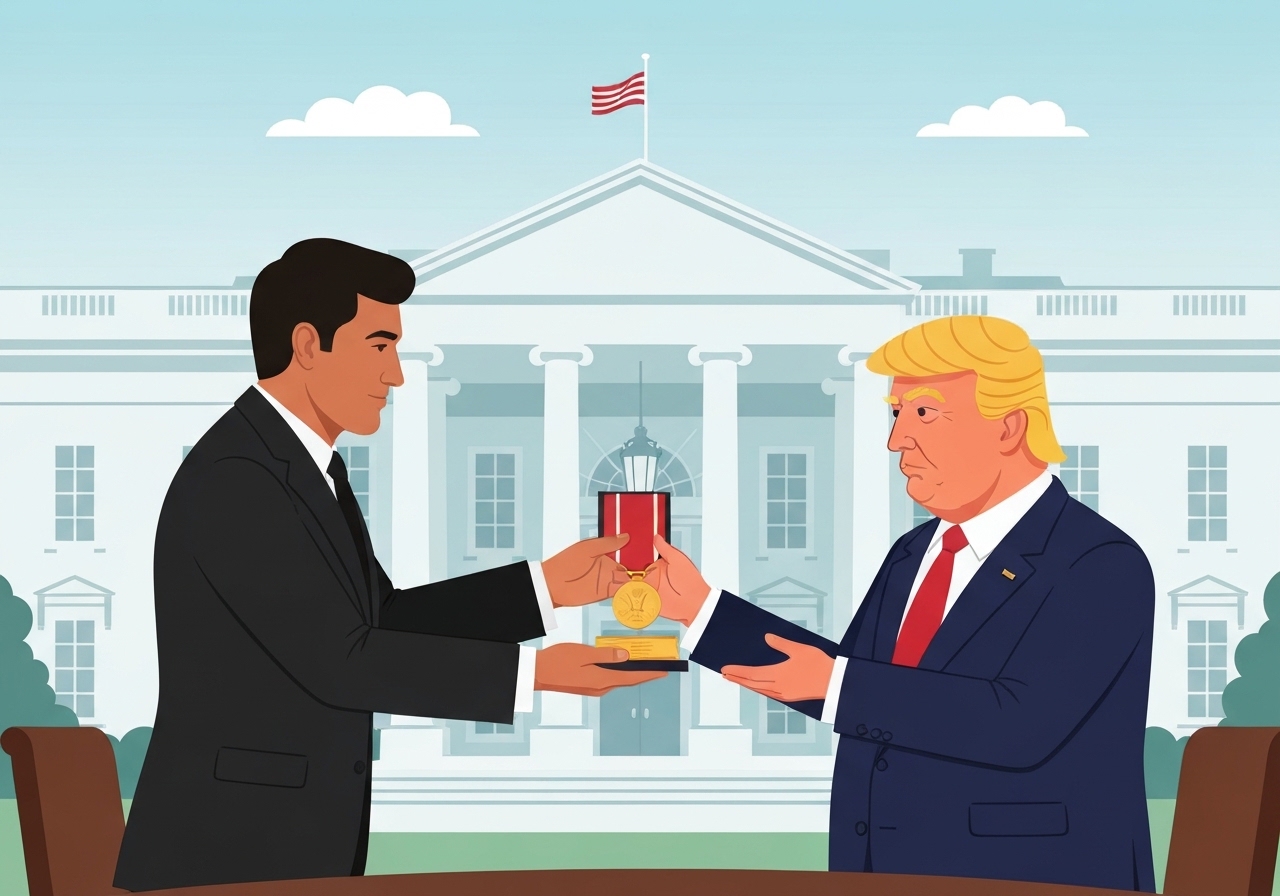
Lead: Venezuelan opposition leader María Corina Machado said on Thursday that she presented her Nobel Peace Prize medal to President Donald Trump during a private White House meeting, calling the gesture recognition of his role toward a free Venezuela. The Nobel Institute has said the medal could not be formally transferred, and the White House later posted a photo of Trump holding the medal framed with a dedication. Machado spent about two and a half hours at the White House before meeting with lawmakers, and she told supporters afterward that they “can count on President Trump.”
Key Takeaways
- María Corina Machado met President Trump at the White House on Thursday and said she presented her Nobel Peace Prize medal to him; she had spent 11 months in hiding in Venezuela before appearing publicly in Norway for the award ceremony.
- The Nobel Institute stated Machado could not give her prize to another person, a formal constraint that does not necessarily prevent symbolic gestures.
- The White House published an Oval Office photo of Trump holding the framed medal; the frame text described the presentation as a personal symbol of gratitude for actions to secure a free Venezuela.
- Machado spent roughly 2.5 hours at the White House, then held a closed-door meeting with a bipartisan group of senators; she later told supporters she believed they could “count on President Trump.”
- Senior White House officials described the discussion as candid but did not offer a timeline for new Venezuelan elections; multiple lawmakers said Machado received no firm U.S. commitment on an election timetable.
- The meeting occurred amid a broader U.S. campaign to seize control of Venezuelan oil assets, including the recent interception by U.S. forces of a sanctioned tanker in the Caribbean.
- Relations on the ground remain complex: acting President Delcy Rodríguez continues to run day-to-day operations in Caracas even as Maduro faces charges and U.S. authorities say he and his wife were captured and transported to New York for trial less than two weeks earlier.
Background
Venezuela has been mired for years in political and economic crisis, pitting opposition leaders against Nicolás Maduro’s government. Machado emerged as a prominent opposition figure after co-founding the NGO Súmate and pushing a 2004 recall referendum against Hugo Chávez; she later drew official ire for visits to Washington in the mid-2000s. In 2024 Machado led a widespread movement rejecting Maduro’s re-election, though electoral authorities loyal to the ruling party declared Maduro the winner amid reports of irregularities and international concern.
The United States has increasingly targeted Venezuela’s state-linked revenue streams and officials with sanctions and, most recently, moves to control oil shipments. U.S. policy has oscillated between endorsing opposition leaders and engaging with interim officials in Caracas—most notably Delcy Rodríguez, Maduro’s second-in-command—heightening ambiguity over Washington’s immediate plan for restoring democratic control and organizing credible elections.
Main Event
On Thursday Machado entered the Oval Office and, she said afterward, handed her Nobel Peace Prize medal to President Trump “as a recognition for his unique commitment with our freedom.” The White House later posted a photo of Trump holding the medal in a large frame that included text describing the presentation as a personal symbol of gratitude on behalf of the Venezuelan people. The Nobel Institute, however, publicly noted that the prize could not be formally transferred.
Trump confirmed on social media that Machado had left the medal for him to keep and praised her, calling her “a wonderful woman who has been through so much” and thanking her for the gesture. White House press secretary Karoline Leavitt described Machado as “a remarkable and brave voice” while also saying that the meeting did not represent a change in the administration’s realistic assessment of her prospects to lead Venezuela.
After her White House visit Machado stopped for supporters near the executive mansion, hugging and addressing dozens of cheering followers. She then held a closed-door session with a bipartisan congressional group. Senators reported Machado warned that if there is no real progress toward a transition or credible elections in the next several months, concerns should rise about Venezuela’s trajectory.
Senators offered differing public takes after the session: some hailed the U.S. role in ousting Maduro as a pivotal event in the region, while others said Machado did not obtain a pledge of an election timeline from the White House. The meeting came amid U.S. actions to seize Venezuelan-linked oil assets in the Caribbean and follow the recent capture and transfer of Maduro and his wife to New York to face charges, events the administration says underscore its intent to disrupt the Maduro-era revenue apparatus.
Analysis & Implications
The symbolic presentation of a Nobel medal to a sitting U.S. president is rare and politically charged. Even if the act was meant as a personal token of gratitude, it risks aligning Machado publicly with the U.S. administration at a moment when U.S. strategy toward Venezuela is in flux. That alignment may strengthen her visibility among opposition supporters while simultaneously exposing her to criticism for perceived dependence on external backers.
From a policy standpoint, the meeting did not produce a clear timeline for new Venezuelan elections. The White House’s refusal to commit to when elections might occur leaves a central question unresolved: whether the U.S. will press for an immediate electoral transition or prioritize stabilizing governance and oil operations first. The ambiguity complicates opposition calculations and could enable interim authorities in Caracas to consolidate control in the near term.
Economic leverage is central to the broader strategy: U.S. seizures of tankers and attempts to control oil revenue streams aim to deprive Maduro loyalists of funding. That effort, however, raises legal and diplomatic risks, including potential disputes over maritime seizures and the governance of oil fields if control shifts. International partners will weigh in, and their reactions could affect how quickly a political transition can be engineered.
Domestically in Venezuela, Machado’s standing is mixed: her Nobel recognition and U.S. visibility boost her international profile, but officials and institutions inside Venezuela—particularly those loyal to the ruling party—retain power over state mechanisms. Whether Machado can convert international backing into effective domestic authority will depend on follow-through from external supporters and the opposition’s capacity to unify and contest control on the ground.
Comparison & Data
| Item | Detail |
|---|---|
| Machado public absence | 11 months in hiding before appearing in Norway |
| White House visit | Thursday; roughly 2.5 hours at the White House |
| Maduro status | Captured and brought to New York for trial less than two weeks earlier |
| Recent U.S. action | Seizure of a sanctioned oil tanker in the Caribbean (part of broader effort) |
The table above summarizes key timeline datapoints mentioned during the White House visit and related U.S. operations. These figures highlight the compressed and tumultuous pace of recent developments: Machado’s sudden return to the public stage, rapid diplomatic engagements in Washington, and swift U.S. moves to disrupt Venezuela-linked oil flows.
Reactions & Quotes
“I presented the president of the United States the medal, the Nobel Peace Prize…as a recognition for his unique commitment with our freedom.”
María Corina Machado
Machado spoke to reporters immediately after leaving the White House, framing the presentation as an expression of gratitude rather than a formal transfer of the prize.
“She is a wonderful woman who has been through so much. María presented me with her Nobel Peace Prize for the work I have done.”
Donald Trump (social media)
Trump posted praise for Machado on social media and accepted the framed medal in the Oval Office photo released by the White House.
“If there’s not some progress…in the next several months, we should all be worried.”
Sen. Chris Murphy (D-Conn.)
Sen. Murphy relayed concerns from the closed-door session that stalled or absent progress toward a transition could worsen Venezuela’s crisis.
Unconfirmed
- Whether the framed medal transfer constitutes a breach of Nobel Institute rules beyond the Institute’s public statement remains legally and procedurally unclear.
- Any concrete timeline or firm White House commitment to hold Venezuelan elections was not given; claims that an election timetable was promised are unconfirmed.
- Assertions that Machado now has a definitive path to national leadership in Venezuela are speculative and lack confirmation from domestic powerholders or newly established electoral mechanisms.
Bottom Line
The White House meeting between María Corina Machado and President Trump was heavy on symbolism and light on firm commitments. Machado’s decision to present her Nobel medal—captured by an Oval Office photograph and a public social-media post—raises the profile of both her cause and U.S. involvement, but it did not resolve key questions about how and when Venezuela will return to democratic elections.
Watch for four developments that will shape the next phase: whether the U.S. sets a concrete election timetable; how interim authorities in Caracas respond; the international reaction to U.S. control over Venezuelan oil assets; and whether Machado can translate symbolic backing into effective domestic political power. Absent clear signals on those fronts, the political environment in Venezuela is likely to remain volatile.
Sources
- Associated Press (news agency) — original reporting on the White House meeting, quotes, and timeline.
- The White House (official) — Oval Office photo and statement accompanying the framed medal release.
- The Nobel Prize/Institute (official) — institutional guidance and statements regarding Nobel prize protocol.