
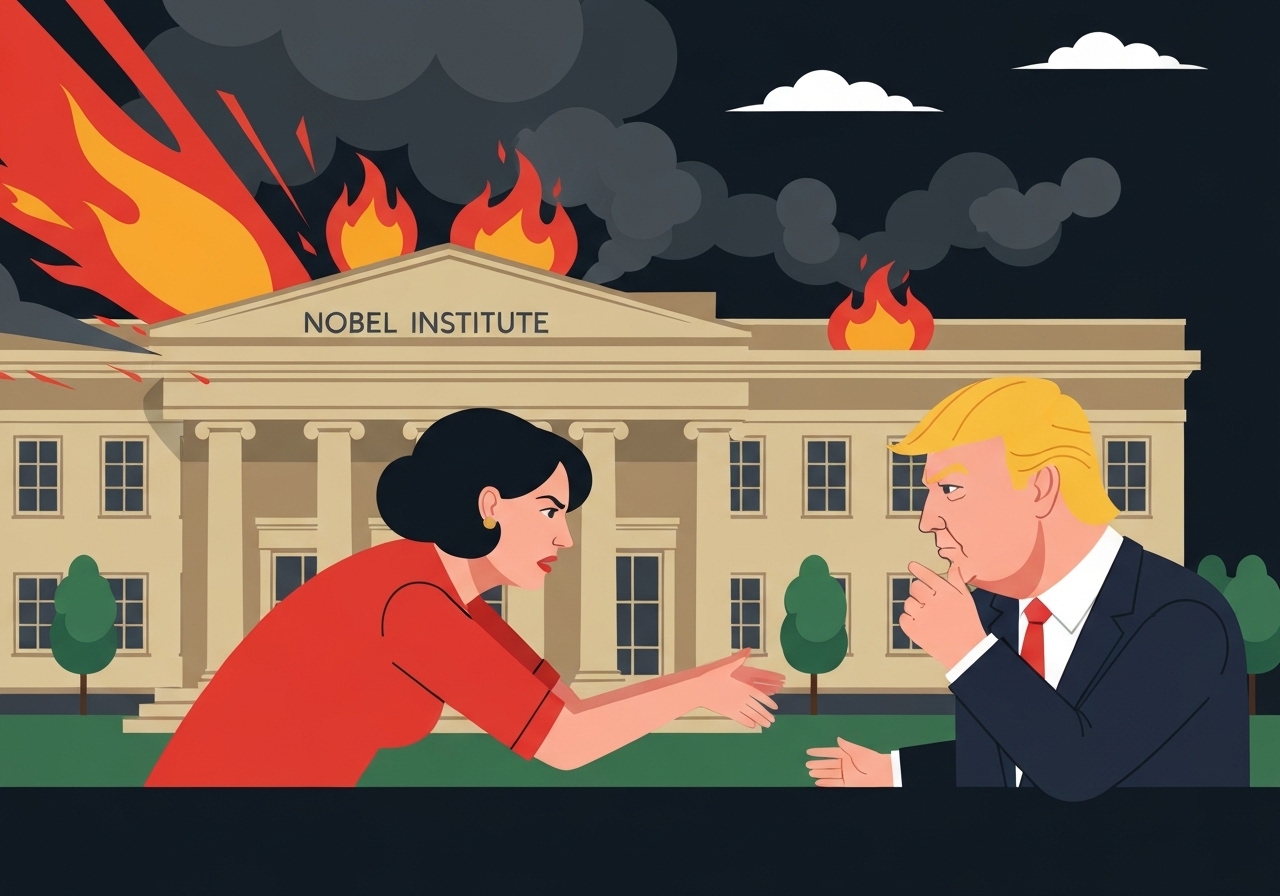
Opposition leader María Corina Machado is scheduled to meet former U.S. president Donald Trump in Washington on Thursday, Jan. 15, 2026, a development that has stirred sharp criticism in Norway over the handling and public perception of last year’s Nobel Peace Prize. The meeting follows Machado’s public suggestion—made in a recent U.S. interview—that the prize be shared with Mr. Trump, and it comes amid broader debate after U.S. strikes tied to the campaign against Venezuelan drug trafficking have reportedly killed more than 100 people. The Nobel Institute has publicly corrected misconceptions about the award’s rules, emphasizing that prizes cannot be revoked, shared or transferred once announced. The episode is provoking questions at home in Norway about the Prize’s role as a diplomatic and symbolic instrument.
Key Takeaways
- María Corina Machado will meet Donald Trump in Washington on Jan. 15, 2026; the meeting was announced publicly in the days before that date.
- Trump publicly asserted—on social media—that he deserved the Nobel Peace Prize, claiming he “ended 8 wars,” and mischaracterized Norway as the awarding authority.
- The Nobel Peace Prize is decided by a five-member committee appointed in Norway; the Nobel Institute stated last Friday that a prize “cannot be revoked, shared or transferred.”
- Machado has praised the U.S. military capture of Venezuelan President Nicolás Maduro and has not publicly condemned an American bombing campaign that has, according to multiple accounts, killed over 100 people.
- The controversy has prompted the Nobel Institute to engage in visible damage control as public confidence in the prize’s neutrality is questioned within Norway.
Background
The Nobel Peace Prize, administered by a committee appointed by the Norwegian parliament, carries both symbolic weight and practical soft-power benefits for Norway. Over more than a century the prize has been used to elevate causes and actors on the global stage; that symbolic currency is widely perceived inside Norway as part of its international influence. The committee is independent of the Norwegian government by design, but the public and media often conflate the institution with the country itself, especially when laureates pursue polarizing diplomatic or political strategies.
María Corina Machado emerged as a leading figure in Venezuela’s opposition to Nicolás Maduro and was awarded the 2025 Nobel Peace Prize. Her political stance and calls for strong international pressure have appealed to segments of the U.S. political right. In recent months Machado’s public posture—celebratory comments about U.S. operations targeting Venezuelan leadership and proposals to share her Nobel recognition—has put the prize apparatus at the center of an international reputational dispute.
Main Event
The immediate flashpoint came after Machado suggested during a U.S. broadcast interview that she would be open to “sharing” the award with Donald Trump, prompting swift public response from the Nobel Institute. The institute reiterated on Friday that once a prize is announced, it is final and cannot be reassigned. That statement aimed to correct a growing misconception—on social media and in some pundit commentary—that the award could be transferred by the laureate or national governments.
Mr. Trump amplified the controversy on his social media account, asserting that he had single-handedly ended eight wars and criticizing Norway’s role in the selection—an inaccuracy that conflates the Norwegian state with the committee of five that actually decides the prize. The mischaracterization frustrated many in Oslo, where the award is treated as a national emblem and where trust in the Nobel brand is considered politically valuable.
Norwegian commentators and some politicians described the episode as an embarrassment for the institution that administers the prize, saying it revealed vulnerabilities in how the prize’s independence and rules are understood internationally. The institute’s public clarification was aimed at both foreign audiences and a domestic public alarmed by the possibility the prize’s symbolism could be co-opted by partisan campaigns abroad.
Analysis & Implications
The controversy raises three intertwined concerns: the integrity of the Nobel selection process, Norway’s soft-power reputation, and the wider politicization of symbolic awards. If laureates or influential political figures treat a prize as transferable or as an instrument for partisan alliances, the prize’s standing as an impartial symbol of peace risks erosion. For Norway, the reputational cost is not merely pride; it is the potential weakening of an internationally recognized conduit for moral authority.
For U.S.-Venezuelan geopolitics, Machado’s outreach to Trump underscores how external actors and diaspora politics can shape opposition strategies in Venezuela. Aligning the prize with a polarizing former U.S. president may deepen domestic Venezuelan divisions and complicate international mediation prospects. It could also force foreign governments to clarify their stances on both Machado’s objectives and the methods used in pursuing regime change or anti-smuggling operations.
Domestically in Norway, the episode is likely to intensify debate over transparency around the Nobel apparatus and the communication of its rules. The institute’s brisk public rebuke of the sharing idea suggests a desire to close the reputational leak quickly, but long-term repair may require more proactive public engagement and education about how laureates are selected and the limits of the prize.
Comparison & Data
| Year | Laureate(s) | Nature of Controversy |
|---|---|---|
| 1973 | Henry Kissinger & Lê Đức Thọ | One recipient declined; award criticized over peace prospects. |
| 2009 | Barack Obama | Controversy over brevity of achievements at time of award. |
| 2016 | Juan Manuel Santos | Domestic backlash after peace deal referendum failed. |
These examples show that the Nobel Peace Prize has frequently sparked public debate when awarded amid ongoing conflicts, political transitions or unfinished negotiations. The present Machado–Trump episode differs in that it combines a laureate’s active political outreach to a foreign politician with a visible military campaign that has produced significant civilian casualties—factors that increase reputational risk for the prize and the institutions associated with it.
Reactions & Quotes
The Nobel Institute issued a short, firm correction after Machado’s comments, signaling urgency in limiting misinterpretation. Observers in Oslo interpreted the statement as both factual clarification and an attempt to calm domestic concern about the prize’s standing.
“Once a Nobel Prize is announced, it cannot be revoked, shared or transferred to others. The decision is final and stands for all time.”
Nobel Institute (official statement)
Donald Trump’s social-media posts framed the debate in personal terms and included a claim about ending multiple wars, a formulation that Norwegian critics said misstates both the prize process and historical record.
“I single-handedly ENDED 8 WARS, and Norway, a NATO Member, foolishly chose not to give me the Nobel Peace Prize.”
Donald J. Trump (social media)
Supporters of Machado argue she is leveraging global platforms to sustain pressure on Venezuelan authorities; opponents say the tactics risk turning a humanitarian-symbolic honor into a partisan tool.
“The award is intended to spotlight peace work, not to be treated as currency in partisan diplomacy.”
Norwegian political commentator (media interview)
Unconfirmed
- Whether Machado formally sought a legal mechanism to share or transfer the 2025 Nobel Peace Prize has not been documented beyond public remarks and is not supported by the Nobel Institute’s rules.
- The precise chain of command and intelligence that led to U.S. strikes and the capture of Nicolás Maduro has not been fully disclosed in public sources and remains subject to official confirmation.
- It is unconfirmed whether Trump would accept a joint recognition in any formal or ceremonial sense beyond public praise and political endorsement.
Bottom Line
The Jan. 15, 2026 meeting between María Corina Machado and Donald Trump crystallizes wider tensions about what a Nobel Peace Prize can and should represent in an era of polarized geopolitics. While the Nobel Institute has moved quickly to clarify the legal and procedural limits on the prize, the reputational challenge is partly cultural: correcting widespread misunderstandings about the committee’s independence and the irrevocable nature of awards.
For Norway, the immediate task is reputational management—ensuring domestic audiences understand that the institution retains control of the award’s meaning and that laureates cannot unilaterally reassign it. Internationally, the episode underscores how symbolic honors can be instrumentalized, with potential consequences for mediation, diplomacy and public trust in long-standing global institutions.
Sources
- The New York Times — U.S. newspaper reporting on the meeting and controversy (media)
- Nobel Prize / Nobel Institute — official statements and prize rules (official)
- Fox News — broadcaster where Machado discussed sharing the prize (media)