
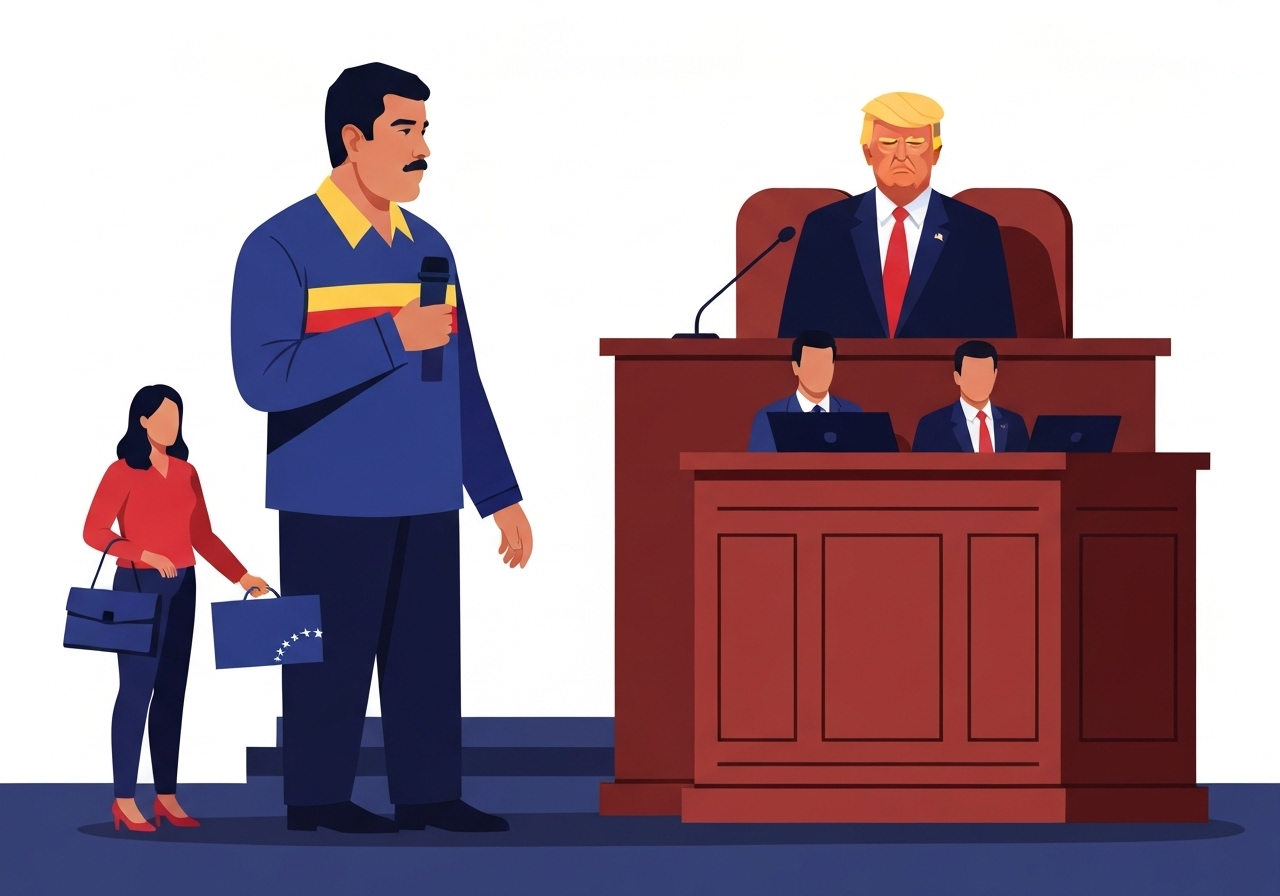
Lead: On Jan. 5, 2026, former Venezuelan president Nicolás Maduro and his wife, Cilia Flores, were arraigned in federal court in lower Manhattan after U.S. special operations forces captured them in Caracas over the weekend. Both defendants pleaded not guilty to charges that include narco-terrorism and cocaine importation; Flores’ lawyers said she is “prepared” for the legal fight and reported injuries from the arrest. President Trump described the operation as a law‑enforcement action and warned other governments in the region they could face similar measures. The arrest has set off diplomatic protests, market moves in energy stocks and an expected congressional war‑powers debate.
Key Takeaways
- Maduro and Cilia Flores were arraigned in the Southern District of New York on Jan. 5, 2026, facing four federal counts including narco‑terrorism and conspiracy to import cocaine.
- Defense counsel said Flores is in “good spirits” but claimed she suffered significant rib trauma during the capture; the judge ordered medical care.
- Defense and transport details: both defendants were moved under heavy security from the Metropolitan Detention Center in Brooklyn to Manhattan by helicopter and motorcade.
- U.S. officials say nearly 200 Americans were involved in the Caracas raid and more than 150 aircraft supported the operation, though it’s unclear whether the 200 figure counts aircrews.
- Markets reacted: Chevron rose $8.51 (5.5%) to $164.49; Exxon Mobil climbed about 2.5%; ConocoPhillips rose 3.2%; U.S. crude traded near $58.13 per barrel and Brent at $61.50.
- Venezuela holds an estimated 303 billion barrels of oil in the ground but production has fallen from roughly 3 million barrels per day 25 years ago to about 1 million bpd today.
- Delcy Rodríguez was sworn in as acting president in Caracas and has been backed by senior military commanders amid protests and a heightened security perimeter around the U.S. courthouse.
Background
For years the United States has accused the Maduro government of facilitating large‑scale drug trafficking and corruption, and a superseding indictment first filed in 2020 named Maduro and multiple associates. Washington had levied sanctions and asset freezes against Venezuelan officials and entities since 2018, citing ties between state actors and narcotics networks. The Trump administration framed the recent operation as an enforcement of long‑standing indictments and compared it to past actions targeting fugitives and narco‑traffickers.
Venezuela’s oil wealth — estimated at some 303 billion barrels of reserves — has been a central element of the country’s geopolitics, but decades of mismanagement and underinvestment have left much of that crude expensive and difficult to extract. U.S. companies have been cautious about re‑entry; Chevron is the only major U.S. oil firm currently operating in Venezuela, and analysts note any sizable revival of output would require large capital infusions and long lead times.
Main Event
According to U.S. authorities, special operations forces struck targets in and around Caracas in the early hours of Saturday and captured Maduro and Flores. Officials say Maduro was flown to the United States the same weekend and brought to federal custody. Secretary of Defense Pete Hegseth told a Virginia audience that “nearly 200” Americans participated and that the force accomplished its goals without U.S. combat deaths; the precise tally and whether it includes aircrew remain unclear.
In Manhattan federal court on Monday, Maduro and Flores pleaded not guilty. Maduro, wearing detention clothing and translation headphones, said through an interpreter, “I’m innocent. I’m not guilty — I’m a decent man,” and asserted he remains president of Venezuela. The proceedings were overseen by Judge Alvin Hellerstein, a senior jurist of the Southern District of New York appointed in 1998.
The Trump administration has publicly framed the operation as a law‑enforcement arrest of an indicted narcotrafficker, with national security officials scheduled to brief congressional leaders. Meanwhile, in Caracas Delcy Rodríguez — a longtime Maduro confidant — was sworn in as acting president and denounced the U.S. action as a violation of international law while calling for a peaceful, cooperative path forward.
Analysis & Implications
Legally, the arraignment moves the case into the U.S. federal justice system where prosecutors will seek to prove charges that include narco‑terrorism and large‑scale drug importation. Extradition questions are moot given the defendants are on U.S. soil, but defense strategy and the scope of classified evidence may shape how quickly the matter proceeds to trial. The selection of S.D.N.Y., a court experienced with transnational cases and high‑profile defendants, signals prosecutors’ intent to manage complex evidence and witness issues.
Diplomatically, the capture has increased tensions across the hemisphere. U.N. Secretary‑General António Guterres said he is “deeply concerned” about adherence to international law and the operation’s potential to destabilize the region. Several regional leaders have publicly condemned the raid; Mexico’s president rejected interventionist rhetoric, while Colombia’s president responded sharply to U.S. threats. Those reactions raise the risk of broader diplomatic rifts and could complicate post‑arrest negotiations over Venezuelan assets and governance.
Economically, short‑term effects on U.S. pump prices are expected to be limited, but energy markets and investor sentiment have already moved: major U.S. energy stocks rose on hopes of reduced political risk and potential future access to Venezuelan reserves. Realizing any sustained increase in Venezuelan production would require significant foreign investment, legal certainty and infrastructure rebuilding — a long‑term process rather than an immediate supply fix.
Comparison & Data
| Item | Before/Now |
|---|---|
| Venezuela proven reserves | 303 billion barrels (estimated) |
| Venezuela production | ~3 million bpd (25 years ago) → ~1 million bpd (now) |
| U.S. crude price (Mon) | $58.13 per barrel |
| Brent crude (Mon) | $61.50 per barrel |
| Chevron share move (Mon) | +$8.51, +5.5% to $164.49 |
These figures show the gulf between Venezuela’s resource base and its current productive capacity. Even with political change, restoring output toward historical levels would require resolving legal claims, securing investments and rebuilding refining and export infrastructure — a multi‑year endeavor.
Reactions & Quotes
“We’re in charge”
President Donald Trump, remarks on Air Force One
Context: President Trump told reporters the United States currently controls the situation in Venezuela and warned other countries they could face consequences if they did not cooperate; he also discussed the possibility of further actions in the region.
“I’m innocent. I’m not guilty — I’m a decent man.”
Nicolás Maduro, in court (through interpreter)
Context: Maduro used his brief court appearance to deny the charges and to assert his ongoing claim to Venezuela’s presidency, even as U.S. prosecutors pursue narcotics and weapons counts.
“I am deeply concerned that rules of international law have not been respected.”
U.N. Secretary‑General António Guterres
Context: Guterres warned of potential regional destabilization and urged peaceful solutions while offering U.N. support to resolve the crisis through diplomacy.
Unconfirmed
- Whether the “nearly 200” Americans cited by the Pentagon includes only ground forces or aircrews and support personnel remains unclear and unverified by an official force‑composition release.
- The Cuban government’s claim that 32 Cuban nationals were killed during the operation has not been independently confirmed by U.S. or international investigators.
- Intelligence reports that Venezuelan officials discussed placing armed personnel or Soviet‑era air defenses on tankers were described to reporters as deliberations; their implementation has not been independently verified.
Bottom Line
The capture and arraignment of Nicolás Maduro and Cilia Flores mark a dramatic escalation in U.S. policy toward Venezuela that blends criminal prosecution with military action. The immediate legal trajectory will be shaped by S.D.N.Y. procedures, classified evidence issues and the speed at which prosecutors and defense counsel exchange material.
Regionally, the move risks deepening diplomatic divides, prompting protests and asset freezes while creating uncertainty for investors. Although energy markets and some U.S. oil stocks have rallied, any material increase in Venezuelan crude flowing to global markets would take years to realize and depend on political, legal and fiscal stability.
Sources
- CBS News — live updates (U.S. news organization)