
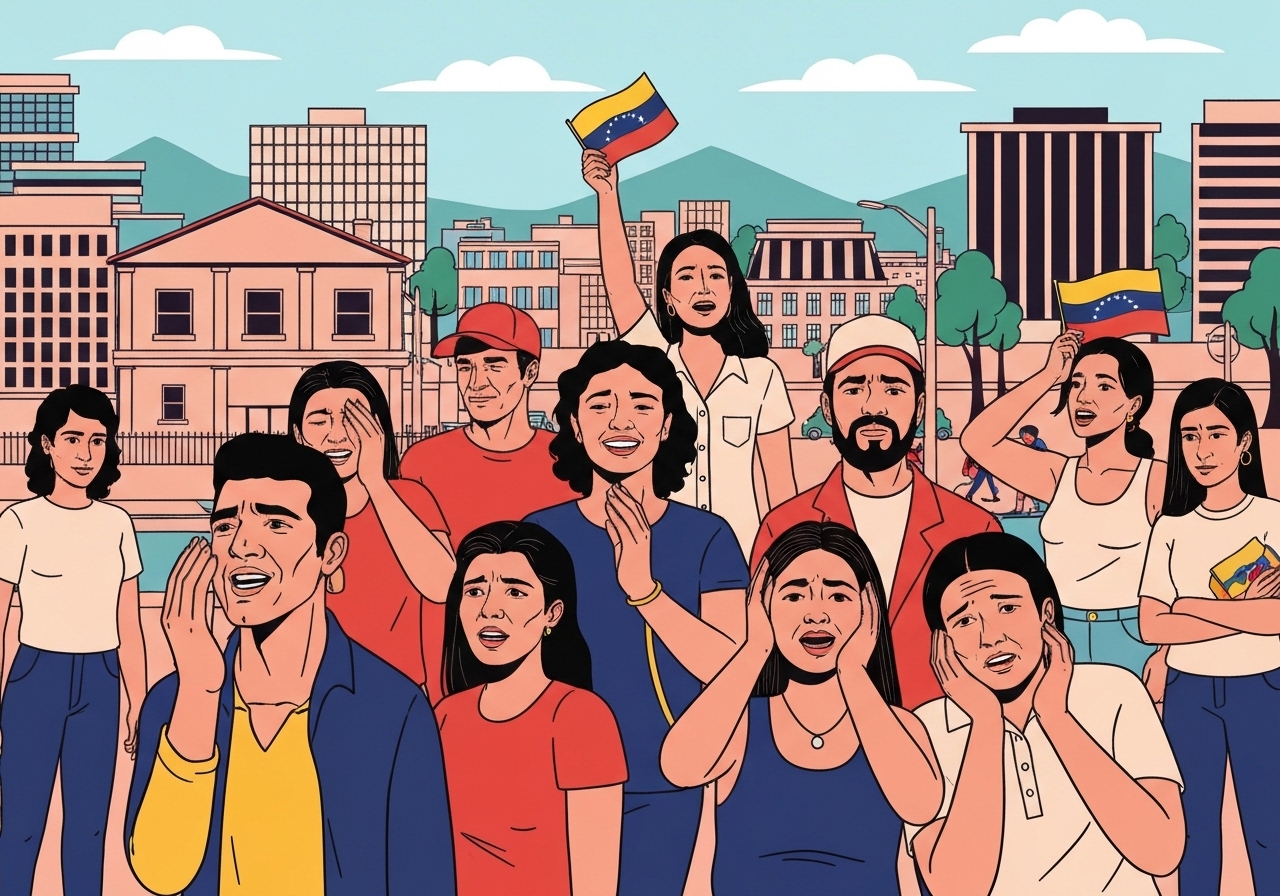
Lead: Venezuelans in Caracas spent the day after a weekend military operation — in which US forces struck airbases, removed President Nicolás Maduro from the capital and transported him to a Brooklyn detention facility — carrying on routine tasks while processing shock and uncertainty. On Sunday local officials urged businesses and schools to reopen even as many residents remained cautious, lining up at shops and tracking developments on television. Voices from diverse neighborhoods expressed a mixture of resignation, hope for orderly transition, and concern about possible unrest. The city’s immediate mood was subdued, punctuated by militia patrols and guarded public statements from government and international figures.
Key Takeaways
- US forces bombed airbases in and around Caracas over the weekend and detained President Nicolás Maduro, who was flown to a Brooklyn jail, according to multiple eyewitness accounts reported on Jan. 4–5, 2026.
- Defense Minister Vladímir Padrino López publicly urged Venezuelans on Sunday to “resume their economic activities, work, and all other types of activities, including educational activities,” signaling an official push for normalcy.
- Many residents reported sleeping through or being awakened by explosions; some left their homes to buy food or exercise pets despite heightened anxiety in the city.
- Public reaction ranged from comments that the episode was “for the history books” to warnings that a hurried transition could spark renewed violence after 26 years of Chavista influence, according to local interviewees.
- Opposition leader María Corina Machado was criticized by US President Donald Trump as lacking the “respect” or “support” to lead the country, a remark that complicates external signals about preferred Venezuelan leadership.
- Residents expressed pragmatic demands if a transition occurs: release of political prisoners, return of international oil companies, and new, credible elections and electoral authorities.
Background
The weekend operation represents a sudden escalation in international involvement in Venezuela’s long-running political crisis. Since the early 2000s the country has been governed by leaders identified with the Chavista movement; interviewees referenced 26 years of Chavista dominance. The disputed 2024 presidential election — widely criticized by outside observers — was cited repeatedly by locals as a turning point after which political tensions intensified.
International actors, including the United States, Russia, China and Iran, have been implicated in Venezuela’s economic and political alignments over the past decade through investment, security ties and energy agreements. Those external relationships, residents say, shaped both the country’s economic decline and the strategic calculations around any change of government. Past episodes of instability in Venezuela have included coup attempts, contested elections and mass protests that produced prolonged shortages of goods and services.
Main Event
Eyewitnesses in Caracas reported that explosions and the sound of aircraft early in the weekend woke many residents, who described confusion and fear. Several interviewees went outside to check on family and pets and to purchase essentials amid concerns that shops might close. The capital’s streets were quieter than normal, though militia elements were visible in some neighborhoods.
Defense Minister Vladímir Padrino López addressed the public on Sunday, urging a return to work and schooling and attempting to project control after the operation. Acting President Delcy Rodríguez — identified by some residents as the interim authority tolerated by the United States for now — issued communications aimed at stabilizing state functions while the international fallout unfolds.
On the ground, Venezuelans described a mix of reactions: some equated the event with historic regime changes, others condemned US military actions as intimidation, and some urged a cautious, negotiated transition to avoid chaotic reprisals. Store lines and localized shortages persisted in many areas, underlining how immediate daily needs continue to shape behavior while political leadership is in flux.
Analysis & Implications
The removal of Nicolás Maduro from Caracas and his transfer to a US penal facility marks a qualitative shift in the Venezuelan crisis. It changes the legal and diplomatic calculus: domestic loyalists may mobilize resistance, while opposition groups face the challenge of forming a credible, inclusive transition mechanism that avoids replicating past polarization. The international community will be asked to balance accountability with steps that prevent a security vacuum.
Economically, uncertainty could deepen shortages and discourage immediate foreign investment; yet some residents voiced hope that a return of major international oil companies could inject capital and services if political stability is restored. Rebuilding public institutions, particularly an independent National Electoral Council and transparent election processes, would be essential to any sustainable political settlement.
Regionally, neighboring states and major powers will weigh responses that consider humanitarian access, refugee flows and strategic interests in energy. The manner in which interim authorities manage prisons, political detainees and civic freedoms in the coming weeks will be a key test of whether the transition is managed legitimately or devolves into further conflict.
Comparison & Data
| Event | Date / Period | Significance |
|---|---|---|
| Contested 2024 presidential election | 2024 | Widely criticized; cited by locals as a catalyst for subsequent instability |
| Weekend military operation and Maduro’s removal | Early January 2026 (weekend) | Immediate change in leadership custody and potential shift in diplomatic posture |
| Official call to resume activities | Sunday, Jan. 4–5, 2026 | Government effort to normalize daily life amid uncertainty |
The table above situates the weekend capture within recent milestones. While hard economic indicators are still evolving, anecdotal reporting from Caracas shows continued shop queues and localized interruptions to services. Longer-term data on migration, oil output and institutional reform will determine how substantive the political shift becomes.
Reactions & Quotes
Government officials, local residents and international leaders offered immediate and divergent assessments; each quote below is presented with contextual explanation.
“Resume your economic activities, work, and all other types of activities, including educational activities, in the coming days.”
Vladimir Padrino López, Venezuelan Defense Minister (official statement)
Padrino López’s appeal sought to calm markets and daily life by encouraging normal commerce and schooling; it was part of an early attempt by authorities to project continuity despite leadership disruption.
“This is for the history books.”
Maria Azocar, Caracas resident (on-the-record interview)
Azocar invoked a long list of past Venezuelan leaders who were deposed or displaced, framing the weekend as another major turning point in a turbulent national saga; she also criticized the US action as intimidation.
“[María Corina Machado] does not have the respect or support to lead the country.”
U.S. President Donald Trump (press remarks)
That remark from President Trump signaled US skepticism about a specific opposition figure even as Washington has been implicated in the operation that removed Maduro, complicating how external endorsement of Venezuelan leadership is perceived domestically.
Unconfirmed
- Precise operational details about how US forces executed the removal of President Maduro remain officially limited and are not independently verified in open-source reporting.
- Reports that multiple formal offers were made to Maduro prior to the operation are referenced by residents but lack publicly available documentation confirming their content or timing.
Bottom Line
The weekend removal of Nicolás Maduro and his transfer to US custody marks a dramatic inflection point for Venezuela, but it does not resolve the deeper institutional and social fractures that produced prolonged instability. Immediate priorities are preventing violent reprisals, ensuring the safety of civilians, and restoring consistent access to food, medicine and public services.
For a durable transition, domestic actors and international partners will need to agree on credible steps: releasing political prisoners, establishing impartial electoral authorities, and sequencing elections with guarantees for broad participation. The coming days will test whether interim arrangements calm the streets and markets or whether partisan pressures deepen divisions and further erode public trust.
Sources
- CNN — International news report with on-the-ground reporting from Caracas (journalism)
- The White House — Official U.S. government website (official statements and briefings)