
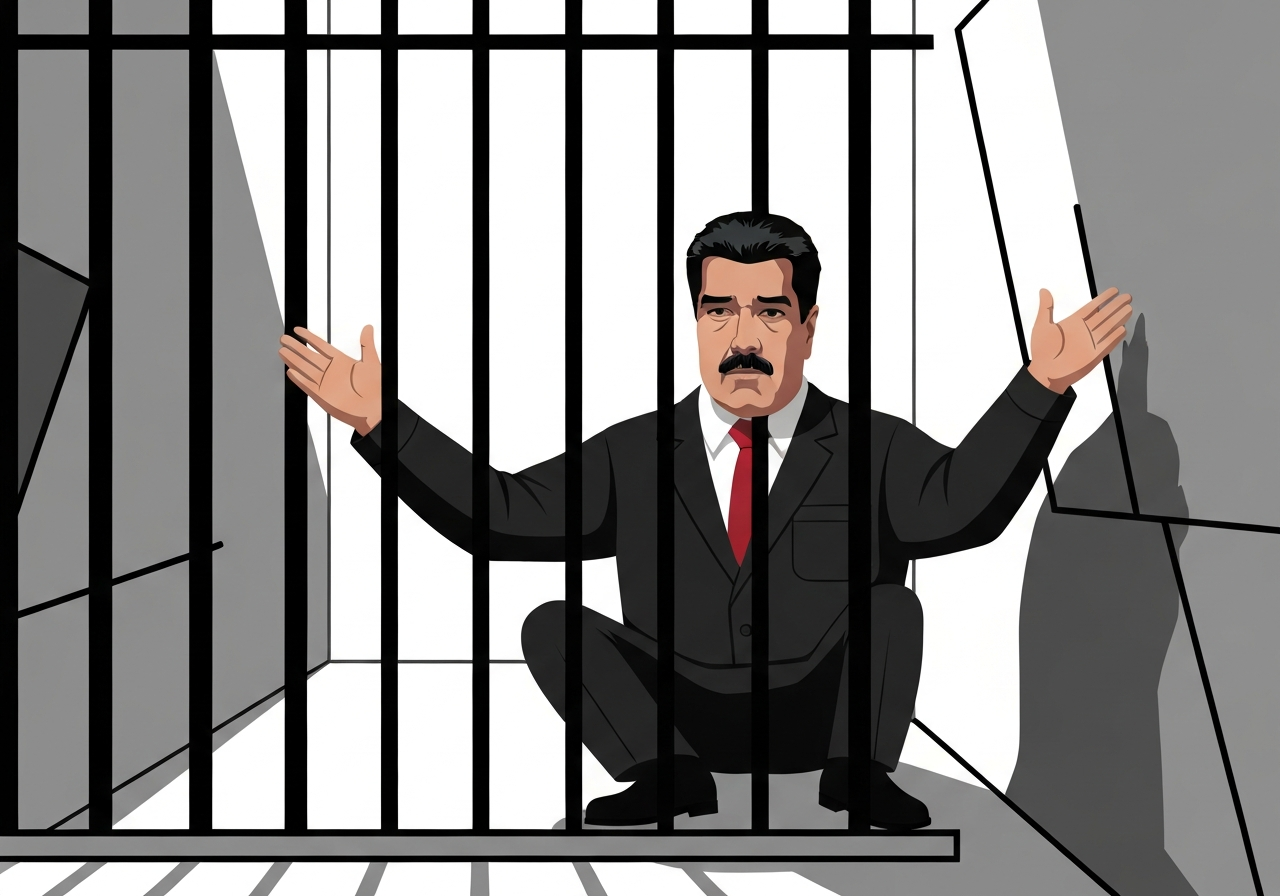
Lead: Nicolás Maduro, the deposed Venezuelan leader, appeared in federal court in Manhattan on March 26, 2026, nearly three months after U.S. forces brought him to the United States to face narco-terrorism and drug-trafficking charges. Law enforcement sources say Maduro has been confined in a highly restricted secure unit at the Metropolitan Detention Center (MDC) in Brooklyn described as a “jail inside of a jail.” He and his wife, Cilia Flores, face separate housing decisions: Maduro is in the unit subject to special administrative measures (SAMs), while Flores is held in a different MDC unit. His legal team has moved to dismiss charges, arguing sanctions-related restrictions impede the couple’s ability to pay for counsel.
Key takeaways
- Maduro was arraigned in Manhattan on Jan. 5, 2026, and pleaded not guilty to all federal charges; he has since been kept under SAMs at the MDC in Brooklyn, sources say.
- The MDC SAMs unit was retrofitted after the Metropolitan Correctional Center in Manhattan closed in summer 2021 and can hold up to 12 inmates, according to law enforcement sources.
- SAMs typically begin with 120-day orders that the Justice Department can renew indefinitely; human-rights researchers have documented cases of long-term SAMs usage.
- Under SAMs at MDC, Maduro reportedly leaves his cell only to shower, meet counsel or take solitary recreation for about an hour, and movements are supervised by two officers and a lieutenant.
- Former Honduran president Juan Orlando Hernández was reported to have been held in the same unit until his June 2024 conviction and was later transferred to FCI Hazelton; Hernández was pardoned in December 2025.
- Maduro’s lawyers contend U.S. Treasury sanctions and Office of Foreign Assets Control (OFAC) licensing decisions have blocked Venezuela from paying legal fees, a claim central to a motion to dismiss.
- Judge Alvin Hellerstein emphasized the primacy of the right to counsel and warned about the strain this complex case could place on court-appointed lawyers.
Background
The SAMs framework is a set of administrative orders the Justice Department can impose when authorities believe an inmate’s communications could endanger others or otherwise jeopardize prosecutions. By statute and internal guidance, only senior DOJ officials authorize SAMs; the orders restrict inmate contact with the outside world, limit group interaction and tightly control visitation and correspondence. Critics and civil-rights groups have long raised concerns about extended SAMs use: a 2017 report by the Center on Constitutional Rights and associated clinics documented cases in which detainees remained under severe restrictions for years.
The physical unit at MDC was created after the Metropolitan Correctional Center (MCC) in Manhattan closed in 2021; law enforcement sources said walls and secure doors were added to isolate the SAMs area. The Brooklyn facility is one of a small number of federal detention centers equipped to hold high-security defendants, and it has housed other high-profile inmates over time. The SAMs unit’s reported capacity—about a dozen beds—reflects its design for a handful of the most restricted detainees rather than the broader general-population population of the jail.
Main event
According to law enforcement sources and court reporting, Maduro arrived in the U.S. in early January and appeared at a Manhattan helipad transfer before his Jan. 5 arraignment. Observers noted he appeared thinner than at prior public appearances and was wearing a tan prison outfit with an orange shirt. Sources say he is confined to the SAMs unit at MDC and remains under 24-hour surveillance while any movement outside his cell is accompanied by multiple corrections officers.
Inside the SAMs unit, Maduro is said to be limited to solitary recreation on a deck that includes a handball court; each detainee reportedly goes outside alone and with staff present. Access to outside visitors and unsupervised contact with other inmates is curtailed by design. The Justice Department’s Office of Operations Enforcement advises on SAMs usage and the Bureau of Prisons implements the physical and operational restrictions when directed.
Maduro’s legal team has filed motions seeking dismissal of the charges in part by arguing that OFAC’s licensing decisions have prevented the Venezuelan government from paying attorneys, effectively depriving him of counsel of choice. Judge Alvin Hellerstein stressed in hearings that the right to counsel is paramount and flagged concerns about whether appointed attorneys could handle the case’s complexity. The government has not publicly disclosed all internal deliberations about the SAMs designation or the OFAC license status; DOJ and Bureau of Prisons requests for comment were pending.
Analysis & implications
The SAMs designation carries concrete procedural consequences for Maduro’s defense. Restrictive contact rules can complicate attorney-client conferencing, evidence review and defense investigations that rely on communications outside the unit. Courts must weigh whether limited access to outside consultation undermines the defendant’s Sixth Amendment guarantee of effective assistance of counsel; constitutional scholars note the right is to effective counsel, not to a particular lawyer, but impairment of defense resources can be grounds for relief in extreme cases.
OFAC licensing adds a second, distinct legal layer. Sanctions can prevent a foreign government from transferring funds to pay attorneys unless Treasury grants a specific license. Maduro’s team says licenses were first granted and later revoked; if true, that sequence raises questions about whether licensing decisions are administrative compliance measures or instruments with litigative leverage. Scholars warn that intertwining sanctions policy with criminal-defense logistics risks politicizing access to counsel.
At a geopolitical level, the confinement of a former head of state under severe administrative measures will reverberate beyond courtroom corridors. Venezuela’s government and allied governments are likely to view the custody conditions and any perceived restriction on defense funding as politically charged, with potential retaliatory diplomatic responses. Domestically, comparisons to prior high-profile detainees and recent pardons — such as the December 2025 pardon of former Honduran president Juan Orlando Hernández — will fuel debate over consistency in federal handling of politically sensitive defendants.
Comparison & data
| Inmate | SAMs reported | Unit capacity/notes | Outcome/status |
|---|---|---|---|
| Nicolás Maduro | Yes (MDC SAMs) | Reported up to 12 beds; solitary recreation, heavy supervision | Arraigned Jan. 5, 2026; case pending |
| Juan Orlando Hernández | Reportedly held in same unit | Later transferred to FCI Hazelton after June 2024 conviction | Convicted June 2024; pardoned Dec. 2025 |
| Jeffrey Epstein | No public SAMs report | Formerly at MCC, died 2019 | Deceased 2019 |
The table places Maduro’s reported placement in context with other high-profile detainees. It shows that while MDC has hosted multiple notable inmates, the SAMs designation is not routinely applied to every high-profile defendant. Researchers caution that SAMs’ duration and intensity vary case by case, and that reported capacities and practices reflect facility-level choices as well as DOJ directives.
Reactions & quotes
Maduro used his arraignment to publicly deny guilt and assert a political framing of his custody; that statement has been central to public and legal narratives about the case.
“I am innocent. I am not guilty. I am a man, the president of my country,”
Nicolás Maduro (arraignment remarks, Jan. 5, 2026)
Maduro’s counsel has framed the OFAC licensing issue as a constitutional problem that could leave the defendant without counsel of choice.
“Mr. Maduro, who lacks the funds to retain counsel, is being deprived of his constitutional right to counsel of his choice,”
Barry Pollack (Maduro defense filing)
Legal scholars emphasize the constitutional focus on effectiveness of counsel rather than the identity of counsel, and they point to DOJ leverage in licensing and detention decisions as a practical factor in litigation strategy.
“You don’t necessarily have a constitutional right to a specific lawyer, but you do have a right to the effective assistance of counsel,”
Steve Vladeck, Georgetown Law (constitutional law expert)
Unconfirmed
- It is not publicly confirmed how many other inmates, if any, are currently held in the MDC SAMs unit; official counts have not been released.
- The publicly available record does not fully document the internal DOJ rationale or all decision memoranda for imposing SAMs on this specific defendant.
- Details about the precise timeline and basis for any OFAC license grants and revocations in Maduro’s case have not been independently verified in available public filings.
Bottom line
Maduro’s confinement in a highly restricted SAMs unit makes his defense logistically and constitutionally complicated: restricted communications and tightly controlled movement can impede preparation, while sanctions-related licensing disputes raise acute questions about the ability to retain counsel. Judges will need to balance national-security and public-safety rationales for SAMs against a defendant’s right to effective representation; that balance will be central to forthcoming hearings and motions.
Observers should watch three things closely: any court rulings on the OFAC-related funding claims, the government’s explanations for continuing SAMs orders, and procedural decisions about counsel access and discovery scheduling. Those developments will determine not only the near-term arc of Maduro’s case but also broader precedents for how SAMs and sanctions intersect with criminal-defense rights.
Sources
- CBS News — report on Maduro’s detention and court appearances (media/press).
- U.S. Department of Justice — guidance on special administrative measures (official/DOJ).
- Center on Constitutional Rights — 2017 report on SAMs and prolonged restrictions (advocacy/legal research).
- U.S. Treasury / OFAC — licensing and sanctions information (official/Treasury).
- Yale Law School clinic publications on SAMs and related litigation (academic/legal clinic).